Archive Page 16

Bridges Over Troubled Water

With a 40,000 page document describing the upcoming tunnel project, you would think that the State agencies would now know everything about the Delta.

WRONG!

Listening to the Water Board Hearings got me started researching the barge traffic and the Delta bridges that huge numbers of barges traveling throughout the Delta would need to have opened in order to travel through.

Since I know the South Delta the best, I started looking there. What bridges do we have?
SouthDeltaBridges

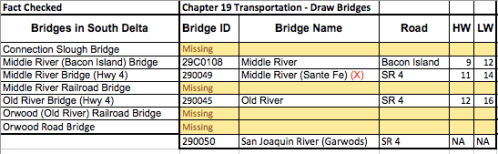
Here’s the bridges the WaterFix EIR thinks we have in the South Delta:
EIRSouthDeltaBridges

What is frightening about this? First, they obviously have never researched the area they are planning this huge construction project to go through. They hire junior researchers who sit in an office somewhere and look at the internet to get some data, but don’t get out on the waterways or ask locals.

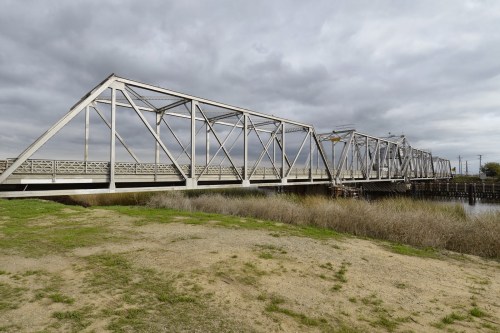
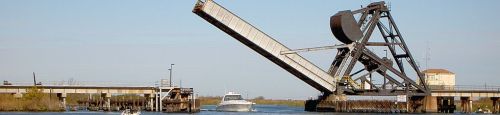
OrwoodRRBridge
Every Discovery Bay boater knows about the big bascule bridge operated for the railroad, the Orwood Railroad Bridge on Old River. There is an alternate, identical bridge on Middle River. I’ve never seen the Middle River Railroad Bridge open. It is the backup in case the Orwood bridge is broken or down for maintenance. You see, if neither of those bridges were operational, boaters in Discovery Bay and nearby marinas would be cut off from the rest of the Delta and beyond. The railroad is obliged to provide waterway access 24×7. The right to navigable waterways is part of the Rivers and Harbors Act. The railroad bridge is the only bridge on Old River between Discovery Bay and the main channel. The bridge operators who control the Orwood RR Bridge are probably the nicest, most polite bridge operators on the Delta and work hard to try not to inconvenience the boaters. (Of course, trains always get the priority!)

THEY DON’T EVEN LIST THE RAILROAD BRIDGES!

Probably because they referenced bridges on the CalTrans site and the railroad isn’t a highway. Hmm.

SIDENOTE: I’ve read more than one state agency project that plans a dam across the railroad slough – virtually removing boat access to the alternate bridge. They don’t care and they have no clue.

Then, weirdly, they put “(Santa Fe)” next to the Middle River Bridge name on Highway 4 and the Low Water/High Water clearances listed for the Hwy 4 bridge are actually the railroad bridge clearances. So clearly, they are messed up.

They didn’t list any times of operation or even the bridges that don’t operate. I added the Orwood Road Bridge because it’s one only very small boats can get through. I wouldn’t be surprised if they try to route a barge through there – haha.

Other Bridges

Other bridges we boaters go through regularly are the Middle River (Bacon Island) Bridge and the Connection Slough Bridge. They should be concerned about both of those. They plan docks and barge landings in Connection Slough. Also they need their construction trucks to go across the Connection Slough Bridge to get to the Mandeville Island tunnel access shaft. But it is totally missing from the EIR (Chapter 19, Table 19.6 “Roadway and Rail Draw Bridges in the Study Area.”) In addition, the table title includes “Rail” but it missed them! Oh, and they added a bridge in downtown Stockton, the “San Joaquin River (Garwoods)” bridge. Not in the Plan Area. The EIR is a mess. This is only one example.

Well, at least now they know the Bacon Island Bridge exists. When the USBR came to Discovery Bay in 2010 to pitch their 2-Gates Fish Protection Project, we complained that they couldn’t put a dam in Old River else they’d block all boat traffic except for certain times and days. They had no clue there was a Bacon Island Bridge. Gees.

Highway 4 Issues – Traffic Nightmare!!!

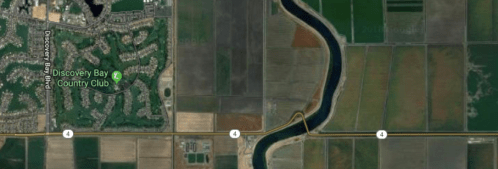
There are two bridges on Highway 4 between Discovery Bay and Stockton. They are among the oldest, built around 1917. Coming from Stockton, the eastern bridge is the Middle River Bridge. They stopped operating it quite a few years ago. It doesn’t even open by request. The second, near Discovery Bay, is the Old River Bridge. It is not operated regularly. In fact, I think it has only opened maybe once in the last 30 years. So the boating traffic south of Highway 4 is mainly wake board boats, water ski boats, and fishing boats. To get barges to Clifton Court Forebay, the barges would need to go through the Orwood RR Bridge. Then it would need to go through the bridge at Highway 4.

During the Water Board Permit Hearings last month, our STCDA team of expert witnesses presented analysis of the project which included how horrible traffic will be throughout the Delta. Captain Frank Morgan of Discovery Bay described his analysis of traffic issues: trucks and cars congesting the small Delta roads and barge traffic and construction going on throughout the waterways.

OldRiverBridge
Bridge of the Week

One big problem Captain Morgan identified was that the Highway 4 Bridge over Old River (the first bridge you encounter when leaving Discovery Bay heading towards Stockton), would need to be opened multiple times a day to let barges pass through. On Highway 4, the columns of construction trucks going from Antioch and from Clifton Court Forebay through the bridge to Bacon Island Road would compound the high volume of commuters and all of them would be waiting in line the 20 minutes or more for the slow barge to get through whenever the bridge is opened, backing up traffic past Discovery Bay and back. (Currently, that bridge never opens.)

I became suspicious if the DWR knew anything about the bridges in the Delta when the DWR lawyer in his cross-examine asked why the Highway 4 bridge would need to be opened. Bill Wells and Frank Morgan needed to explain to him that tug boats were needed to push or pull the barges and tugs need to be high enough to see over the barge and what it is carrying so yes. That bridge’s clearance has just 10-12 feet clearance when closed. Our ski boat can squeeze under it. I’m checking to see if there are any tug boats low enough.

The DWR lawyer also asked Frank Morgan if they couldn’t just build a higher bridge there. Frank’s eyes got big as he sat absorbing the question and then said in his opinion they couldn’t. There’s a big curve just prior to the bridge and the roads are narrow levee roads. He thought it would be hard to go back far enough to ramp up to 40 feet on the narrow 2-lane levee roads with sloughs on each side. And the DWR guy seemed to agree it would need to be 40′ high at least, if what they were proposing was having completed tunnel segments on those barges. But the DWR lawyer didn’t know what the barges would be hauling so couldn’t answer. (Researching, I doubt they’d try to move 40′ high completed tunnel segments, but it isn’t clear.)

I wish they would put a new bridge in. The current two bridges are scary, narrow, and traffic accidents occur regularly.
Hwy4Bridge-Aerial

OldRiverBridgePhoto
Four Square

It continues to amaze me how little they understand about the Delta and how many errors we continue to find in their huge document and knowledge.

First meeting of the DCA Board

The five Delta County Supervisors were all at the first Delta Conveyance and Construction Authority (DCA) Board Meeting (previously called the Joint Powers Authority (JPA)) today in Sacramento. They were their to show that the entire Delta is opposed to this project, and to voice their dismay at this board being formed and starting any efforts before permitting is complete. Their comments included calling out the behind closed door meetings that are so prevalent in this project. Solano County Supervisor Skip Thompson, who heads the Delta Protection Committee, protested that there are 4 million people directly affected by this project yet there hasn’t been one conscientious effort to reach out to us. He asked, “How are you going to work with local government and the community to make sure we are not harmed by the project?” Good question since the State agencies have made no alterations to the project to alleviate any of our concerns that we have expressed, clearly, over the past years.

DeltaCountiesCoalition

I was told that the Supervisors were duly ignored with strong comments from at least one Metropolitan Water District Executive who is now a new DCA Director on the Board, saying he will do whatever is necessary to get this project underway.

The DCA Board plans to meet at 2 p.m. the third Thursday of each month in the Sacramento Library. But the President, Santa Clara Valley Water District’s Tony Estremera, seemed to have an agenda of his own – namely to try to get more meetings scheduled and move as quickly as possible towards construction. He kept pushing for meetings every two weeks. There was no support for his proposal. In fact, because of the Brown Act and public transparency, and because they didn’t have a place to meet in 2 weeks, he was basically told “No”. Even the MWR executive said June 21st is early enough. Estremera didn’t relent. Even after minutes were recorded as, “The next meeting will be held June 21 here at the Sacramento Library” Estremera interjected, “Unless we hold an earlier meeting.” He also had a tendency to get lost during the meeting and not know which agenda item they were talking about. Interesting.

Clearly, Estremera was very happy someone offered him the prestigious role as President of this newly formed and important DCA Board. In fact, on Monday May 14th he issued this statement: “Santa Clara Valley Water District will lead the charge [emphasis mine] as we move ahead with the important work of improving water supply reliability for our county and the state. I look forward to the challenge of implementing this project.”

I would expect that from the MWD Directors. But at the Santa Clara Valley Water District Meeting, at least lip service was paid to understanding the huge concerns Delta residents have with this project.

I wish I were a fly on the wall at some of the wheeling/dealing that goes on in California politics. At least Estremera is up for re-election!

First, they ignore the science . . .

science-being-ignored
Order yours here.

Let’s not forget. In 2009 the California Legislature directed the Delta Stewardship Council (DSC) to write a Delta Plan, starting with science. The Legislature wanted scientists to determine how much water needs to flow through the Delta to maintain a healthy environment to then determine how much excess water is available to export.

That makes sense! That is logical!

FemaleScientist
The Fable of the Farmer and the Fish

  But the 2010 Delta Flows Requirements Report said the exporters were already exporting too much water. (The maximum average export to keep the estuary healthy is 3 to 3.5 million acre feet (MAF) per year average. They export 5 to 6 MAF average. And they want more!)

The DSC chose to ignore the science. They even put a cover page on the report that said basically that the report is only science and the report forgets that farmers and cities in the south need more water than that.

State agencies have proceeded to march ahead, ignoring science.

The new Delta Tunnels project (“WaterFix”) goal is to not only continue to over-export, but to take even more, the fresher water directly from the Sacramento River.

How well do you think that is going to go?

Have you seen any good disaster movies lately?

jurassic park

Construction Noise Impacts

In this blog, I’ll report on the findings from the Water Board Hearings about the noise impacts from the tunnel construction on the small communities in the North.

The towns of Hood and Clarksburg are in the middle of the massive tunnel project. That is where the pumping station will be located.

An expert sound witness hired by Save the California Delta Alliance to testify in the Water Board Permit Hearings about the WaterFix (Delta Tunnel) permits, reviewed the WaterFix Noise Chapter and found that, in his opinion, the calculations for sound used by the DWR are incorrect. Walter Salter testified that, ‘Construction noise levels are likely underestimated in some areas, by as much as 10 dB to 15 dB or more…” He found that, “Construction noise (pile driving, blasting, and trucking activities) is expected to significantly interfere with the activities at certain recreational facilities or businesses available for community enjoyment, such as the Clarksburg Marina and the Hood Supply Company (restaurant).”

During his testimony, Salter testified that it is likely that school children in Hood and Clarksburg would not be able to hear what their teachers are saying during the six months of construction for years and years!

Is the noise level really going to be bad? Slater stated that, “4 pile drivers could be in concurrent use at each ‘feature’ or facility/intake with up to 90,000 pile strikes per day at each facility. Over a 12 to 15-hour work day, that would result in over 100 pile strikes per minute, and perhaps several per second.”

Yes! That sounds very, very bad to me. That isn’t something communities should be subjected to.

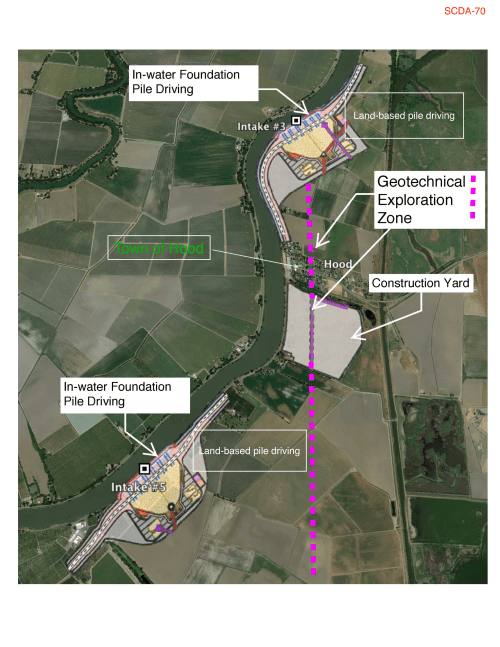
How close are these communities to the pumping stations being built? Here is how the construction sites dwarf the small legacy town of Hood:
scda_70 TownOfHood.png

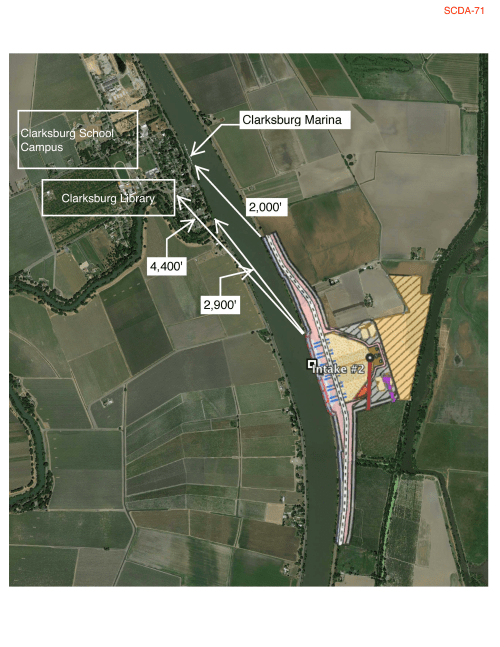
And on the other side of the river, the Clarkson School is close enough that kids won’t be able to hear their teachers:
scda_71 Clarksburg.png

Even for Discovery Bay, the construction is further away, but it will be annoying and disruptive. And up and down the Delta waterways, boating in the Delta will no longer be peaceful and scenic.

What we Found Out about Construction

Clarifications added 5/14/18: At the Water Board Hearings April 20 and 23, the Save the California Delta Alliance experts testified about the impact of the tunnel construction project on the waterways, roads, and communities due to barge traffic, in-water construction, high volume truck traffic on small Delta roads, and noise pollution.

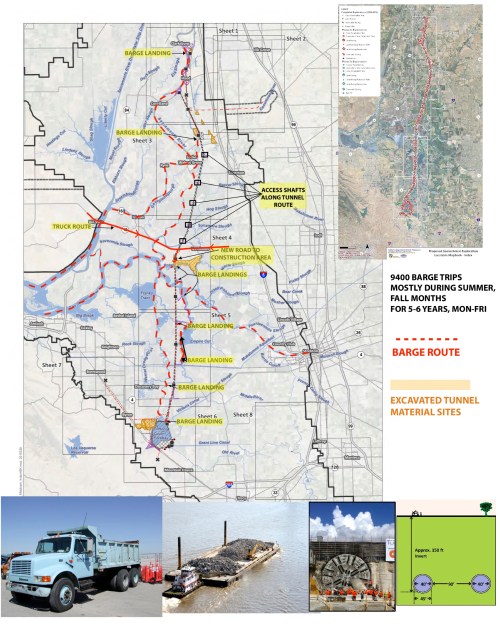
Suffice it to say, the Delta waterways will be virtually unusable for boat traffic during the years and years of construction. In the map below, red dashes show the barges – over 9,000 barge trips over 5.5 years. Other documents state construction will be ongoing for 11 years.

Even though they will be boring a tunnel, 150 feet down, there are access shafts to the surface every few miles. At those shafts, there will be construction and noise, pile driving, big docks built for barge loading/unloading, trucks on the levee walls to take the tunnel liners off the barges and conveyer belts to put tunnel much on the barges. This activity will be noisy, dusty, 24×7 during boating months so flood lights at night. New electric transmission lines will be run down the route (ruining views of Mt. Diablo). The shaft sites will be built up 25-35 feet above sea level.

As you can see from the dashed redlines, barges will be traveling from the three staging areas (Antioch, Bouldin Island, and Clifton Court Forebay) to each of the access shaft areas.

Note that the barge route to/from Clifton Court Forebay goes under Highway 4, requiring the first bridge east of Discovery Bay to be opened multiple times/day. I’ve never seen it open. Frank Morgan, operator of the Rosemary, has been out in his boat for 30 years and only saw it opened once. He called to get it opened on day but was told it wasn’t operable. Now, picture the commute traffic from Brentwood/Discovery Bay to Stockton. Currently it is heavy commute traffic and very dangerous due to the two-lane levee road with no shoulders, sloughs on either side, and extremely narrow bridges. Now let’s open that bridge for at least 20 minutes to get a barge through, multiple times per day. Now let’s include in the traffic line-up a long line of construction trucks trying to go from Antioch through the bridge and left turn on Bacon Island Road to get up to those sites. This is nuts. And it repeats throughout the Delta’s on the small, narrow highways.

As Bill Wells testified talking about the Bouldin Island site, “There is no hydrological rationale or engineering necessity for picking this location. It happened to be convenient for DWR and our legacy communities, absurdly dwarfed by the adjacent massive construction works, must be destroyed as a result. They have insisted on locating their largest staging facility and muck dump on Bouldin Island, off of Highway 12, between two drawbridges that will be prone open by constant construction barge traffic—creating the worst traffic nightmare imaginable on the main recreational gateway to the Delta. (SCDA-104.) There is no reason why this facility has to be located here.”

Bottom line, access in and out of the Delta to get to marinas and other launch sites will be nearly impossible. If you can get here and launch your boat, your travels throughout the waterways will be anything but peaceful and relaxing. The sloughs will have multiple 5 MPH zones around barges and landing docks – not conducive to water skiing or wake boarding.

How can the Delta still be a boating and recreational hub with this construction project going on, from north to south?

Santa Clara Water District is voting Tuesday May 8 on whether or not to support the tunnels. Having the Delta so close to Silicon Valley was a big draw in our decision to work there and water ski/boat on the weekends. If they vote yes for the tunnels, they will be taking a prime recreational area away from the constituents!

In the next blog, I’ll write about an alternative route that would avoid all of this mess – the Eastern Alignment.

scda_72-UpdatedByJan

Your Weekend Assignment

Reminder: Tuesday, May 8, 9:30 a.m. Santa Clara Valley Water District (SCVWD) meets again to vote on funding the tunnels at the SCVWD’s headquarters: 5750 Almaden Expressway in San Jose.

What can you do if you cannot go to the meeting? Please send comments in before the meeting (this weekend would be great).

And if you live in San Jose, please call into the Mayor (who is up for reelection) letting him know what you think of his support for the tunnels (in a polite and courteous way, please.) Call Mayor Liccardo’s office at (408) 535-4800. Leave a short comment and leave your name and zip code.

Important Notes about Comments:

  • Write a concise comment explaining why the Delta tunnels project does not make sense for Santa Clara County. Focus on the loss of such a wonderful, nearby recreational site. If you don’t live in Santa Clara County but have some other relationship (such as use to live there, family lives there now and visits the Delta on weekends, etc.) add that.
  • Make sure your comment includes your name, city of residence, zip code.
  • State that you would like your comment added into the record.

PASS ALONG TO ALL YOUR FRIENDS AND RELATIVES WHO DO LIVE IN SANTA CLARA COUNTY. It’s important that the Board realizes that this is a big hit to their constituents and diminishes the value of Santa Clara being located so close to such a wonderful weekend and vacation spot.

Here are the SCVWD Board’s email addresses. If you live in Santa Clara Valley, look up your District # using this map finder and write to your representative:

Name   District   Email   Stance on Tunnels
Barbara Keegan   2   bkeegan@valleywater.org   For  
Gary Kremen   7   gkremen@valleywater.org   For  
John L. Varela   1   jvarela@valleywater.org   Against  
Linda J. LeZotte   4   llezotte@valleywater.org   Against  
Nai Hsueh   5   nhsueh@valleywater.org   On the fence  
Richard Santos   3   rsantos@valleywater.org   Against  
Tony Estremera   6   testremera@valleywater.org   On the fence  


Or to send them all email: Board@valleywater.org.

Comments can also be sent online via this website link click here.

Santa Clara Valley Water District

Tuesday, May 8, 9:30 a.m. The Santa Clara Valley Water District (SCVWD) Board meets again to vote on funding the tunnels. The meeting will be at the SCVWD’s headquarters: 5750 Almaden Expressway in San Jose

They were going to vote Wednesday May 2, but due to a lot of opposition showing up, a large packet of materials they hadn’t had time to review yet (not clear yet what that was), and a concern that they needed to participate in order to have a “seat at the table” to be able to represent Northern California’s interests they decided to delay the vote until they had time to review the packet.

A lot of members have been asking how to send the Santa Clara Valley Water District members comments prior to their meeting Tuesday May 8 at 9:30 a.m. to vote whether to pay their portion of the tunnels.

Comments can be sent via this website link click here. (When I tried that last Wednesday, it didn’t work but it now goes to the right page/form). And/or you can email them (emails listed below).

I recommend if you comment, start with your relationship to Santa Clara Valley, if you have one. (Like you lived their for N years, or still do and have a weekend home on the Delta, or you work there and/or your son/daughter/etc. lives there and comes to visit you on the weekend to play in the Delta, etc.)
SCVWD-Map
Santa Clara Valley Water District Map

We should stress that the tunnel construction project is going to destroy recreation on the Delta, which is a primary recreation site for their Silicon Valley citizens. They don’t seem to understand they are taking away a place where so many of their users go for weekends, because it is so close and wonderful and unique. Ask if they’ve informed their users about this problem.

If you visit the historic sites in the North Delta, complain how this project will destroy them and how people in Silicon Valley enjoy seeing the quaint legacy towns.

From the Wednesday May 2 meeting, it was reported that the Board’s concern with not being part of the project is that they won’t have any say, and by “buying in” they believe they will have a “seat at the table.” Tell them if they vote yes, they need to vote with the caveat that the project will be altered so as to not harm the Delta recreation and sites that their users now enjoy on weekends – and that’s by picking another one of the alternatives in their EIR: The Eastern Alignment (which is a tunnel route away from the Delta waterways) AND move the pumping facility far away from quaint legacy towns. The Eastern Alignment was the route planned for the original Peripheral Canal so there’s no reason the project could not go there. (We all know it is still a really bad, horrible project, but if we get them to go back to the Eastern Route, by the time they go back through the process for new permits, etc., Brown will be long gone. And in the horrible case that they actually start on this project, so many lives won’t be disrupted).

That’s my thought, anyway. I need to study the Eastern Route more, but if they move the pumps away from the legacy towns and build their route east, it doesn’t appear that it will affect any communities or waterways and hence so much better for people, fish, wildlife, and recreation than the through-Delta route. It’s still a really, really bad idea.

Here is the list of board members from their website:

Name   District   Email
Barbara Keegan   District 2   bkeegan@valleywater.org
Gary Kremen   District 7   gkremen@valleywater.org
John L. Varela   District 1   jvarela@valleywater.org
Linda J. LeZotte   District 4   llezotte@valleywater.org
Nai Hsueh   District 5   nhsueh@valleywater.org
Richard Santos   District 3   rsantos@valleywater.org
Tony Estremera   District 6   testremera@valleywater.org


Or to send them all email, Click Here.

Status Update – April 22

Lately I’ve been asked a lot, “Just exactly where are we in the battle to stop the tunnels?

So I thought I’d better do a status update.

1 – What’s Going on Now? The Water Board Hearings are In-Process: We are still in the middle of the multi-year permit process being conducted by the State Water Resources Control Board (SWRCB) or “Water Board” for short. The tunnels need the Water Board to approve a permit to locate new intakes for the tunnels north on the Sacramento River near Hood. These Hearings are a lengthy process. Part I of the hearings started in 2016 and concluded at the end of 2017. STCDA and others participated in providing testimony. The California Department of Water Resources (DWR) is the agency requesting the tunnel permit and have been giving testimony why the tunnels are needed. Numerous other groups, cities, counties have been giving testimony about why the tunnels would be bad. Part II of these hearings started in February and are anticipated to go on at least until June. Then they will decide whether or not to issue a permit.

The Water Board has had some hiccups with Part II. First, Michael Brodsky our legal council uncovered that the Water Board Hearing Officers and the DWR were having behind-the-scenes ex-parte communications. (A big legal “No-No.”) But the Water Board declared that was nothing, really, told everyone not to worry, all was fine. But it did delay the start of the hearings for a few weeks and will be good fodder for a legal case if they do award a Permit. Other groups also raised a complaint when the DWR announced a one tunnel plan and requested permit request changes. The Water Board blew those complaints off also, but the controversy continued. So the DWR said, “never mind – we are really going with two tunnels” and Gov. Brown got MWD to buy into paying for the second tunnel, just so that the hearings won’t be delayed until after Gov. Brown has left office. So now the Part II hearings are under way. STCDA and others are presenting testimonies regarding recreation and other aspects.

A week ago, the DWR just announced some other changes to their plan. We tried (as did others) to complain that those changes affected our Part II testimonies and we needed to have time to update them, but of course the Water Board rejected our complaints. So we will address the impacts of the project as it is currently configured in our case-in-chief now, and then after DWR submits detailed information and actually makes a decision (if they do) to make any changes, the Water Board has guaranteed us that we will have full opportunity to address those changes during the rebuttal phase later this summer. Hopefully all that will slow the project down even more. We really hope to tie it up until after Brown is out.

So then what?

2 – If the Permit is Approved, we will resort to a law suit: We anticipate the Water Board will approve the permit. Why? Because Gov. Brown has stacked the Hearing Committee with his cronies and the Water Board has been working with DWR to help them build their case. It’s a stacked deck, rigged. So then what?

As soon as the Water Board issues a permit, we and other groups will issue law suits against their decision. We think we have a very good case to make. After all, the tunnels are so destructive for the Delta and our communities here. And the Hearing process has been rigged.

3 – ACOE Permit: The Army Corps of Engineers needs to issue a permit, but that should be a fairly rubber-stamped process. But we will protest that permit also.

4 – EPA Approval: Then the EPA (the Environmental Protection Agency at the Federal level) needs to approve the tunnels.

The EPA is what ultimately stopped the 2010 “Two-Gates Fish Protection Project.” And in 2014, the EPA panned the Bay Delta Conservation Plan (BDCP), the predecessor project to this current WaterFix Delta Tunnels project. That rejection sent Brown et al back to the drawing board; which is when the “WaterFix” was born.

Will the EPA stop it again? “WaterFix” isn’t any better than the BDCP. In fact, it is the BDCP without any of the environmental fixes, without the habitat part. So WaterFix is just the destructive tunnel part. It seems like a no-brainer that the EPA would reject it again. Yes?

Well, unfortunately, not so fast. The Trump Administration and Scott Pruitt, head of the EPA, have been dismantling the EPA as fast as possible. We really can’t depend on them to have any desire to stop a big infrastructure project that Brown tots will bring tons of new construction jobs to the state and increase profits for big agribusiness corporations just to save the Environment and help us, the little guys. Brown and Trump certainly aren’t buddy-buddy but, to-date, the word has been the Trump Administration supports the project.

Fortunately California’s environmental laws are still in-place and we, and others, have been proving at the Water Board hearings that “WaterFix” violates those as well as creating a slew of other problems. So if the EPA approves the tunnels, unfortunately another law suit.

5 – At each stage, another law suit if they forge ahead: We have laid the groundwork for these law suits through everyone attending meetings, providing all of your written comments at each point, the expert testimonies at the Water Board Hearings, and other efforts. So we remain optimistic that our position, opposing the tunnels, is well documented and justified.

This is a battle and each step requires us to use time of costly expert witnesses and some court administration costs (although to-date we’ve kept that low). Still, to continue we need support again this year.

Thank you to those of you who have already donated. Thank you especially to those who have committed monthly donations.

If you can help, click here:


Or send a check made out to “STCDA” to:
STCDA
P.O. Box 1760
Discovery Bay, CA 94505

Tunnel Proponents are wrongly trying to leverage the new Hayward Fault Report

Scientists have just issued a new report about the possibility of the Hayward Fault to suffer a major earthquake in the near future. Fortunately for we in the Delta, the impacts will be slight. But that doesn’t stop the people advocating for the Delta Tunnels to try to slant the report to fit their position. (What’s new?)

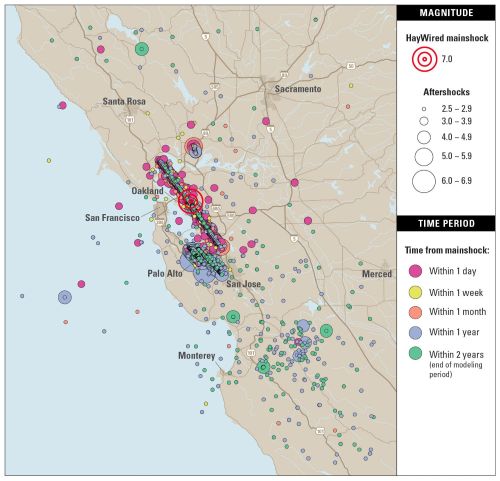
The “Haywired” analysis was as if the slip were centered under the city of Oakland. Mercury News Hayward Faults Nightmare Scenario.

The report discusses potential impacts to the Bay Area’s water supply. The Hetch-Hetchy aqueduct pipes travel across that route, as do East Bay Mud’s water supply lines. Those are a concern. The Hetch-Hetchy pipes take water from Hetch-Hetchy near Yosemite to Crystal Springs Reservoir and that clear Sierra water is used by both San Francisco and Silicon Valley. East Bay Mud, more recently, installed a pumping station near Sacramento (in Freeport) and routes water from there to the East Bay.

Of course, some (i.e., proponents of the Delta Tunnels) are linking that HayWired report to the earthquake scare about the Delta. But there’s really no concern for the water exported from the Delta, even though the water exporters and California Department of Water Resources (DWR) have been trying to build that case, that hoax for years. Dr. Pyke and others have called that the “earthquake bogey” and disproved any connection. But, of course, if you scare the L.A. population enough into thinking they could end up thirsty if the “big one” happened up north, well that gets buy-in for the Delta Tunnels.

Well, here is the important point:

To protect the water supply of their collective 4 million customers, both East Bay MUD and the San Francisco PUC have protected their water mains with clever engineering systems that allow the earth to shift around the pipes, which range from 6 to 9ft in diameter, without damaging them. One of the San Francisco PUC’s major pipes is fitted with ball joints and slip joints that allow the steel-lined tube to shift and move without breaking.

San Francisco PUC’s ongoing upgrades are part of the $4.8 billion Regional Management Program, of which a key element is major seismic upgrades.

Among East Bay MUD’s major supply pipes, critical sections in high-risk fault zones have been retrofitted so they can shift and flex within spacious concrete tunnels.

“The pipe is on rollers so that when that offset occurs, it can move with the shifting earth,” said Andrea Pook, an East Bay MUD spokesperson, referring to a 2,000ft section of pipeline bored through the East Bay Hills.

“That tunnel could actually shear, but without shearing the pipe itself,” Sykes added.

For the unlikely event that the main water line is ruptured, East Bay MUDkeeps a six-month supply of reservoir water ready on the west side of the hills.

Now, let’s compare that with the Delta Tunnels

The tunnels are not being designed to withstand earthquakes. Really? Yes. I posted this earlier showing how the Delta Tunnels are NOT being designed to withstand earthquakes: Tunnels not being designed to withstand earthquake in the Delta!

The map in the HayWired report shows that, at most, some small aftershocks could shake the Delta area.
aftershocks_scaled_v6_rgb__1488393011694__w1500

Fortunately, the levees have proven to not be prone to falling down in an earthquake. So there really isn’t any problem – just the state agencies trying to make more hay.
How California Water Suppliers Are Getting Earthquake-Ready.

How the CV Farmers and their supporters think about water in California

I listened to an interesting audio stream this week, discussing “Sustainable farming means farming with less and less water” on the City Visions program on KALW Radio.

Ethan Elkins was the host of the audio stream.
Other participants:
Ellen Hanak, Public Policy Institute of California
Ashley Boren, Sustainable Conservation
Cannon Michael on the phone, Bowles Farming in the Central Valley

First, I’ll post my transcript from that discussion. I apologize up-front if I didn’t capture anything correctly. In particular, I sometimes had trouble telling whether it was Ellen or Ashley talking, so hope I credited the right person with the right statements.

Afterwards, I’ll post the comment I sent in about where the discussion missed the mark.

The Discussion

Ethan: Typically the farmers are not receiving 100 percent allocation. How is that affecting you?
Cannon: Vast area west side has 20 percent allocation. Large, large swath of land that folks are pretty disappointed. The allocation report is coming so late [due to the late rainfall], it makes it hard to plan and plant. [Jan’s note – not sure what the state should do about that, if anything. They can’t allocate until they know how much they have.]

Ellen: We move water around a lot in California. A lot of it is based on who owns the source.

Shasta Dam comments: There were comments about Fed support for raising Shasta Dam. That was surprising, they said. CA has a state bond with almost $3 billion going. There are 11 projects in competition for that funding. Raising Shasta isn’t one of those 11. Those involve some above ground, other in-ground storage.

Ethan: Do we need to increase storage?
Ellen: The state needs to take much better advantage of the vast underground water storage we have available – at least 3 times more capability than all of our above ground dams we have now. Plus it’s cheaper and they refill.

Ethan: Why is there a debate about that?
Ellen: It is changing. We haven’t coordinated as well as we can between our above-ground storage and below-ground. Many farmers have converted to micro-sprinklers/drip irrigation. During wet years, they keep using those that are based on ground water instead of taking advantage of the available water.

Cannon: Farmers are doing everything they can to reduce water usage. We are also concerned with the anadromous fish in California. The majority of Shasta is being used for cold water for salmon populations. Chevron recently reported that climate change is real and manmade so we do need to admit that and look at above ground storage to preserve fish species. Underground storage is a regional thing that can/should happen. There’s really no shame it takes water to make food, but need to prove we are good stewards.

Ethan: Where there are the most farms, tends to be the most conservative voters in the state, who don’t believe in climate change. Yet it sounds like you do (to Cannon).
Cannon: Maybe there’s just a sense of exactly what is causing it and … we see crop shifting from southern areas coming into their area, a lot of variability. No tule fog any more. You can see the changes happening. Unfortunately, it’s become such a polarized political discussion, there’s much more people coming to the table and realizing this issue (climate change) is going to continue.

Ethan: Farmers need to grow stuff, people need to eat.

Ethan: We hear CA’s policy sometimes rewards inefficient use of water.
Ashley: I don’t subscribe to the view that our water rights system automatically leads to inefficiency. The system is a little like mining claims. There’s a protection in that, you need to use it or loose it. That was good so people didn’t just sell it to other people. But in CA we do allow trading it. We find that that actually really does help to reallocate it and gives people an incentive to use it efficiently. We aren’t in as terrible shape as some other Westerns states that don’t have as much flexibility. We’re talking about not just drip irrigation, but shifts in what they are growing. CA used to grow just field crops. Now half is orchards, vines, strawberries. That’s the kind of economic efficiency in a state where water is so scares.

Ellen agrees. CA used to mostly grow field crops. Now it’s fruit & nut orchards, vineyards, vegetables. So that’s economic efficiencies.

Ashley agrees ag is extremely water efficient and getting more value for each drop of water. One thing we’ve come to realize is a paradigm shift that has to happen due to climate change. We are having more droughts and some big water years. We want farmers to think about if they have land that can percolate down into the ground, we want them to flood their crops during big water years. Thinking about adapting and really flood irrigate in those really wet years. With our new SGMA passed in 2014, she believes there will be programs that give farmers credit for that.

Cannon: There are certain crops you can’t use drip irrigation. When we get into root veg crops like carrot, onions, garlic that doesn’t always work. We also use GPS and laser level fields because any excess hurts, doesn’t help.

Caller: I understand we grow alfalfa and ship to Saudi Arabia for cows there in the desert where they shouldn’t even have cows.
Ashley: Not sure about the Saudi Arabian cows, but we do grow alfalfa for the CA cattle industry, which is the most revenue for CA.
Ellen: We do export some alfalfa. That particularly comes from the Imperial Valley. There’s very productive desert farmland. Gets senior water rights from the Colorado River. The reason they export it (a) very high quality alfalfa and (b) we have a lot of free shipping containers to go back to Asia and Japan as a result of our trade program.
Cannon: The interesting question is what does “ag water use” actually mean. We are taking water, transforming it, and sending it back to human uses. He’d say a large lawn in Bel Aire is “water use.” It’s a good conversation for people to have when you talk about our need for food. The better way to have the discussion is if it is not produced here in California, where’s it going to come from. Fiber for cloths, etc. Even though the anti-ag folks have done a good job about how much water it takes to produce a hamburger, there are still millions sold every day. Throwing bombs at each other is not productive. Where do we want food and fiber to come from. Should be local and a defined set of penalties for farmers when they break rules. In CA we do protect our workers, we protect our environment. How do we insure safe and affordable food is available for everybody.

Discussing SGMA: Goes into effect Jan 2020
Cannon: It’s possible that huge amounts of land, a million acres, could come out of production, south of the Delta, due to the SGMA. What are other options? Barring increasing storage or fish species. Unfortunately, we aren’t seeing good outcomes from the fish side. If we could come more with a holistic approach to fixing things in the Delta, if we could be more creative and stop fighting each other as much in the courtroom setting, we would see more positive results. There are groups out there that want better solution and moving water is critical. But we can’t do it without the fish species recovering.

Call-in (Doug): Yesterday driving down I-5 sign “Is growing food a waste of water?” He asks “is growing food in a desert a waste of water?” In other areas like Spain, growers grow without water, like dry farming vineyards.
Cannon: About farming in the desert piece,every place needs something. San Francisco can’t be the city it is without Hetch-Hetchy. There shouldn’t be any shame that this is an engineered state requiring moving water around. There isn’t any shame to produce food. If people want store shelves with local food, then … at the end of the day it still takes a considerable amount of water for me to put a tomato on your table. It just is what it takes. If you rely on rain-fed ag, there are too many variables. In CA we need to move the water. There’s no shame in the fact that we eat every day and that takes water.

Ethan: Are there other models, like Israel, that are doing better?
Ellen: It’s kind of funny because during the epic drought, we had a lot of folks coming over from Australia and Israel telling us about the technologies they use. A lot of those are already in use here. California is more on the leading edge than most other places because we do have a lot of regulations in place that mean we grow high quality and responsibility.

Ethan: What’s going on in the Delta?
Ashley: What Cannon was referring to was that the way the water gets there, it has to go through the delta. The way the pumps operate are creating a lot of problems for the Delta Smelt and other species. So now water is cut back to try to protect those species but we haven’t seen any improvement in those species. They are sacrificing without gain. We don’t really understand why they aren’t improving. Part is water, part is habitat, there are predator species in the Delta. There is a whole host of factors. It is kind of a mess in the Delta. What we’d like to see most of all is people working together to try to figure out what to do. We didn’t have enough of that early on and as a result we have people in their camps and a lot of litigation. Something has to be done in the Delta. The Governor is very gung ho about the tunnels so we don’t have to pump and harm the fish.
Ellen: A lot of the scientists are at a point of saying we maybe experiencing a regime shift in this region. Some of the species listed as endangered, there are so few it’s hard to generate a rebound. It’s also hard to use them as indicators for whether you are doing a good job. We need to think about the shift in the approach to ecosystem management and think about goals for the ecosystem instead of a specific species. It means really think about how to be as efficient and effective with that water, combining it with habitat.

Ethan: Would the twin tunnels solve some of these challenges in the Delta?
Ellen: They wouldn’t solve it on their own but are an important piece.

Ethan: What would you like seen as a policy change:
Ashley: One of our big priorities is helping the state and farmers implement the SGMA. It is a critical resource for the state. There are things that need to happen to successfully implement that.
Cannon: No immediate fixes. Would just like to see more of the collaborative spirit and less of the bomb throwing and rhetoric. United by food. United as Californians to the type of state we want to see left to the next generations. I want to see rivers full of fish, good drinking water. How do we marginalize the voices that are trying to make the news. The fact we have great environment, great agriculture, great cities. What is there to lose at this point finding new paths to work together.

Caller Linda: It was really more of an observation. I completely agree in collaboration. I have a lot of empathy for farmers in the CV. But I was a little bit disturbed by us not being ashamed of moving water around and engineering water when we use so much water on almonds and exporting almonds to the world. I think it is disingenuous to say we are putting food on the tables when we are exporting so many almonds.
Ellen: America is built on trade. We import things, we export things, it includes tourism in and out. California is an incredibly productive place to grow a lot of food products that grow well and travel well in international markets.
Ashley: I think almonds are an unfair target. They got so much negative publicity during the drought. When you think about the nutritional value, the protein. It is probably better than other products. Also she wants to know how much water we consume just eating.

Jan’s Comments

The first part of the program was interesting and Cannon seemed very balanced between wanting to produce food and concern about the environment. But once they got to the Delta questions, all three totally missed the point. It’s simple, really. Science says that the Delta ecosystem requires that no more than 3.0 to 3.5 million acre feet/year (MAF) be withdrawn. For decades, the exporters have taken 5.0 MAF +. That is why the fish species are in decline. They’ve known that for years but refuse to limit exports. No amount of new habitat improvements can give us healthy fish without enough fresh water flowing, yes flowing to the ocean. Until that basic fact is faced, the Delta will remain in jeopardy.

What can be done? The caller, Linda, hit the nail on the head when she said, “I think it is disingenuous to say we are putting food on the tables when we are exporting so many almonds.” The acreage of almonds has grown exponentially. Orchards continued to expand even during the drought years. In 2013, one in six acres of line crops in Stanislaus County alone were converted to almonds. The problem with orchards is that trees can’t be fallowed during dry years. And while Ellen was correct that almonds ship well and are very profitable, that also means they can be easily imported. Californians want farmers to grow the fresh fruits and vegetables for out tables first. We don’t want beans and other produce from Mexico if they can be grown locally. Fine if they can also grow nuts, but we can import those. After all, Iran was the main producer of pistachios in the world until the sanctions were imposed and Stewart Resnick started growing pistachios to fill that void. It is interesting to note that Steward Resnick is also a huge, multi-million dollar donor to very right-wing organizations who fight to keep sanctions on Iran. Resnick also is part owner of the privately held Kern Water Bank, which holds four times more water than Hetch-Hetchy. I wonder if that was what Ellen meant when she said projects to increase ground water had some issues.

But I digress. The original CVP idea was that the desert farmlands could take advantage of “excess” Delta water. Now the farmers feel they deserve all of the water their paper contracts say they can have during the wettest years. Actually, there isn’t ever enough water to satisfy all the contracts even during wet years. Cannon talked about the scary potential of taking acreage out of production to satisfy the SGMA. They really need to evaluate and remove acreage, starting with the tainted selenium-laced land by I-5 now. We need to start reducing exports to save the Delta and balance that with reduced almond acreage. Instead, the state plans has been taking fertile Delta farmland out of production and plans to turn our irrigation water here into salt water. That’s just wrong. We need to start working on real solutions for regional self-sufficiency: conservation, recycling, desalination, etc.

Blog Stats

  • 126,145 hits

Support the STCDA

Sign up for Emails

Sign Up Now

Request a New Lawn Sign

Click Here to send an email to the lawn sign committee.

Receive news blog via email.

More Blogs

Educational Books about the Delta

Sassy the Salmon
and
The Fable of the Farmer and the Fish
All ages: K and above
Proceeds go to STCDA