Archive Page 13

A Summary of Tunnel Construction Issues

It seems there are so many issues and impacts from the Delta Tunnel (California WaterFix) construction project, it’s hard to keep track. But they are all important and all are significant. What’s more, they are all more destructive because of the ill-thought-out choice of tunnel routes: Through the heart of the sensitive estuary instead of around it. Through the middle of the “Delta as a Place” that is supposed to be protected, according to the Delta Reform Act and the Legislature.

NOTE: This is a work in progress. I’ll continue to add references and links over time.

So, focusing on construction issues alone, here’s a list and reference to any article(s) or blog(s) that describe it more fully (in random order of importance):

  1. Tunneling through the soft alluvial soils found in the Delta is risky
  2. Testimony of Tunneling Expert Tom Williams. Note he states: “The construction of two forty foot diameter, 40 mile long tunnels in soft wet sedimentary and peat soils is a significant engineering challenge”. DWR picked the wrong route!
  3. Tunneling under the main shipping channel is risky
  4. Tunneling through the Rio Vista gas fields WaterFix Tunnel through Gas Fields/Wells. (Note: Seventeen construction workers died when Metropolitan tunneled through a gas field building their Castaic tunnel some years ago).
  5. Tunneling through soft soils found in the Delta is a risk to our levees. NOTE: DWR recognized the risk when they moved the tunnel alignment to not go under levees maintained by the Army Corp of Engineers. They didn’t want to try to meet standards the ACOE sets for their levees.
  6. Tunneling under the Santa Fe (BNSF) railroad trestle (carrying freight and Amtrak trains) Amtrak
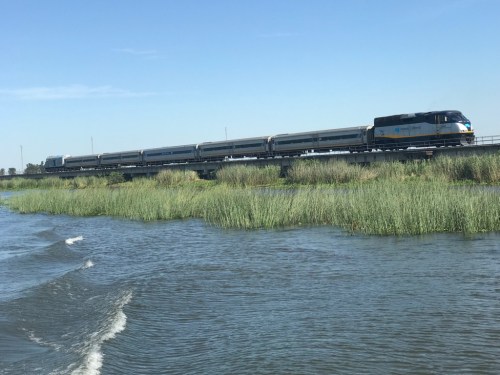
    Yep – that’s the plan. Tunneling through the soft Delta soils right under the train pilings.
  7. Barge docks and barges throughout the waterway making boating and recreation untenable:
  8. Affects of shutting down boating and recreation on Delta marinas and communities
  9. Impact from 24×7 construction trucks on Delta highways (mostly rural 2-lane levee roads)
  10. Impact of construction trucks on Highway 4 between Brentwood/Discovery Bay and Stockton
  11. Raising the Old River Bridge 8 times/day on Highway 4 just east of Discovery Bay
  12. Road damage from 24×7 construction trucks: KCRA Road Impact Video
  13. Farmers in the Delta unable to get their produce to market when all Delta roads are gridlocked
  14. Ruining the historical town of Locke – built by Chinese immigrants in 1913
  15. Impacts to Clarksburg and Courtland and the people living there
  16. Impacts to Hood and the people living there:
  17. Impacts to Bethel Island and the people living there. Bethel Island is a small Delta island community surrounded by 30-40 marinas, restaurants, and other businesses servicing the Delta boating and fishing community. It is located next to Franks Tract – a State Recreation Area and primary bass fishing locale for all of Northern California, bringing in bass fishing tournaments and tourists to Bethel Island and the Delta. Franks Tract is under consideration by the State to fill in with dirt and dams. See
  18. Impacts to Discovery Bay and the people living there
  19. Impacts to Boating and Recreation throughout the Delta
Franks Tract Project moves forward – argh

Please see the notice below from Jamie Bolt, owner of Bethel Harbor on Bethel Island. Jamie has been working with all of the groups with vested interest in Franks Tract and other Delta Islands.

Send your questions or comments via email to: contact@deltaconservancy.ca.gov.

In particular, the State is planning on filling in Franks Tract with dirt, damning False River, and other terrible, unacceptable actions which will impact Bethel Island I’ve written about this project in multiple blogs. Here’s the overview: https://nodeltagates.com/2018/01/10/franks-tract-feasibility-study/

If you go to https://nodeltagates.com/ and “ Search” (right side Search box) for “Frank” you’ll see more blogs with information about this very bad project.

Send your questions or comments via email to: contact@deltaconservancy.ca.gov (I don’t know when the deadline is).

The CA Dept of Fish & Wildlife (CDFW) who is heading up this project).held a big meeting in January at Bethel Island which was attended by marina operators, restaurant owners, business people with a stake in keeping Franks Tract the primary bass fishing area for Northern California and maintaining open boat access to Bethel Island establishments. The unanimous response to the Franks Tract proposal to fill in and dam was “What? That would be a disaster!” More recently the CDFW issued their findings that the Franks Tract project was “feasible.” That means they totally ignored the economic impact and hardship this project would cause to the Community of Bethel Island. Another example of the state prioritizing the desires of the water contractors over real people living in the Delta.

Please send comments and even better, if you can go to the November 13 workshop, please do.
Tuesday, November 13, 2018 | 6:00 – 8:30 pm
Jean Harvie Community Center
14273 River Rd, Walnut Grove, CA 95690
Click here to view map

Alert from Jamie Bolt

Greetings All,

**ALERT**

Please see below the PUBLIC meeting notice for the workshop to discuss the ‘first draft’ of the Central Delta Public Lands Strategy.
Since the first meeting in early August, the name has curiously been changed from the Central Delta Corridor Conservation Strategy to the Central Delta Public Lands Strategy. This name change is not done without express purpose on their part.
This project will serve purpose for the California Water Fix to mitigate thousands of acres of land as required by the state for the twin tunnels project.

If you scroll to the bottom of the below notice you will see the map of delta islands included in their ‘conservation strategy’.
You should note that Franks Tract is specifically included in the Public Lands description and may be extensively filled in as ‘restored marshland’.

You should also note that Bethel Island is surrounded to the east, north, southeast and northwest by the planned project properties.
You should be aware that it was discussed at the last workshop that False River be included in the project and be dammed/dead-ended.

Under the guise of partnering with the public, you will note the workshop wording states they have been “working collaboratively and in coordination with local communities”. They also state the agency supports “the economic well-being of Delta area residents”.

The damming of False River and the filling of Franks Tract are NOT in our best interests. We have not been consulted as a community.
Our delta as we know it is at risk.

I urge you to share this information with others you may know with a stake in these plans. This includes anyone who recreates on Franks Tract.
I urge you to follow the link at the bottom of the page offering more information on the program.
I urge you to stay abreast of this massive project which is at our front door!

Thank you,

Jamie Bolt
Bethel Harbor, Ltd.
925-684-2141

Delta Conservancy Central Delta Corridor Project Announcement

To view the announcement below in your browser click here

From: Delta Conservancy Central Delta Corridor Project [mailto:Linadria@CatalystGroupCA.com]
Sent: Tuesday, October 30, 2018 6:29 AM
To: Jamie Bolt
Subject: Central Delta Corridor Public Workshop — November 13

Central Delta Public Lands Strategy
The Sacramento-San Joaquin Delta Conservancy will host its next public workshop to discuss the first draft of Central Delta Public Lands Strategy (formerly titled: Central Delta Corridor Strategy), which outlines multi-benefit opportunities on publicly-funded* lands from Sherman Island to the Cosumnes Preserve.

Tuesday, November 13, 2018 | 6:00 – 8:30 pm
Jean Harvie Community Center
14273 River Rd, Walnut Grove, CA 95690
Click here to view map

The goal of this public workshop is to share the draft strategy document, which outlines a high-level strategy to guide investments on publicly funded lands. This is the ideal place for you to understand the guiding principles, near-and-long-term opportunities, goals and objectives and conservation priorities. Get an update on each phase of the strategy development and the project.

Project partners include the following landowners: The Nature Conservancy (TNC), California Waterfowl Association (CWA), California Department of Parks and Recreation (DPR), California Department of Fish and Wildlife (CDFW), California Department of Water Resources (DWR), Bureau of Land Management (BLM), US Fish and Wildlife Service (USFWS), and Metropolitan Water District of Southern California (MWD).

For background information and the latest updates on this project visit the Central Delta Corridor Partnership page at: http://www.deltaconservancy.ca.gov.

Send your questions or comments via email to: contact@deltaconservancy.ca.gov.

Thank you for your interest in the Central Delta Corridor Partnership and the Central Delta Public Lands Strategy.

*Publicly-owned lands include lands owned by state, federal, and regional government agencies and lands purchased with public funds.

About the Sacramento-San Joaquin Delta Conservancy
The Sacramento-San Joaquin Delta Conservancy is a state agency that supports implementation of ecosystem restoration, efforts that advance environmental protection, and the economic well-being of Delta area residents, visit http://deltaconservancy.ca.gov to learn more.

The Delta Conservancy mission: Working collaboratively and in coordination with local communities, the Conservancy will lead efforts to protect, enhance, and restore the Delta’s economy, agriculture and working landscapes, and environment for the benefit of the Delta region, its local communities, and the citizens of California.

We’re humans, not “receptors”

HoodConstruction_waterfixand1
North Delta intakes 2018 WaterFix Conceptual Engineering Report

This Tunnel project is crazy. Such a destructive construction project! Now the DWR justifies putting construction right next to and through the small town of Hood because there are “no sensitive receptors” in Hood to the hazardous materials as part of the construction. (Note: “receptor” is a DWR code word for humans or other living entity). How did DWR justify saying that? Because, DWR stated, there are no hospitals, schools, or parks in Hood.

Wait a minute! Aren’t there any old people, kids with asthma, puppies?

BTW – DWR is admitting there be hazardous materials in the air.

Here’s the complete write-up about this: WaterFix DWR Claims No Sensitive Receptors to Hazardous Materials in North Delta Towns.

We are humans, not “receptors”. It reminds me the public outcry to DWR’s plan to leave muck ponds everywhere throughout the Delta (muck – the crap that is excavated from the tunnel hole 150 feet down – wet, smelly stuff). They didn’t modify their plan, they used global edit throughout their 40,000 page EIR and replaced “Muck” with “Reusable Tunnel Materials”, aka “RTM.” That certainly solved the problem.

Thank you for making comments at the DSC Meeting last week!

Thanks to those of you who trekked up to the Delta Stewardship Council Meeting in Sacramento last week. I’m sorry we didn’t have enough to fill a bus but lots of you came anyway. Between all of the organizations who put out the call, the room was full.


Bill Wells (top left), Jan McCleery and Jamie Bolt (right). At the bottom, Skip Thomson, Solano County Supervisor (pro Delta) and Randy Florin, DSC Chair with Turlock tree/wine farm background (pro Tunnel). Photos by Tony Kukulich, Brentwood Press

Michael Brodsky, STCDA Legal Council, made an excellent appeal to the DSC on Wednesday, highlighting the impacts the horrible construction project will have throughout the Delta – from the north to the south. (See the full text of his Appeal and his slides).

Comments started on Thursday afternoon. Thanks to you who went to Sacramento and delivered comments including our members and California Assemblyman Jim Frazier. Here’s Jim’s Comments.

On Friday, the comment period started with folks representing the exporters making their plea for why they need clean water in LA and for Central Valley farming. They were good and valid comments, but they ignored that this plan will destroy the Delta as a Place including the communities and people who live here.

Then Pro Delta speakers took their turn at commenting. Those included yours truly, STCDA Board Members Bill Wells and Jan McCleery. Jan’s comments focused on the construction impacts to Delta communities, highways, and boating waterways and raised the question about why the destructive through-Delta route was chosen instead of the around-the-Delta Eastern Route. Jamie Bolt, the owner of Bethel Harbor, represented the many, numerous establishments on Bethel Island and throughout the Delta that will be devastated with this project. Contra Costa Supervisor Diane Burgis gave a strong rebuttal to the exporters comments and advocated the need to balance concerns for the Delta with the water exporter’s needs. Cecily Tippery from Discovery Bay read the comments from Jerry McNerney (very good – read them including the updated W.E.S.T Bill he’s introducing to the US Congress for a better solution to California’s water), Barbara Barrigan-Parrada from Restore the Delta complained about the lack of communications and outreach to the impacted groups, Deirdre Des Jardin from California Water Research raised very interesting technical questions pointing out concerns about if the plan will protect salinity control in the Delta.

There were a host of folks who showed up to comment. Particularly moving was a gentleman from Locke who showed pictures of that legacy town built in 1915 by Chinese immigrants and considered an important historical site. The second picture showed a grim depiction of how the fragile town would look after only a few years of construction trucks rumbling 24×7 down the narrow main street – shaking the town structures down. Another man from Hood described the historical farmhouse he purchased and has been preserving for decades. Like Locke, his home is on the CA historical registry. The tunnel construction plan is to put a construction road right down the middle of his front yard and going through groves of 100 year old cypress trees.

The damage throughout the Delta from this ill-thought-out plan will be immense. Wouldn’t you go around a treasure like the Delta if you were trying to protect it? Not through the middle, tearing everything up? See more here:

DSC Meeting References:

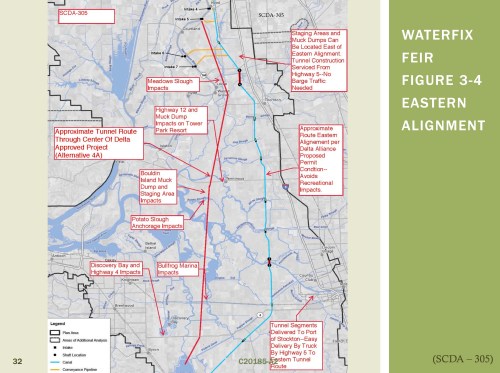
The Eastern Route

As more and more information emerges about the horrible and significant Delta Tunnel construction impacts on the Delta, the question arises, “Why did the DWR pick the through-Delta route for their tunnels?”

It’s hard to believe anyone would plan a major construction project through the heart of the fragile estuary they are committed to protecting. Especially when they have a much better alternative – the Eastern route.

EasternRoute

The recent Delta Protection Commission scathing report to the Delta Stewardship Council argues that the California WaterFix (CWF) tunnel construction and resulting facilities are totally inconsistent with the rural aspects of the Delta that make it so unique and worth preserving. The DPC letter points out that the construction facilities and pumping stations “create impacts on Delta communities will be lasting and severe.” Read more from our prior blog: DPC is on our side.

The DWR’s EIR says the construction impacts to the Delta (to communities, recreation and boating, etc.) are “Significant and unavoidable”. But we argue that the 10 plus year construction impacts are avoidable. The destruction to the Delta from this huge construction project, through the fragile estuary and wetlands, under fragile levees, the Santa Fe Railroad trestle, and other infrastructure could be avoided – if they had chosen the Eastern route.

Because of cost, (10 miles, $1 to $1.5 billion) DWR has ignored the risk to levees and infrastructure, waterfowl and communities and chose the through-tunnel route. (Does it sound like the same mistakes DWR made with the Oroville Dam?)

I do not think that any tunnel is cost-justified and since there is no guarantee they will operate the new tunnels (or tunnel) with any more concern to the required delta flows than they have for the past decades, we are sure water quality will continue to degrade and salmon continue to head towards extinction.

BUT . . . if they dig around the Delta, the Eastern Route, they wouldn’t need to clog small rural highways since there’s quick access to/from Highway 5. They wouldn’t go through wetlands, wouldn’t affect legacy towns, wouldn’t shut down boating and recreation. Then the DWR could say they are working to protect the “Delta as a Place.”

How can the DWR have chosen the through-Delta route when one of the co-equal goals was to protect the Delta as a place?

We would still have concerns with a tunnel along the Eastern route, but that route would not destroy the Delta as we know it.

References:

Acronyms:

  • CWF – California WaterFix; i.e., the Delta Tunnels
  • DPC – Delta Protection Commission. The good guys representing the Delta as a Place. They are trying to live up to their name and “Protect” the Delta.
  • DSC – Delta Stewardship Council. Responsible for writing the Delta Plan which defines the co-equal goals of:
    (1) Providing reliable exports of water
    (2) Protecting the Delta as a Place.
    The DSC is focused on #1; they are the bad guys when it comes to protecting the Delta as a Place. They are not “Stewards” of the Delta.
  • DWR – California Department of Water Resources. The agency responsible for writing the CWF and will be responsible for building the tunnels. Note: This is the agency that designed and built the Oroville Dam and manages the State Water Project (the export pumps sending Delta water to the Central Valley farmers).

ta Stewardship Council.

Delta Protection Commission (DPC) is on our side

WeLoveTheDPC.png

An open letter to the Delta Protection Commission(*):

Thank you DPC for your loud and strong statement that the California WaterFix (CWF) is inconsistent with the Delta as a Place. Finally a government group is standing up for Delta communities!

As you know, Delta communities and organizations have been arguing against the CWF for years. More recently, at the SWRCB hearings, Save the California Delta Alliance (STCDA) brought in expert witnesses focusing on the construction phase of the project: the impact of 24×7 construction traffic on all of our Delta highways (rural, mostly 2-lane roads), the impact of the barge docks and barge traffic on boating and recreation (boating in the Delta will become a thing of the past), the impact on the small legacy towns of Locke, Hood, etc. that are of historical significance, and the impact on all of the communities in the Delta that rely on tourists and boaters to come to the Delta (but won’t be able to when all the highways are gridlocked with construction traffic). For people living in the Delta communities, their lives will be significantly impacted for many years. Your letter highlighted the “blight” this project will bring to our communities. Thank you.

My favorite paragraph from the DPC Letter:


Our review of the record suggests that CWF does not “avoid or reduce conflicts . . . when feasible”, as required by [the Delta Plan]. DWR’s supporting findings identify numerous impacts to Delta communities associated with the CWF project. Included among these impacts are disclosures of the impacts on community character of the CWF project’s construction activities, including declining property values, blight and abandonment. It is not hyperbole to suggest that the CWF project presents an existential crisis for the small Delta communities that would be most affected by the protracted, intensive construction period, the permanent infrastructure, and the radical – not evolutionary – effects on the Delta economic drivers of agriculture, recreation, and emerging heritage tourism. DWR has failed to grapple with the reality, demonstrated through evidence in the record, that CWF puts the long-term sustainability of small Delta communities in serious jeopardy; it also thoroughly fails to offer any meaningful mitigation for such impacts.

Again, thank you soooo much for DPC’s bold stand against the Delta Tunnels. The Delta “Stewardship” Council members are not being stewards of the Delta. Thankfully now the Delta “Protection” Committee is stepping forward and protecting us. Good job !!!

Note: (*) The Delta Protection Commission is a state-appointed commission with responsibility to:

  • Provide oversight of Delta land use and resource management
  • Promote the protection of life and property through the maintenance and improvement of Delta levees, and by facilitating coordinated emergency preparedness and response
  • Promote a robust regional economy – one that protects agriculture, natural resources, recreation and the cultural and historic values of the Delta

The fifteen-member Delta Protection Commission was created under the Delta Protection Act. Its diverse composition provides for stakeholder representation in the areas of agriculture, habitat, and recreation.

Members of the Commission include: One member of the Board of Supervisors of each of the five counties within the Delta (Contra Costa, Sacramento, San Joaquin, Solano, and Yolo); an elected city council members representing the Delta counties; landowners from north, south, and central Delta reclamation districts; and high-level leaders from Business, Transportation and Housing, the Natural Resources Agency, Food and Agriculture, and the State Lands Commission. The two ex-officio members of the Commission are representatives of the Senate and Assembly.

The DPC has the responsibility to provide comment and input on projects that would affect the Delta.

Website: delta.ca.gov

The Tunnels are not “Consistent” with the Delta as a Place

Here’s a great blog with more information about the bad review the Delta Protection Commission gave on the meetings this week being held to approve the Delta Tunnels (WaterFix). This week, the Stewardship Council is planning on certifying the Delta Tunnels as being “Consistent” with the Delta Reform Act and the Delta Plan. Whereas they are just the opposite. They violate both.

Read more here . . . https://cah2oresearch.com/2018/10/22/delta-protection-commission-waterfix-inconsistent-with-delta-reform-act-and-delta-plan/

Watch out for Nutria!

Bill Wells reported in the Bay and Delta Yachtsman in his Delta Rat Scrapbook article in September that:

Just when we are getting the invasive plants in the Delta under control a new scourge rears its ugly head in the region, the nutria. They were first brought to California in 1899 when someone tried to establish a fur ranch with the animals in Los Angeles. They spread throughout the state and were subject to intense eradication efforts. By 1978 they were thought to be gone but apparently they just went underground and hid, waiting for the day to launch a new attack. Since the first one was seen in Merced last November over 200 have been caught in traps around the greater Delta area. Nutria are found in 30 states including the entire west coast and wreak havoc wherever they are found. They were introduced into southern states to control invasive plants like hyacinth. Unfortunately, they eat all plants including the roots. They also burrow into levees and farmlands. In some places in the U.S. they have turned tidal marsh into open water.

Nutria are carriers and transmit a host of communicable diseases. They don’t have many predators in California and one female can produce 200 offspring in her lifetime. These are some bad hombres. Right now the only way to deal with the Nutria invasion is to trap, poison or hunt them out of existence. In Louisiana there is a five-dollar bounty for each Nutria tail turned in to state agents. Also, in Louisiana, Nutria meat is on the menu in restaurants. They also make dog snacks out of the meat. Supposedly it is high in protein and low in fat compared to most domestic animals. In California it is illegal to hunt or possess the cute little creatures so the best you can do is report them when you see them.

Here is a link: https://www.wildlife.ca.gov/Conservation/Invasives/report. Recently I have seen two dead animals alongside the road in the Walnut Grove/Isleton area that looked a lot like nutria. The roads did not have a shoulder near where I spotted them so I could not stop to investigate. Keep your eyes open for these pests; from a distance they can be confused with a beaver or muskrat. They are identifiable by their white muzzle and white whiskers.

Here’s more pictures and information:
https://www.wildlife.ca.gov/Conservation/Invasives/Species/Nutria/Infestation.

AdultMale_Capture3_061417c_800px

NutriaID_T9A1296
Though muskrats may have a white muzzle, both muskrats and beaver have dark whiskers. Nutria have characteristic white whiskers, and most often have conspicuous, darks ears with light-colored fur underneath, as seen in this image. Photo courtesy of Peggy Sells.

OthersNotNutria

ATTENTION BOATERS: Why you should be on our bus Friday!

The Delta Protection Commission (DPC) came out Friday with a scathing review of the California WaterFix (CFW). (Note: The DPC is a group that includes the Delta County Supervisors and who’s charter includes working with the Delta Stewardship Council and protecting the Delta.)

Their review helps set the stage for our comments to the Delta Stewardship Council on Friday, October 26.

This is why we need all boaters to get on the bus to Sacramento this Friday. This is a unique opportunity to drive home these points to the Stewardship Council!

P1000104

The points made in the DPC’s letter are pertinent to the Friday meeting at the Delta Stewardship Council and help provide concrete reasons why the Stewardship Council should not adopt the Delta Tunnels and call them “consistent” with the Delta Plan. They are not!

A key part of the DPC’s arguments against the WaterFix are around recreation:
“When first presented with the environmental analysis of socioeconomic impacts in 2013, Council staff’s comment letter raised concerns about changes to Community Character:

    “The EIR/S states that ‘adverse social effects could also arise as a result of declining economic stability in communities closest to construction effects and those most heavily influenced by agricultural and recreation activities.’ Actions should be offered to reduce or mitigate adverse impacts in Chapter 16.”

The letter continue to say: “Of the numerous mitigation measures and “other commitments” DWR presents in the Consistency Certification, none are directed at supporting local communities as they address the impacts to their community character.”

  • DWR did not adopt any mitigation measures that would meaningfully support the economic health and well-being of Delta communities.
  • Recreation is second only to agriculture in contributing to the Delta region economy. According to the ESP (the Delta Protection Commission’s Economic Sustainability Plan), visitors to the Delta region generated a total of 12 million visitor days of use annually in 2010 with a direct economic impact of more than $250 million in spending, with most of this visitation in interior areas of the Delta that will be largely impacted by CWF [WaterFix].

This point is key:
“Included among these impacts are disclosures of the impacts on community character of the CWF project’s construction activities, including declining property values, blight and abandonment. It is not hyperbole to suggest that the CWF [WaterFix] project presents an existential crisis for the small Delta communities that would be most affected by the protracted, intensive construction period, the permanent infrastructure, and the radical – not evolutionary – effects on the Delta economic drivers of agriculture, recreation, and emerging heritage tourism. DWR has failed to grapple with the reality, demonstrated through evidence in the record, that CWF puts the long-term sustainability of small Delta communities in serious jeopardy; it also thoroughly fails to offer any meaningful mitigation for such impacts.”

Isn’t that what we have all been saying in every way we know how to say it? That this horrible construction project will ruin our community, our economy, our way of life.

I know people have shown up time and time again, before this same Delta Stewardship Council, and given similar comments. But now we can point to the conclusions that the State’s Delta Protection Commission is highlighting and say that this terrible project will not protect the Delta as a Place and definitely will not protect boating and recreation or the communities that rely on it for economic sustainability.

Between DWR’s failure to adequately consider or mitigate impacts to Delta recreation from WaterFix construction the failure to adequately consider or mitigate impacts to North Delta towns, it is looking like there is a strong case that DWR just blew it.

Similar points were also brought up in Michael Brodsky’s excellent appeal filed for Save the California Delta Alliance, which is available here:
https://coveredactions.deltacouncil.ca.gov/profile_summary.aspx?c=f794626c-c216-4600-885d-fe27c1cbedeb

The Delta Stewardship Council is also allowing 3 minute testimony from individuals, most likely on October 26, 2018. Save the California Delta Alliance is organizing a bus on that day.

Email stcda@NoDeltaGates.com to reserve your seat on the bus. Also let us know if you have time restrictions and/or what time you would prefer the bus to return to Discovery Bay.

The bus leaves Discovery Bay at 7:30 AM on Friday, October 26 . . . if we have enough sign-ups. So please RSVP as soon as possible!

Alert: Get on the Bus!

We’re headed to Sacramento this Friday, October 26, to give our final comments to the Delta Stewardship Council about why the Delta Tunnels (California WaterFix) should not be part of the Delta Plan.

Are you coming with us? Please email stcda@NoDeltaGates.com if you can join us on the bus for $25/person!

The bus (if we have enough people responding “yes”) will leave the Discovery Bay Marina/Boardwalk Grill Parking Lot at 7:30 AM in order to get to Sacramento at 9 AM.

Location of the Meeting:
Ramada Inn West Sacramento – Conference Center
1250 Halyard Drive
West Sacramento, CA 95691

Michael Brodsky and others representing the Delta forces working to protect the Delta, will be doing our final arguments to the DSC on Wednesday and Thursday. Then Friday is the final public comment period to the Delta Stewardship Council.

We need you to attend and stand up and tell the Council why the Delta Tunnels don’t protect the “Delta as a Place” or Recreation. The question is whether the tunnels project is consistent with the Delta Plan. Our commenters should say the “tunnels project is not consistent with the Delta Plan because…….” and then give their reasons.

Here are some of the things we are arguing in our appeal to the Council.

  1. Achieving the “coequal goals” is the guiding principle for the Delta Plan. The Coequal Goals are “ the two goals of providing a more reliable water supply for California and protecting, restoring, and enhancing the Delta ecosystem. The coequal goals shall be achieved in a manner that protects and enhances the unique cultural, recreational, natural resource, and agricultural values of the Delta as an evolving place”

    The tunnels do not protect and enhance recreation and do not protect and enhance the cultural values of the Delta. The Tunnels EIR admits that the project will have “significant and unavoidable adverse impacts on recreation,” which are “long-term and cannot be mitigated to a level of insignificance.” These impacts will “occur year-round” This is all found in the EIR at p.15-469. The EIR also found that the Tunnel Project would have significant adverse environmental impacts on agricultural resources.

    People should talk about whatever impacts concern them the most. Most importantly, the Delta Tunnels have failed to address recreational appropriately – it is a weak spot and Achilles Heel for them. Comments about how this impacts recreation and why that is important to you personally is important. Others who aren’t boaters should talk about impacts to them personally – to their communities, farming, etc.

  2. The Tunnels Project is not consistent with the Delta Plan because the water contractors have failed to implement measures to reduce reliance on the Delta as required by the Delta Plan.
  3. The Tunnels Project is not consistent with the Delta Plan because it does not contain measures required to mitigate traffic impacts. Here people can talk about the traffic impacts on Highway 4. In case you haven’t been paying attention, the plan is to route construction traffic 24×7 from Antioch to Bacon Island Road. That is passed Discovery Bay, across the single-truck-lane bridge, and tearing up our fragile 2-lane Highway 4 levee road. (They are doing similar over-loading of all of the little Delta highways – Highway 12 and 160). The stupidity of having a huge construction project located in an area where there are mainly waterways and little levee roads is beyond belief. Yet here we are. That plus the barges that will flood the waterways will bring noise, pollution, and a mess into the center of the Delta.

I have attached the brief Brodsky filed with the Council. You can look there to get more talking points:
Michael A. Brodsky appeal c20185-a2 no attach

Are you coming with us? Please email stcda@NoDeltaGates.com if you can join us on the bus for $25/person so we know whether to have a bus (or 2)! Wear your tee-shirts or we’ll have more for people to buy. And Stop the Tunnel signs!


Blog Stats

  • 126,145 hits

Support the STCDA

Sign up for Emails

Sign Up Now

Request a New Lawn Sign

Click Here to send an email to the lawn sign committee.

Receive news blog via email.

More Blogs

Educational Books about the Delta

Sassy the Salmon
and
The Fable of the Farmer and the Fish
All ages: K and above
Proceeds go to STCDA