Archive for January, 2015

Dams in the Delta! Send in your comments!

A call for comments! The DWR is trying to get approval to install rock dams in three areas without proper review or process (reminiscent of the 2-Gates Project). The end of the comment period is February 25, 2015. So please send in comments now.

Send comments via E-Mail to: DWREDBCOMMENTS@water.ca.gov
Fax: (916) 653-6077
Snail Mail: Jacob McQuirk, Supervising Engineer, Bay-Delta Office
California Department of Water Resources
PO Box 942836
Sacramento, CA 94236

First, the issue. Next are some suggested comments.

THE ISSUE: The DWR is trying to get approval to install dams whenever they want over the next 10 years in three locations: West of Franks Tract, Sutter Slough and Steamboat Slough. The dam in False River next to Franks Tract will block the primary route for boats traveling between Discovery Bay/Bethel Island and Benicia, Petaluma and San Francisco. The dams in Sutter and Steamboat Sloughs will affect boating between Sacramento and San Francisco.

Unlike the 2-Gates, these aren’t opening gates but rock dams.

The dams could have some benefits – but without an environmental review it’s unclear if the benefits outweigh the negative impacts.

Of concern, this could set the precedent for dams wherever they want – even to re-start the 2-Gates proposal in Old River and Connection Slough which would block boats in and out of Discovery Bay and between Bethel Island and Discovery Bay.

The end goal, of course, is if they don’t get the Delta Tunnels approved, to “wall off” Middle River to form a direct channel from Sacramento to the Clifton Court Forebay to ensure lots of clean water for the farmers. The result would be the entire west side of the Delta would be a brackish mess. Goodbye salmon.

They claim they do not need to go through a formal EIR/EIS process. They are trying to rush approval through for these rock barriers without proper process. The DWR admits these rock dams will be detrimental to boating. They do not state if there’s issues with migrating fish yet we know from the 2-Gates fiasco that their planned gates there would have more likely killed fish than “protected” them as advertised.

Their goal is to block salinity from coming into the Delta so that they can continue to pump more water out than the Legislature approved. They need more water because they keep expanding profitable almond orchards in the Central Valley desert. Did you notice that we are seeing more produce (beans, asparagus, etc.) from Mexico and Costa Rica lately? Because the Central Valley is rapidly converting produce crops to the more profitable almonds. The need for almonds is rapidly growing in Asia.

Suggested Comments (re-write in your own words):

  • MOST IMPORTANT COMMENT: I oppose installing any dams in the Delta without a complete environmental review. The DWR admits these dams will be detrimental to boating. An environmental review is needed to determine what the effect on migrating fish, impacts to the levees, boating and other environmental and economic problems.
  • What will dams mean economically to communities reliant on boating and what will that cost for added fuel costs and other impacts?
  • What will be the effect on migrating fish? The Head of Old River dam has been documented to trap smelt behind the dam for predators to easily kill. The 2-Gates Fish Protection Project (another set of dams/gates proposed for salinity control) were withdrawn due to the likely negative effect on fish. These new dams need a complete environmental analysis before approval.
  • Will the rock be completely removed once the dams are removed or will there be wing dams and if so, what will that do to the water flow and how will that impact the safety of boating in the area?
  • These dams are to stop salt water; however, the direction on operating the pumps is supposed to maintain the X-2 line (salinity line) west of Pittsburg. How will Antioch’s water supply and western farms be affected if salt water is allowed to intrude nearly to Franks Tract and as far North as Steamboat and Sutter Sloughs?
  • Why were LA’s reservoirs and the Kern Water Bank “topped off” in 2013 during the 2nd year of a drought allowing the Northern California reservoirs to be at too low a level to support adhering to the legislative-directed salinity controls in the Delta?
  • How will these dams help maintain urban users’ fresh water supply during 2015? The LA reservoirs were topped off in 2013 and the LA mayor has said that LA has enough water until 2016. Isn’t this really to continue to provide expanded water to the Central Valley farmers for almonds?

Related Information:

  1. These dams could become permanent. They definitely will be full-time over the summer since they are rock dams, not like the 2-Gates proposed opening gates.
  2. The dams are not planned to be fully removed. The wing dams on the side will remain. What will that do to the water flow during high tides? Will it be safe to boat through?
  3. There is a massive hyacinth/egeria densa problem in the Delta that is caused by low water flows. Frank’s Tract could become a meadow if the water flow is tampered with. Marinas are already having to spend millions of dollars of their own money to control invasive plants. If there are dams on Steamboat and Sutter Sloughs, the hyacinth problem there will be horrendous as there will be little or no water flow.
  4. Barriers are part of an overall backup plan (if the BDCP fails) to “wall in” the delta and create a pipeline from Sacramento to the Forebay to export water south. These dams are 3 of a dozen or so that were seen on the BDCP maps in 2009 as part of the “through-the-Delta” peripheral canal plan.

The proposed False River dam is already further upriver than the agreed-to X-2 Salinity line. Letting salt water that far upriver will impact the City of Antioch’s drinking water and west-side farms. This is not a good plan.

There is an alternative – slow down exports during this time of drought. These dams support ongoing exports even during the drought. The need is as much a result of mismanagement of the water system in California as anything. In 2013 the USBR and DWR approved releases of water from Northern California dams to completely fill LA reservoirs and the privately-held Kern Water Bank. That was totally irresponsible and now Northern California’s water crisis is worse than it would be if the system had been well-managed. The dams are not as much for drinking water protection but rather to increase the amount of exports allowed for Central Valley corporate farmers; mainly for almonds to ship to Asia.

Dams are not the answer. At least not without a complete EIR/EIS to study the effects on Northern California fish, boating and western farms.

These are the same rock dams we asked people to comment about last April but end of 2014 the DWR withdrew the request siting sufficient water flow for 2014.

This year the DWR is trying to streamline approval to have the dams installed whenever they decide.

Documents are available online at http://www.water.ca.gov/waterconditions/emergencybarriers.cfm
Can’t Kill the Earthquake Bogey

In August, 2014, I wrote Can we Kill the Earthquake Bogey Yet?

Unfortunately, the answer is “No”.

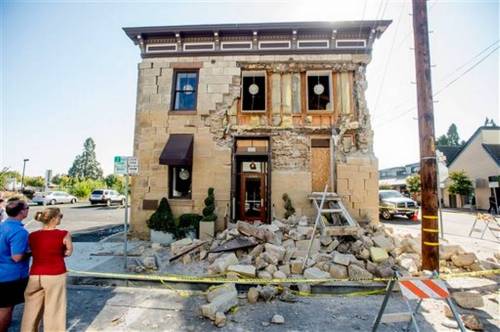
December 14, 2014, the Sacramento Bee printed another article: UC Davis study finds next Napa earthquake could imperil Delta levees.

Of course, the BDCP re-distributed that on their BDCP Facebook page January 21, 2015.

I commented both places – anyone else who wants to add a comment and chime in is appreciated. (I’m always kind of wordy – any pithy smart one-liner responses would probably make more of an impact. Help me out here.)

——————————- Jan’s Comment ————————————-
Why do we keep repeating this erroneous incorrect storyline? First, if there were a big risk of levee failure in the Delta, wouldn’t the state be taking rapid action to insure that human lives aren’t lost if levees fail and Delta communities flood? Would the state really be risking the economic issues of the railroads and major highways in the Delta flooding? Of course they wouldn’t. They are not taking action because the “Earthquake Bogey” is a false, erroneous scare tactic.

The scare tactic was thought up by the proponents of the BDCP tunnels (i.e., Big Ag) following the Katrina disaster and it has been effectively used since to scare Southern California water users into thinking there are risks to their water supply to try to get their buy-in to the expensive BDCP plan.

The fact that there are no active fault lines in the Delta should have put this issue to rest long ago. The Hayward Fault (the nearest active fault line) is 30-60 miles away from the Delta. Levees have been shown to not be affected by shaking.

Immediately after the Napa shaker, the civil engineering firm Kjeldsen Sinnock and Neudeck (KSN), the Stockton civil engineering company that maintains about half the levees in the delta, went out to inspect the levees. Delta Levees once again proved the “Earthquake Bogey” argument of the BDCP to be what it is – just a scare tactic. Just as during the Loma Prieta earthquake, the levees were unaffected. Neudeck insists delta levees are now even wider, taller and stronger. He also said inspections are done constantly by the engineers hired by reclamation districts.

The article states that during the last “century”, 162 levees have failed. It does not add that since 2004, no levee has failed. Levees are continually being expanded and improved. The article does not also identify that not one of the 162 levee failures was due to earthquake – not even during the 1906 earthquake when the levees were narrower. Nor during the 1989 Loma Prieta earthquake.

Shame on the Sacramento Bee for printing this biased, un-researched article. Please get input from non-biased sources and show both sides of the story.

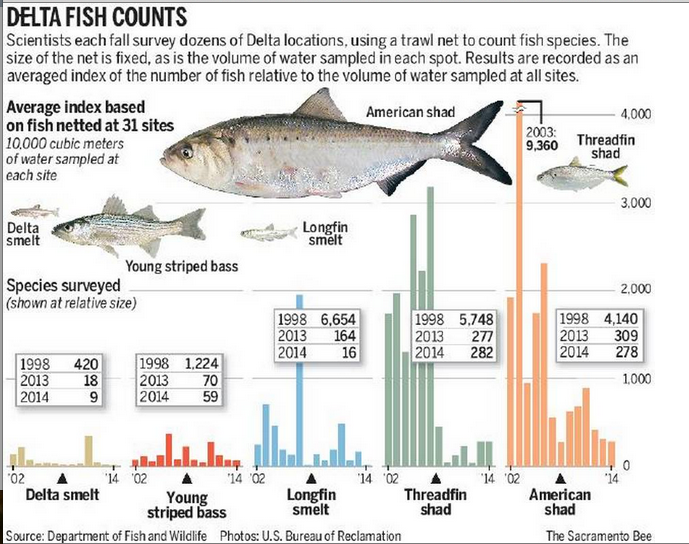
Delta fish species decline

All Delta fish species are known to decline in drought years. That’s because they depend on ample freshwater outflow to support their habitat, and such flows decline during drought. The fish have long been affected by water diversions from the estuary, as well as other factors. The drop is quite staggering.

DeltaFish

Read more here: http://www.sacbee.com/news/state/california/water-and-drought/article6603369.html#storylink=cpy.

Does California need more dams?

Some argue that a new dam here, raising a dam there, is part of the answer to the California water crisis.

The McClintock-Costa bill HR 934 which is expected to pass the House and may win Senate approval as well would remove the “wild and scenic” status from the Merced river to allow expand its large dam on the Merced River. Write Senators Feinstein and Boxer and ask them to vote against this bill.

Why is this an issue? Don’t we need more dams for more water?

The McClintock-Costa bill would do much more than help a water district enlarge its reservoir and ruin a portion of a majestic river. If passed by Congress, it would set a national precedent. The federal government has never before removed a wild and scenic designation on a river. The designation is considered to be one of the nation’s most important and powerful environmental regulations, and protects many California rivers from being further dammed up and diverted.

A great article was released today, Tunnel Vision Part Two that identifies the real risk in HR 934.

HR 934 is backed by the Merced Irrigation District, a water agency representing agricultural interests in the Central Valley that want to expand its large dam on the Merced River, but can’t — unless Congress lifts the wild and scenic status.

The bigger prize, though, is the rivers along the North coast. Wild and scenic — that’s the strongest designation that we have,” said Jon Rosenfield of the Bay Institute. “If we’re willing to remove that for one irrigation district, who’s going to stop us from doing that to another river?” The Eel, the Smith, and the Trinity are now protected by wild and scenic designations. Those rivers contain millions of acre-feet of water that could be diverted.

Currently, Big Agribusiness and powerful water interests in California are not only blocked from accessing North Coast rivers because of their wild and scenic designations, but they’re also stymied by the state’s water conveyance system, particularly the Delta. The fragile estuary serves as a natural barrier to those who want to move more freshwater from Northern California to the San Joaquin Valley and Southern California.

That’s where the Delta tunnels come in with their oversized capacity.

“If you build this infrastructure,” said Jeff Miller of the Center for Biological Diversity, referring to the giant water tunnels, “at some point, it’s going to be used to its max.”

Read more: Tunnel Vision Part Two.

Time to Write the Senators Again

Update on Federal Legislation which would destroy our Central Valley Salmon Runs. Need letters to legislators. Click http://water4fish.org/campaigns/index.php/.Water to send your comments.

In early 2014 a water bill was passed by the U.S. House of Representatives which would have devastated the Central Valley salmon populations. It was sponsored by the San Joaquin agricultural members of the House. In early December, both Senators Feinstein and Boxer were instrumental in stopping an amended version of that bill in the Senate because it would have overturned the Endangered Species Act protections for the salmon. Undeterred, later in December the House passed a new bill which contained most of the same salmon killing provisions.

The new Congress will take up these bills again in 2015. Water4Fish, the Golden Gate Salmon Association and other organizations are gearing up for the battle. You can help. Letters to Senators Feinstein and Boxer thanking them for their 2014 actions and requesting their continuing help in 2015 can have a big impact.

The WaterForFish group have drafted an email that you can easily send to Senators Boxer and Feinstein. Go to www.water4fish.org and click on “Send Letters to Legislators”. Fill out your information and click on “Send Emails”.

Let’s learn from others’ mistakes

Seattle’s “Big Dig” tunnel project shows another example of what a Delta Tunnel project will look like.

How does Seattle’s “Big Dig” compare to the planned Bay Delta Conservation Plan (BDCP) tunnels?

Seattle’s Big Dig Delta Tunnels
Number of Tunnels: 1 2
Diameter: 56 feet 40 feet
Depth below the ground: 120 feet down 150 feet down
Length of Project: 2 miles 30 miles
Number of vertical shafts: 0 10 – every 3 miles
Type of soil: soft landfill soft, alluvial soils

After the first 3 weeks of the beginning of boring the Seattle tunnel in 2013, they were already 2 weeks behind schedule. Currently the projected 14 month project which was planned to complete December 2014 is now projected to take until August 2016 or later (almost 3 times as long as original projections). They’ve only tunneled 1,000 feet of the 2 miles/9,200 feet (our tunnels are 30 miles long) and have already used 70 percent of the estimated total cost (do I hear huge overruns?) Seattle’s “Big Dig” is only 2 miles long yet the tunnel-boring machine has been stuck underneath Seattle for more than a year. The machine is stuck in soft ground which used to be underwater (sound like Delta ground?) Now they are having to dig a huge hole down to haul the behemoth tunneling machine out to repair it. The huge hole caused them to have to dewater surrounding ground water and is causing nearby buildings to sink and crack. What a mess!

Why isn’t this what we will be looking at in the Delta if the tunnel plan goes through? Huge delays, cost overruns and unforeseen damage surrounds Seattle’s “Big Dig” and it’s only 2 miles long versus the Delta tunnel 30 mile, dual tunnel project.

Going “under the Delta” sounded so much less pervasive and more environmentally correct than a peripheral canal. Easier to “market” and “sell” to the general populace. But it is what it is – a huge construction project through the heart of sensitive Delta wetlands and rich farmlands that will do endless amounts of economic and environmental damage to Northern California.

Read the December 30, 2014 Washington Post Article.


Blog Stats

  • 127,721 hits

Support the STCDA

Sign up for Emails

Sign Up Now

Request a New Lawn Sign

Click Here to send an email to the lawn sign committee.

Receive news blog via email.

More Blogs

Educational Books about the Delta

Sassy the Salmon
and
The Fable of the Farmer and the Fish
All ages: K and above
Proceeds go to STCDA