
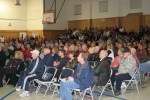
The following letter was read at the meeting yesterday in Discovery Bay by our member Michael Brodsky, and signed by many of the people in attendance. For the folks that were unable to sign yesterday, but wanted a way to sign this letter on our web page, please read at the end of this post.
We, the undersigned, submit these comments in mass to express our grave concern that adequate consideration has not been given to the environmental, economic, and cultural impacts of the proposed 2-gates project. We also express grave concern that the stated purpose of the project, to alter smelt behavior in the delta, is little more than wishful thinking without adequate scientific support.
Because any benefits of the project are, at this time, speculative at best, and the potential for negative impacts so great, we are confounded that the BOR has elected to cut environmental corners by proffering a FONSI instead of conducting a full environmental analysis and producing an adequate EIS. It appears to us as if the BOR is in a headlong rush to begin construction despite many red flags auguring for caution and more careful scientific analysis before any decision to proceed is made. We sincerely hope that you will reconsider the rush to break ground and will take the necessary time to make an adequately informed decision.
The BOR extended the comment period (originally 30 days) by two weeks, albeit two weeks including the Thanksgiving holiday. Based on the information presented below, we believe that it is obvious that starting construction on this project in December 2009, as the BOR originally intended, is completely out of the question. Given the amount of work BOR has yet to do to justify the project, a more realistic start date (if indeed serious investigation reveals any merit to the project) would be December 2011 at the earliest. We request a further extension of the comment period of at least 90 days from the date such extension is announced. We believe that comments in response to this EA will be useful to the BOR in scoping and performing a full Environmental Impact Statement, which we also believe is mandatory in this situation.
A blue ribbon panel of independent scientists has reviewed the project and concluded that the project proposal “has some significant shortcomings and problems.” CALFED Science Program, Science Review of the Two Gates Project, September 29, 2009 (“CALFED Science Review”) at 10. Chief among these is that “[a] critical element of project design, the smelt behavior model, is incomplete and not connected to existing literature on fish behavior models.” CALFED Science Review at 11. CALFED concludes that the assumptions about smelt behavior upon which the entire project is based have never been substantiated: “[s]ince the behavioral rules are biologically questionable, the assumptions that they will capture the response of fish to the Two Gates operations is a central defining
aspect of the project that needs substantiation.” Simply put, with the information that is available at this time, there is no reason to believe that the 2-Gates project will do anything at all to achieve its purpose, which is the alteration of smelt behavior. On the other side of the ledger, the very significant and far reaching impacts of the project on the hydrodynamics and water quality of the delta are firmly established by the BOR’s own documentation: “Changes would occur to channel flows (direction, magnitude, and/or duration) and water quality (primarily turbidity and salinity).” 2-Gates Fish Protection Demonstration Project, Draft Environmental Assessment (“Draft EA”) at 123. The project “would substantially modify hydrodynamic flow patterns in the interior delta.” Draft EA at 125. Examples of altered flows acknowledged by BOR include January–February reductions in flow of 43% on Old River at Holland Cut on ebb tide and a reduction in flow volume of 33% on flood tide; a reduction in flow of 16% on Middle River at Middle River on ebb tide. Draft EA, table 3.9-3 at 221–222. In March, examples of flow reduction include a reduction of 44% on Old River at Holland Cut on ebb tide and a reduction of flow volume of 68% on Old River at Holland Cut on flood tide as well as a reduction in flow volume of 75% on flood tide on Old River at Bacon Island. Draft EA, table 3.9-4 at 223. These flow reductions and alterations raise serious questions about circulation, stagnation, accumulation of contaminants, increased deposition of sediments, algal growth, impact on human health, and fish species other than smelt. It will take serious and rigorous scientific analysis that has not yet been done to answer these and many other outstanding questions.
The BOR has concentrated almost exclusively on attempting to analyze how its project will affect smelt behavior with very little attention to other impacts that 2-gates will have on the environment. This fundamental failure to consider the wide ranging impacts of the project was not lost on the CALFED Science Review: “The Panel feels that considerable uncertainty remains around potential unanticipated consequences of the Two Gates Project operation.” CALFED Science Review at 18. Examples of impacts that the Science Review found BOR has failed to adequately consider include “potential impacts on juvenile salmon,” and “other species of concern or sensitivity, such as Sacramento Splittail,” and “Sacramento tule perch.” CALFED Science Review at 18.
Nor has BOR considered the impacts on human health. An intended result of the project is to increase residence time for waters of the central and south delta. With increased residence time, lowering of dissolved oxygen and algal growth are to be expected.
However, BOR has not considered changes in water quality due to lowering of dissolved oxygen. BOR has proposed providing stations to monitor algal growth after the gates are installed, but none of those monitoring stations is to be located in Discovery Bay where
children frequently swim.The CALFED panel characterized the EA’s treatment of potential environmental impacts as having “little rigor.” CALFED Science Review at 18. Where our property values, the health of the environment, and the health of our children are at stake, “little rigor” is not good enough for us. We hope that it will not be good enough for you either. We request that BOR extend the comment period for at least 90 days on the currently circulating EA, and that BOR use its experience in circulating this EA to conduct the necessary science to
1) justify the project with rigorous scientific support; and
2) prepare a full scope Environmental Impact Statement.
If you would like to sign this letter (and hadn’t had a chance at the meeting), please click on this link (or on the “comments” link right below this post), state your name and address, and any other comment you wish to leave. We will add your name to the overall list of people that signed the petition.
Thank you!


 Save the California Delta Alliance (STCDA)