Archive Page 9

Mamma Mia – Here we go again . . . The Single Tunnel Project kicks off

BREAKING NEWS – Single Tunnel Notice of Preparation Released

The Department of Water Resource’s (DWRs) Notice of Preparation came out today – announcing the kick-off of the single tunnel project. Here is the PDF of the full NOP.

Groan.

Save the California Delta Alliance) was formed because of the 2009 Two-Gates project that threatened to shut off boating between Discovery Bay and the rest of the Delta. The community responded. We stopped the unstoppable Two-Gates Project.

Done? Oh, no. Then there was the peripheral canal project that morphed into the California WaterFix Twin Tunnels. After eight years we won again – two-tunnel project was withdrawn.

So now, Mamma Mia here we go again. The DWR just released a Notice of Preparation to begin the process anew.

2010 – We stopped the Two-Gates
2019 – We stopped the Twin Tunnels
2020 – We will stop the One Tunnel
            Then there will be zero tunnels!
 

We are asking for your help one more time. Help us put this final project away.

The fight continues in 2020. We cannot be complacent. Fighting back takes time, money, and perseverance.

Please Donate

The Five Delta County Coalition also slammed the NOP

“It’s been 11 years since the introduction of the Bay Delta Conservation Plan Twin Tunnels proposal, and nearly a year since Governor Newsom’s withdrawal of California WaterFix Twin Tunnels project. It appears DWR is pursuing another inadequate and scientifically flawed project with one tunnel.

See their response here: 2020-01-15_Tunnel_NOP_statement

Newsom’s “Water Resilience Portfolio” Released

Earlier this month, a Water Resilience Portfolio was prepared by the state agencies. In April 2019, Governor Newsom directed state agencies through Executive Order N-10-19 to develop a “water resilience portfolio,” described as a set of actions to meet California’s water needs through the 21st century.

The response from Save the California Delta Alliance’s President, Karen Mann, to the Water Resilience Portfolio was:

It was quite a surprise to see their Portfolio list more than 100 projects; some quite costly – a very ambitious plan! Some of the projects are good ideas, but there was no information about the priority of the projects nor the time line. It was great to see the recycle of storm water and study of desalination as part of this Portfolio. Residents of Discovery bay will be pleased that the 2019 legislation requires the Water Board to establish and maintain program to reduce and/or eliminate Toxic Algae in our waterways.

We note the push to mitigate the needed increase of water flows with Volunteer Settlement Agreements (VSAs). The report states they plan to “harness the best of science, engineering and innovation”; however there has been no scientific evidence that fish can survive the improved habitat without adequate water flows – Fish still need adequate water to live!

Finally, it was a disappointment to see the Tunnel Project was still included – we had hoped we could explore alternative solutions. Even though Governor Newsom declared on 04/29/2019 that the tunnel project would be reconsidered and the project would be redesigned – the only change noted so far (as provided at the DCA’s Stakeholder Engagement Committee (SEC) Meetings) has been essentially the same as prior information as the prior project which had two tunnels now configured for the single tunnel (which may have a 4-6 story diameter, same input location in the Town of Hood, etc.). It was our hope that this Portfolio would also consider alternative solutions which would not require the “invasive” tunnel construction which traverses though the center of the Delta which would result in adverse environmental impacts during the 10+ years of construction, and unknown destruction of the Delta fishery.

In addition, it is worth noting that the State Water Project is the largest user of electricity in California and a significant contributor to climate change. It uses all of the electricity generated by the state’s hydroelectric plants plus billions of kilowatts generated by gas fired power plants every year to pump billions of tons of water from the Delta to Southern California up and over the Tehachapi Mountains and as far south as San Diego. The first and obvious step in resilience is a planned retreat from the climate atrocity of pumping water over a mountain range and instead developing local supplies to replace all water exported south of the Tehachapis.

The Year in Review

Happy Holidays to you and your family!
stcda-holidays

2019 was a big year for Save the California Delta Alliance because the hard work of 2018 and prior years paid off.

In summary:

  • After an eight-year epic battle we defeated the twin tunnels.
    • In December of 2018 the Department of Water Resources (DWR) was forced to withdraw one of its tunnel permit requests in hearings before the Delta Stewardship Council. (Our legal counsel, Michael Brodsky, and the witness testimonies he brought forth were extensively quoted in these wins.)
    • When Gov. Newsom suggested a single tunnel earlier this year, the DWR tried to argue that a single tunnel somehow magically solved all of our objections.
    • But in May, DWR threw in the towel completely. They canceled all project approvals and tossed (de-certified) the deeply flawed EIR, which is exactly what we sought in our lawsuit.
  • However, efforts continue with design studies that include the same through-Delta route. We expect their new larger single tunnel EIR may still:
    • Pose construction destruction throughout the Delta.
    • Pose unmitigable impacts to boating and highways.
    • Ignore the science about how to save the fish and water quality in the Delta.

The fight will continue in 2020. We cannot be complacent. Fighting back takes time, money, and perseverance.

Read the details below. And please continue to support our efforts to save the Delta we all love and call home. Donate what you can and keep an eye out for notices of our town hall meetings and other events. You can donate here:


Read more below . . .

After an eight-year epic battle we defeated the twin tunnels

After an eight-year epic battle we defeated the twin tunnels, first called the BDCP and then later re-named California WaterFix.

True to its name, the fix was in for WaterFix from the beginning and state officials pushed ahead with the project and seemingly no amount of evidence that it was a disaster for the Delta could dissuade them. Then the tide began to turn in November of 2018 when Delta Alliance and several of its allies, including Contra Costa, San Joaquin, and Sacramento Counties, the Delta Protection Commission, and the City of Stockton challenged the tunnels in front of the Delta Stewardship Council. See Delta Alliance’s slide presentations to the Council here.

The evidence was so overwhelming that the Council’s staff made a determination that WaterFix violated the Delta Plan! This was a huge success because no project can get underway in the Delta that violates the main “Delta Plan.” The 150 page determination quoted extensively from Delta Alliance’s evidence presented by our Legal Council, Michael Brodsky, and from testimony of Delta Alliance Board Member Bill Wells and Delta Alliance Member Captain Frank Morgan. Read the Council’s determination here.

Rather than face a humiliating final vote of the Council’s seven members, DWR withdrew its permit request in December of 2018 and said it would make revisions and come back and try again.

Through 2018, Delta Alliance was fighting the tunnels on several fronts, including the hearings at the Council, separate hearings before the State Water Resources Control Board on DWR’s water rights permit, and in Sacramento Superior Court in our challenge to the WaterFix EIR. It was a busy time.

It was obvious that DWR’s defeat at the Council was the beginning of the end for WaterFix and that the project simply could not survive scrutiny. But Governor Brown pushed ahead nevertheless; perhaps for him and his dream of completing his father’s vision of the State Water Project a Hail Mary attempt at continuing the court fight was better than admitting defeat.

This year:

When Governor Brown departed and Governor Newsom took office in January of 2019, Governor Newsom saw the handwriting on the wall. In his February State of the State Address he pulled the plug on WaterFix and announced he would pursue a smaller single tunnel instead.

This gave DWR cover to throw in the towel in the court case. In May of 2019, DWR surrendered by taking all the steps that Delta Alliance demanded in our lawsuit. Read our complaint, which is a good history of the whole tunnels saga, filed in Sacramento Superior Court in August of 2017, here. DWR canceled all project approvals and tossed (de-certified) the deeply flawed EIR. DWR promised to pay more attention to Delta construction impacts in planning for a single tunnel and to obey the law in the new EIR do-over.

In parallel, there are efforts to move the single tunnel plan ahead by a separate design studies authority given to the Delta Conveyance Design and Construction Authority (DCA), an entity formed last year comprised solely of state water contractors, half representing L.A.’s Metropolitan Water District. If you remember, in May 2018 when the DCA was formed, the new President of the Board, Tony Estremera, was absolutely beaming at the prospects of digging up the Delta and stated, “We look forward to a nice long, long period of construction.”

The new single tunnel project hasn’t been written, but they are proceeding assuming the prior tunnel route is still in play, which means all of our concerns about the serious impacts to our roads, waterways, farms, legacy towns, and the Delta communities are unchanged.

What is the timing?

Governor Newsom is pushing hard to get the single tunnel approved and built, but our victory against the twin tunnels means that he has to repeat the whole process, which will take about three years. We will challenge him at every step of the way. And if the state gets that far, and approves a new single tunnel, we will file suit again. We cannot be complacent. Fighting back takes time, money, and perseverance.

What do we need to do in 2020?

We must keep fighting and leave no stone unturned. Much of our victory against the twin tunnels was due to the excellent expert testimony we submitted. We hired an acoustical engineer, a structural engineer, a hydrologist, a freshwater ecologist, and a traffic engineer to testify in the various hearings. These folks need to be paid and it was your donations that paid them. Thank you.

Please continue to support our efforts to save the Delta we all love and call home. Donate what you can and keep an eye out for notices of our town hall meetings and other events. You can donate here:

Please Donate


or by mailing a check made out to STCDA to:

    STCDA
    P.O. Box 1760
    Discovery Bay, CA 94505.

STCDA is a non-profit 501(c)3 dedicated to maintaining a healthy Delta for fish, farmers, communities, and boating & recreation.

New Biological Opinions Released

NOAA research scientists were surprised when the new biological opinions came out this week. When they submitted their report in July, they thought the BiOp would be a “Jeopardy” opinion, meaning the project would result in jeopardizing listed fish species. But it went through a team of reviewers (including at NOAA) and the final BiOp is a “No Jeopardy.” Hmmm.

So what changed? After the July findings, US Bureau of Reclamation (in charge of the Central Valley Project) and the Department of Water Resources who operate the State Water Project, continued to “clarify and refine the proposed action” to address the NOAA Scientists’ concerns. This resulted in a final proposed action, transmitted to NOAA and USFWS on October 17, 2019. NOAA and USFWS (not the scientists who worked on the original “Jeopardy” report – then who?) then substantially revised their analyses of anticipated effects. On October 21, 2019, they transmitted their conclusions to Reclamation and DWR that the proposed action is consistent with the requirements of the ESA. That’s a pretty fast turn-around for a 900 plus page report.

Call me a skeptic, but it looks fishy to me. I’m sure more will come out about the report, but when I read the Terms and Conditions, I was disappointed how weak the wording was. There are no target results, no measurables. Just a lot of conditions saying Reclamation & DWR need to continue to monitor how the fish are doing. They just need to let NMFS know how the fish are doing. But no corrective action or results requirements.

The last thing the Delta needs is more water taken away. Fish need habitat and more water. We had a high water year, and the numbers of fish show how valuable it is. We have record high numbers of juvenile winter-run passing through Red Bluff and on their way down to the Delta right now (record at least in the past 10-20 years).

This new BiOps replaces 2008 USFWS BiOp and 2009 NMFS biological opinions that were to be in effect for 20 years. USFWS covers non-anadromous (inland) fish such as Delta smelt, and NOAA/NMFS covers anadromous fish (salmon, steelhead and green sturgeon) as well as marine mammals such as the southern resident killer whale (which is listed as endangered since it feeds on winter-run Chinook salmon).

Reactions: https://mavensnotebook.com/…/reactions-water-agencies-stak…/

One barge is bad enough! What will tunnel construction do?

If you saw my prior blog, Barges in the Delta! Yikes!, you read about the scary interactions South Delta boaters have had with the tug maneuvering one single barge around in Old River.

Now think about what the Tunnel Project means.

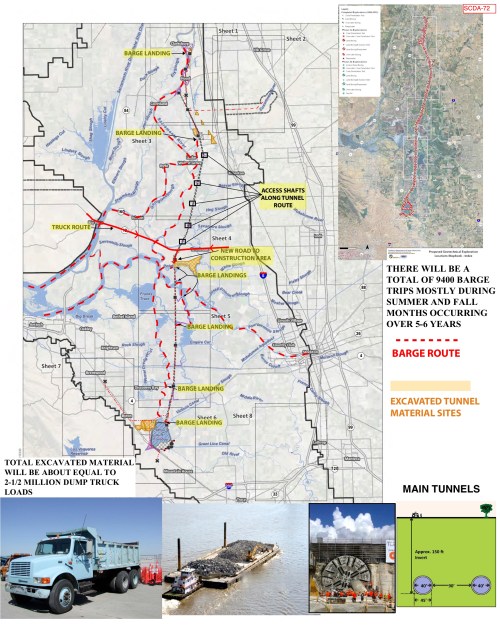
Thousands (yes thousands) of barge trips will occur during the 5-6 year tunnel construction period. Up to eight round-trips per day from Clifton Court Forebay to the various shaft sites.

There is no question that the tunnel project will totally shut down boating and recreation on Delta waterways, closing down marinas and impacting Delta boating communities’ economies.

Below is the analysis of the two-tunnel project. One tunnel will be a shorter construction time but still a lot of barges and the same number of docks, building platforms, and shaft sites.

scda_72-overallroute copy.jpg
Map showing the entire tunnel route including barge landings and barge traffic

Barges in the Delta! Yikes!

Several boaters have had encounters of the close kind with tugboats maneuvering large barges around Woodward Island recently.

In August I posted an Urgent Warning for South Delta Boaters after a friend of mine had “too close” of an encounter with a tug pushing a barge on Twin Sloughs. (The locals call the parallel sloughs named North Victoria Canal and Woodward Canal “Twin Sloughs.” These are high populated recreational lanes for skiers and wakeboarder near Discovery Bay.)

He slowed down but the tug’s powerful props were pulling his Mastercraft towards the barges, twisting it in the water. He said it was very difficult to control.

The barge work since moved to Old River on the west side of Woodward Island. There are several huge barges rafted together there. Old River is much wider, so not as much impact to boaters . . . usually.

What ere they doing? They are doing levee work. The dirt is being dumped behind the levee to widen and strengthen it. They are going in a clockwise direction. When they finished along the south side of Woodward Island (Twin Sloughs), they moved to the west side (Old River). They aren’t doing the north side (the slough along the Santa Fe Railroad trestle) but will do along the east (Middle River).

New Concerns!

We’ve gotten multiple reports from boaters of large power boats having issues with these barges over the past few weeks.

Our friends in a power boat encountered a tug trying to maneuver a barge under the Orwood RR Bridge. Our friend had called Channel 16 for the bridge opening and the tug boat operator, who was also on Channel 16, warned the power boat to stay back. He was having trouble getting his big barge through the bridge opening. Our friend did, and then when clear followed the barge through the bridge.

He slowly followed the barge until it pulled over to the side to tie up with the other barges. Then then passed, but noticed a strong pull from the tug’s powerful engines.

More disconcerting were two DBYC boaters heading north a few weeks ago when they encountered a large barge being pushed by a tug in the center of Old River. It was our President Karen Mann who was single-handing her power boat, following Charlie Weever in his power boat. They debated what to do as the tug and barge filled up most of Old River. Eventually, they had room (barely) to pass the tug and barge. But it was a harrowing experience. They had the depth to pass, but had to watch the rocks on the levee and watch the barge activity. Like other boaters have reported, Karen said it was all she could do to keep her 20,000 pound power boat from being twisted by the tug’s powerful engines. Worse, the tug honked at them. She and I talked about the situation and both wondered, what is the right protocol? Are we supposed to not pass tugs pushing barges? They go very slow. We don’t know where they are heading. What are the rules?

Other Discovery Bay boaters have reported having scary times passing the tugboats maneuvering barges in Old River.

So I did some research and here’s what I’ve found. If anyone has more to add, let me know and I’ll update this blog. But yes, it apparently is allowed to pass tugs pushing barges. But we do need to be cautious.

  • The speed of a ship, towboat or tugboat can be deceptive. A tow can travel one mile in seven minutes — a ship even faster — and it generally takes 0.75 to 1.5 miles to stop. If a water skier falls 1,000 feet in front of a moving tug or tow, the skier has less than one minute to get out of the way. Yikes. Take note!!!
  • Large vessels must maintain speed to steer, and they must stay in the channel.
  • A pilot’s “blind spot” can extend for hundreds of feet in front of tugboats.
  • In narrow channels, a tug’s or tow’s powerful engines can cause a smaller vessel to be pulled toward the tow when passing alongside.
  • “Wheel wash” is a strong current caused by towboat or ship engines that can result in severe turbulence hundreds of yards abaft a large vessel. This is the scary phenomena both our Mastercraft ski boat friend felt but also Karen with her 20,000 lb. vessel.
  • Sailing on inland rivers can be hazardous, and sailors (boardsailors, too) should know that a tow or tug can “steal your wind,” so you won’t have the same wind you started with when executing a maneuver near a commercial vessel.
  • Ships, towboats and tugboats use VHF channels 13 and 16. If you are unsure of situation or their intentions, contact them. Remember, you are sharing the waterways with vessels operated by highly trained and conscientious professionals. If you have a true emergency or need information, they can and will help if properly contacted.

The above was from From: https://www.soundingsonline.com/news/operating-around-tugs-and-barges
Original Source: http://www.americanwaterways.com

That last item was of particular interest to me. I didn’t know we could contact the tug boat operators on channel 13 or 16 and ask them to advise us.

MORE INFORMATION:

TugBoats
https://www.dgif.virginia.gov/wp-content/uploads/operating_near_commercial_vessels_safety_tips.pdf

Cheers to the Coast Guard!

I was concerned when our friends said they were delayed trying to get back to Discovery Bay from DYC a week ago because the Orwood Railroad Bridge over Old River broke down.

BACKGROUND: When we bought in Discovery Bay, we knew that the Santa Fe Railroad line cuts off Discovery Bay and the other marinas and communities at the south end of the Delta) and the rest of the Delta, to Sacramento, the San Francisco Bay and out to the Pacific. There are only two waterways from the very south Delta to the north: Old River and Middle River. Between the two is the Sante Fe RR trestle. There are redundant RR bridges, one at Old River and one at Middle River. The Old River bridge, called the Orwood RR Bridge, typically operates 24×7. Before buying property in Discovery Bay, understood that Discovery Bay was protected by being ever cut off from being able to go to/from the Delta because if the Orwood Railroad Bridge over Old River ever broke down, the alternate Middle River RR bridge would be put into 24×7 operations. Therefore, boaters from Discovery Bay and other areas in the South that are too high to fit under the closed RR bridges, would always be assured that if they took their boats out, they would be able to get home.

RR-Bridges
Map of the location of the two railroad bridges (the Orwood RR Bridge over Old River and the Alternate RR Bridge over Middle River). The Santa Fe line that could, without bridges, cut off boater access between Discovery Bay and the South Delta and the rest of the Delta and to the Pacific.

OrwoodRRBridge
Photo of a boat coming through the Orwood RR Bridge

THEN RECENTLY: I saw emails from our Discovery Bay Yacht Club (DBYC) Fleet Captain about upcoming maintenance work on the Orwood RR Bridge (probably due to the breakdown a few days prior). The fleet captains were checking to see if the maintenance shutdowns would affect any cruise-outs or people going to/from their outings.

I’d always understood that the Alternate Middle River RR Bridge was supposed to go into 24×7 operation whenever the Orwood RR Bridge went down so we had guaranteed 24×7 access in and out of Discovery Bay. However, few years ago when the Orwood RR Bridge went down, I called the US Coast Guard Bridge Chief who was very nice but informed me that the alternate bridge had had a fire and wasn’t operable. That gave me angst. I worried that we may be out on an outing with kids and grandkids and not be able to get the boat home on Sunday night. We would need to find a marina north of the bridge that we could arrange to leave the boat at. That can be difficult if you are moving the boat when marinas may be already shut down. Then finding an Uber driver willing to come to an out-of-the-way location, preferably with two kid’s child seats. With six or more of us, that’s two Ubers and they are not very plentiful in the Delta. Or trying to find a willing friend or neighbor. Not a disaster in the scheme of things, but does make boating a less pleasant outing.

My bigger fear was if there was no real commitment to ever fixing the alternative, then if there was a massive breakdown, did Discovery Bay and other south Delta boaters face the possibility of being cut off from the Delta for long periods of time? If that was the case, that would be a real hit on our home values and economy. But the Bridge Chief said they were going to repair it so I figured it was a short-term issue.

So now, years later, the issue came up again and it didn’t seem the Alternate Bridge had swung into operation. I was surprised. I reached out to the Bridge Chief again. What a prompt, nice email I received in return! I was impressed. He even apologized if the prior breakdown had given boaters issues. The USCG are the boater’s friend.

I’m happy to report that the Alternate RR Bridge is available. I didn’t know it, but the Bridge Chief said it’s always available with 12-hour notification. Whew! That is a relief. In addition, the Coast Guard has committed to open the alternate on demand if Orwood is down and inform Discovery Bay boaters about any outages or planned maintenance. How nice.

My real estate friend said she’d get that information spread to other agents. It’s a good selling point for Discovery Bay homes – that the US Coast Guard has a commitment to supporting boaters going in and out of our area.

This isn’t the first time I’ve been impressed with the RR Bridge operations. I think, and I’ve heard others agree, that the Bridge Operators are the nicest we’ve encountered anywhere in the Delta. They are always so polite, treat boaters with respect, and really seem to care about our convenience. Some other bridges are known for operators who grumble when they are requested for a bridge opening (even though that’s their job). But the RR Bridge operators are always apologetic if a train is coming and they need to make a boater wait. Whereas there’s no complaint from boaters – we certainly understand they can’t be opening the bridge when a speeding Amtrak is coming through.

A cute story about the Bridge Operators.

About ten years ago, our friend was selling his power boat to buy a sail boat (in preparation for one day sailing around the world. He and his wife are currently starting their eighth year of their circumnavigation journey). He was planning on keeping his new sail boat at Discovery Bay during the summer months, so we could anchor together at Mildred for weekend raft-outs.

Bringing his power boat back to Discovery Bay to sell it, Brian radioed the Orwood RR Bridge operator with a question: “Can your bridge accommodate a sail boat with a 70 foot mast?”

The bridge operator, with a proud voice answered, “Yes sir! My bridge can go ‘vertical’!” He sounded like he was beaming.

And it does. Whenever we’d take the boats out during the summer, Brian would radio, “Orwood Railroad Bridge. This is the vessel Persephone. We are a sail boat with a 70 foot mast. Can you take your bridge vertical?”

The bridge operator would respond, “Aye, aye Captain. Going vertical!”

That was always fun.

One day when we approached the bridge from the south, there were multiple maintenance personnel in bright orange vests, swarming over the partially opened bridge. Brian radioed the bridge operator requesting a vertical opening. But the operator replied, “I’m sorry, Captain. But we are doing some maintenance here. You will have to squeeze through.”

Brian did a little gasp, knowing the clearance was in no way sufficient for his mast. Immediately the bridge operator came back on and said, “Just kidding, Captain. Going vertical!” (I think the railroad bridge operators enjoy their work.)

September Activity Report

I had a nice vacation in September to see the Fall Colors on a cruise from Quebec, Canada, down the St. Lawrence Waterway, with stops in the Maritime Provinces then on to Bar Harbor (Maine), Boston, and New York City.

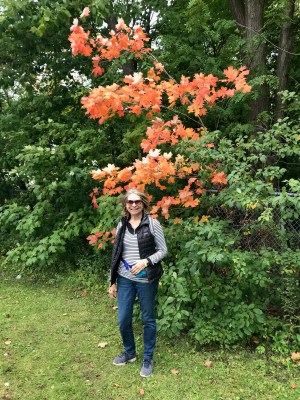
Although it was advertised as a “Fall Colors Cruise,” there weren’t really any “fall colors” yet. It was still too early in the year, except for this one tree:
IMG_1697

Meanwhile, here on the Delta, a lot was happening. I have updated our Events Tracker page. That’s a page that has kept track of all of the activities related to the Delta since August 2009 when we found out about the Two-Gates Fish Protection Project, and shortly thereafter the Peripheral Canal/Delta Tunnels effort.

Since people don’t often check that page unless there is something specific they want to look up, here’s what happened in September:

  • Sep 17 – Delta Conveyance & Construction Design Authority (DCA) announces the formation of a “Delta Stakeholders Engagement Committee.” Immediately, there is an objection from STCDA and other concerned groups that the DCA is run by the water contractors (thus is hardly an independent agency).
  • Sep 17 – STCDA writes to Wade Crowfoot objecting the Stakeholders Committee reporting to the DCA, an agency run by the water contractors. Wade crowfoot responds.
  • Sep 19 – Newsom vetos SB1, the bill approved by the legislature to counteract the Administration’s roll-back of environmental protections.

    Response from STCDA: “We are very disappointed in Governor Newsom’s decision to bow down to the Trump administration’s roll back of environmental protections for the Delta and its fish species. SB 1 would have guaranteed the continued existence of environmental protections, including restrictions on over-pumping of Delta water for export. SB 1 was good for fish and for the people who live and recreate in the Delta. The veto causes us to question whether the new Governor’s supposed commitment to take concerns of Delta stakeholders seriously is genuine.”

  • Sep 19 – Karen Mann, President STCDA, is accepted on the Delta Stakeholders Engagement Committee. Even though we object to the process of having the Stakeholders reporting to the DCA (an agency run solely by the Water Contractors), Karen took a seat at the table to keep us involved with the activities.
  • Sep 26 – Disappointed in Wade Crowfoot’s response and decision to move ahead with the Delta Stakeholders Engagement Committee as part of the DCA, STCDA issues a letter of concern to Erik Vink, the Delta Protection Commission.
  • Sep 30 – Various groups oppose the Voluntary Agreements (VAs) being proposed as an alternative to increasing the Delta Flows. California Water Research details the issues with VAs.

Prioritizing Levees for Exports over Delta Communities

Please email your comments to the
Delta Stewardship Council, oal_amendRRP1@deltacouncil.ca.gov
today or early tomorrow, before their 1 p.m. Delta Levees Investment Strategy meeting. Tell them you object to prioritizing the water export levees over Delta communities and schools, exports over people.

What’s happening?

The Delta Levees Investment Strategy regulations target state funding for upgrading levees on 17 “Very High Priority” islands in the Delta (out of 144 total.) Under the proposed regulations, state funds can be spent for upgrades to the 36 “High Priority” and 91 “Other Priority” Delta islands only after all the levees on the 17 “Very High Priority” Delta islands are fully upgraded.

Funds are not anticipated for Discovery Bay, population 15,525, and Rio Vista, population 9,009, and which are second priority for levee improvements. And the Delta legacy towns of Clarksburg, Courtland, Locke, and the eastern bank of Walnut Grove are the lowest priority, even though Clarksburg and Courtland have public schools. (Walnut Grove is on both sides of the Sacramento River.)

What is getting higher priority than Delta towns and schools? Islands marked as “critical for Delta exports,” and most of those have low populations, if any. Why aren’t the State Water Contractors paying to protect their infrastructure?

See the maps.

According to the article below, Central Delta Water Agency attorney Dante Nomellini Sr. noted that as a result of the rigid regulations, no, or almost no funds will be available for improvements to “High Priority” Delta islands, and none for “Other Priority” Delta islands. Thus the proposed regulations basically defund levee upgrades on 88% of Delta islands. For this reason, the Delta Levees Investment Strategy is opposed by the Central Valley Flood Control Association, the Delta Protection Commission, Central Delta Water Agency, Local Agencies of the North Delta, many Reclamation Districts, and the California Farm Bureau Federation, as well as California Water Research and Delta Defenders.

If you want to attend the meeting in person, it’s Thursday August 22. The hearing will start at 1 pm at the Park Tower Plaza, Second Floor, 980 Ninth Street Sacramento.

Write to the
Delta Stewardship Council, oal_amendRRP1@deltacouncil.ca.gov
today or early tomorrow, before their 1 p.m.

Read more from the California Water Research.

Fighting to Save the Delta as a Place, Fighting Construction Destruction

Governor Newsom is looking at a single tunnel option.

Some at the negotiating table are still failing to recognize the effect a through-Delta tunnel construction project would have on the Delta itself. On the Delta as a Place.

Let’s be clear: Construction destruction along a through-tunnel route will ruin the Delta communities, highways, waterways, and farms (from the north to the south) in all five Delta counties: historical towns in Sacramento County (Hood and Locke) and in Yolo County (Clarksburg), farmers in Solano County (Rio Vista), boating communities in Contra Costa County (Discovery Bay, Bethel Island), tourism, marinas, and water ways in San Joaquin County (Stockton and South Delta marinas).

Whether the water quality impacts of a single tunnel can be proven by the water contractors to be acceptable for the Delta environment or not, the fact remains that if a huge tunnel is built along the current through-Delta route proposed by the Department of Water Resources (DWR), construction destruction will rip up the entire Delta for years, from Hood in the north to Clifton Court Forebay in the south, leaving smelly tunnel muck in its wake.

This is not protecting the estuary!

The only way to protect the estuary, the legacy towns, Delta communities, waterways, waterfowl, fish, and farmers is to locate the destructive construction project around the Delta, not through it. Or, better still, abandon the effort altogether.

In December 2018, we won the battle!

Save the California Delta Alliance’s Legal Council, Michael Brodsky, successfully exposed the issues with the through-Delta-route as well as the water quality impacts. He did so for three years, arguing brilliantly and bringing expert testimony to the State Water Resources Control Board (SWRCB) tunnel permit hearings. The testimonies forced the SWRCB to defer on approving the tunnel permits until the Delta Stewardship Council (DSC) first approved the plan “consistent” with the Delta Plan. (Being consistent with the Delta Reform Act and the Delta Plan is a requirement for any project that affects the Delta.)

The Delta Plan has two co-equal goals, one of which is to “Protect the Delta as a Place.”

We proved the tunnel plan to be inconsistent with the Delta Plan:

  • It was proven that the location of the pumping facility and intakes would cause blight to the legacy communities in the north, the historical communities the Delta Plan is to preserve.
  • It was proven that gridlock on every Delta highway would occur from the construction traffic flooding into the small 2-lane rural levee roads, shutting down highways required for commuters, stopping goods from being delivered to Delta communities, and stopping Delta farm products from being able to be trucked out. A burden on the communities that could not be mitigated.
  • It was proven that the inundation of barges, construction docks, pile driving, etc. would virtually end tourism and boating during the duration of the project, still estimated at least five to six years, causing economic ruin to a significant number of marinas and related businesses. The Delta Plan requires preservation of recreation and boating.
  • It was proven that the barge traffic would require highway bridges to open that now never do due to commute traffic and/or the age of the old historic bridges; threatening to destroy historic bridges plus causing more commute gridlock.
  • It was proven that muck ponds would cause long-term impacts to Delta communities, marinas, and farms.

It seemed obvious that the project would need to find another route, if it were to continue.

The DSC Staff listened, and recommended that the tunnel plan not be approved as “consistent” with the Delta Plan. In the Staff’s recommendation, they cited the compelling statements made by Michael Brodsky about the construction destruction – throughout the Delta.

The DWR then pulled back their permit request. That should have been the end of the through-tunnel route.

But after a hiatus, work is continuing (drilling and design efforts) along the same, flawed route.

Construction destruction to the Delta would be avoided by going around the Delta, instead of through it.

One of the DWR’s alternative routes was the Eastern Route. There may be additional issues with that alternative. And even if an alternative route is shown to be a good plan, proof that the exported water would not continue to damage the fisheries would still need to be proven.

Bottom line: The through-Delta route is totally unacceptable.

And the fight continues.


Blog Stats

  • 126,141 hits

Support the STCDA

Sign up for Emails

Sign Up Now

Request a New Lawn Sign

Click Here to send an email to the lawn sign committee.

Receive news blog via email.

More Blogs

Educational Books about the Delta

Sassy the Salmon
and
The Fable of the Farmer and the Fish
All ages: K and above
Proceeds go to STCDA