Archive Page 38

Conflicting Needs

Two recent news articles (both by Dan Batcher) illustrate the conflicts behind the Delta Issues. On the one hand are the water contractors who want more and more water for the Central Valley corporate agribusinesses that have been expanding, in particular, almond growing for Asian markets. On the other hand are the needs for the same water by Delta Farmers and Commercial Salmon Fisherman. Read on for an update on those two articles, why we care about salmon, and other recent events including Tuesday’s Senate Hearing on the Bay and Delta Conservation Plan (BDCP).

We haven’t heard much about the plight of the Salmon Fishermen since the closure of Commercial Salmon Fishing off the coast of California and Oregon in 2008 and 2009, but Dan Batcher’s May 15th article gives us an update.

May 15th – How the Lack of Fresh Water Flows is Impacting Salmon and the Salmon Industry

May 15, 2013 – (From Dan Batcher’s article): “As Governor Jerry Brown continues to push for the construction of the peripheral tunnels under the Bay Delta Conservation Plan (BDCP) a new analysis released on May 13 by the Golden Gate Salmon Association (GGSA) and the Natural Resources Defense Council (NRDC) reveals that the salmon fishery is limping along at only 20 percent of the population goal required by state and federal law.”
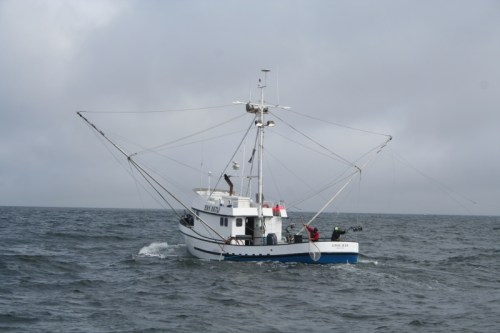
“The landmark Central Valley Project Improvement Act (CVPIA), passed by Congress in 1992 under political pressure from a big coalition of recreational anglers, commercial fishermen and environmentalists, set a goal of rebuilding salmon runs to almost a million adult fish by 2002.”

“‘More than a decade past the law’s deadline, the salmon fishery continues to struggle due, in large part, to excessive pumping of fresh water from the Bay-Delta that deprives salmon of the cold, flowing rivers and healthy habitat they need to thrive,’ according to a joint Press Release from GGSA and NRDC.”

“The groups say if current laws were enforced, a restored salmon fishery would ‘generate billions in new revenue and add thousands of jobs from Santa Barbara to northern Oregon. These jobs are tied to commercial fishing men and women, fresh and salt water recreational anglers, coastal communities, tribes, fish processors, equipment manufacturers, marinas, and food and hospitality services.'”

“Recommendations
State and federal agencies can step-up their efforts to restore salmon by acting on the following recommendations:

  • The Department of the Interior should reform Central Valley Project water contracts and revamp its salmon rebuilding efforts in response to a scathing independent review. Specifically, Interior should better manage water and restoration funds dedicated to salmon recovery, incorporate the latest scientific information and appoint a manager to be accountable for the progress of the restoration program.
  • The State Water Resources Control Board should set stronger standards to protect salmon in the San Joaquin River and the Bay-Delta ecosystem, in proceedings to revise these standards that are currently underway.
  • The California Department of Water Resources should incorporate salmon doubling into the Bay Delta Conservation Plan process.
  • The California Department of Fish and Wildlife should launch an ambitious state salmon restoration effort.
  • The U.S. Department of the Interior should aggressively implement NRDC’s agreement to restore the salmon run on the San Joaquin River.”

“The construction of the 35 mile long twin tunnels under the Delta could hasten the extinction of Central Valley chinook salmon, Delta smelt and other fish species, according to state, federal and independent scientists.”

“Other threats to salmon recovery include Congressman Jim Costa’s legislation (see next report) to exempt the Central Valley and State Water projects from Delta pumping restrictions required under the Endangered Species Act to protect Central Valley salmon and Delta smelt” (see next section below).

Read the entire article Dan Batcher’s article “Bay-Delta salmon population just one fifth of mandated goal”.

May 12th – Desert Agribusinesses Attack the Salmon

Meanwhile, They’re at it again! On May 12, 2013, Congressman Jim Costa (D-CA) introduced legislation to exempt the Central Valley and State Water projects from Delta pumping restrictions required under the Endangered Species Act to protect Central Valley salmon and Delta smelt. See Dan Batcher’s article “Costa Introduces Legislation to Strip ESA Protections for Delta Fish” for more details.

This is reminiscent of the addition to the Senate Jobs Bill attempted by Sen. Feinstein in February 2011 to suspend the Environmental Species Act (ESA) protections for Chinook salmon and mandate certain pumping regimes from the Delta. That line item to the Jobs Bill was in response to a request from Feinstein’s friend and Paramount Farms’ owner, Stewart Resnick.

“The current Costa bill is supported by San Joaquin Valley water districts, including the Westlands Water District, Friant Water Authority, and the San Luis and Delta Mendota Water Authority. Other backers of the bill include the Latino Water Coalition, an agribusiness ‘Astroturf’ group, and [of course] Paramount Farms, owned by agribusiness tycoon Stewart Resnick, the largest orchard fruit grower in the world.” Many of these are the same agencies that we are supposed to entrust with protecting the Delta through adaptive management of the new pumps.

Meanwhile, Dick Haggerty, in the Modesto Bee on May 14th lamented that “It is so sad to drive down Interstate 5 in the southern portion of our valley and see miles of dead and dying orchards, all sacrificed to the migration of a few thousand silvery fish” and he goes on to describe the “beauty” of driving south where “it seems you never will leave the sight of almond orchards. They border our highways for hundreds of miles” and “the appearance of cotton fields somewhere south of Merced…those fluffy white fields.”

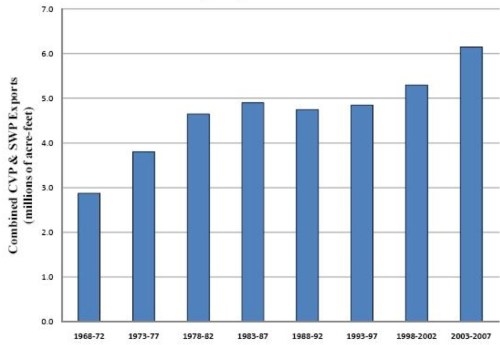
Hello – Mr. Haggerty may love to see almonds everywhere but the increase in almonds growing in the desert has been what has caused the increase in water exports from the Delta south so that today, the typical yearly exports are more than half of the river’s water versus the more reasonable level of less than 50% during the 80’s and 90’s. Growing water intensive crops like almonds and cotton in the desert is what is causing the water crisis.

And let’s go back to Mr. Haggerty’s prior statement “all sacrificed to the migration of a few thousand silvery fish.” Let’s talk about those fish.

Salmon – A Keystone Species

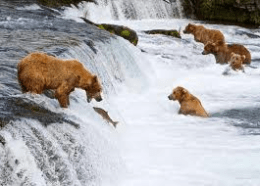
Salmon are a keystone species. Keystone species are those that are key to a multitude of other species. Without them the ecosystem would unravel. This is not an environmentalist’s exaggeration, but scientific fact.

Watch the video about the salmon crisis in British Columbia to learn how important salmon are. It’s over an hour long but if you even watch the first part, it identifies the key role salmon play in the ecosystem. http://player.vimeo.com/video/61301410?autoplay=1.

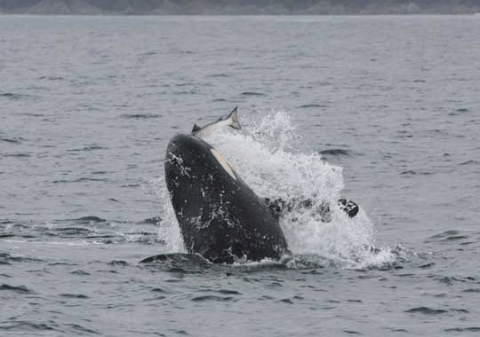
When you see the pictures of the dead salmon on the Frazier River you can understand the concern raised in the video. The salmon in B.C. are being killed in mass from diseases from the fish farms and what happens in Canada will effect Washington and drive hunting whales south. Likewise what happens to the Sacramento King Salmon run effects all of us from California to Southern Washington and continuing to export water at the current level is causing their demise.

Who needs salmon?

The Controvery is on-going

May 13th Kate Poole, NRDC, blogs “A Healthy Fishing Industry Is Just One of the Benefits of Strong Endangered Species Protections” echoing the recommendations made by the NRDC.

An interesting exchange is provided in the comments when a constant commenter, Mike Wade, from the California Farm Water Coalition, tries to dispute that improved delta fresh water flows would really help the fish but his remarks are easily refuted by both Kate and another reader.
The Fox are Guarding the Henhouse

Adaptive Management – Sounds like a Good Approach on the Surface

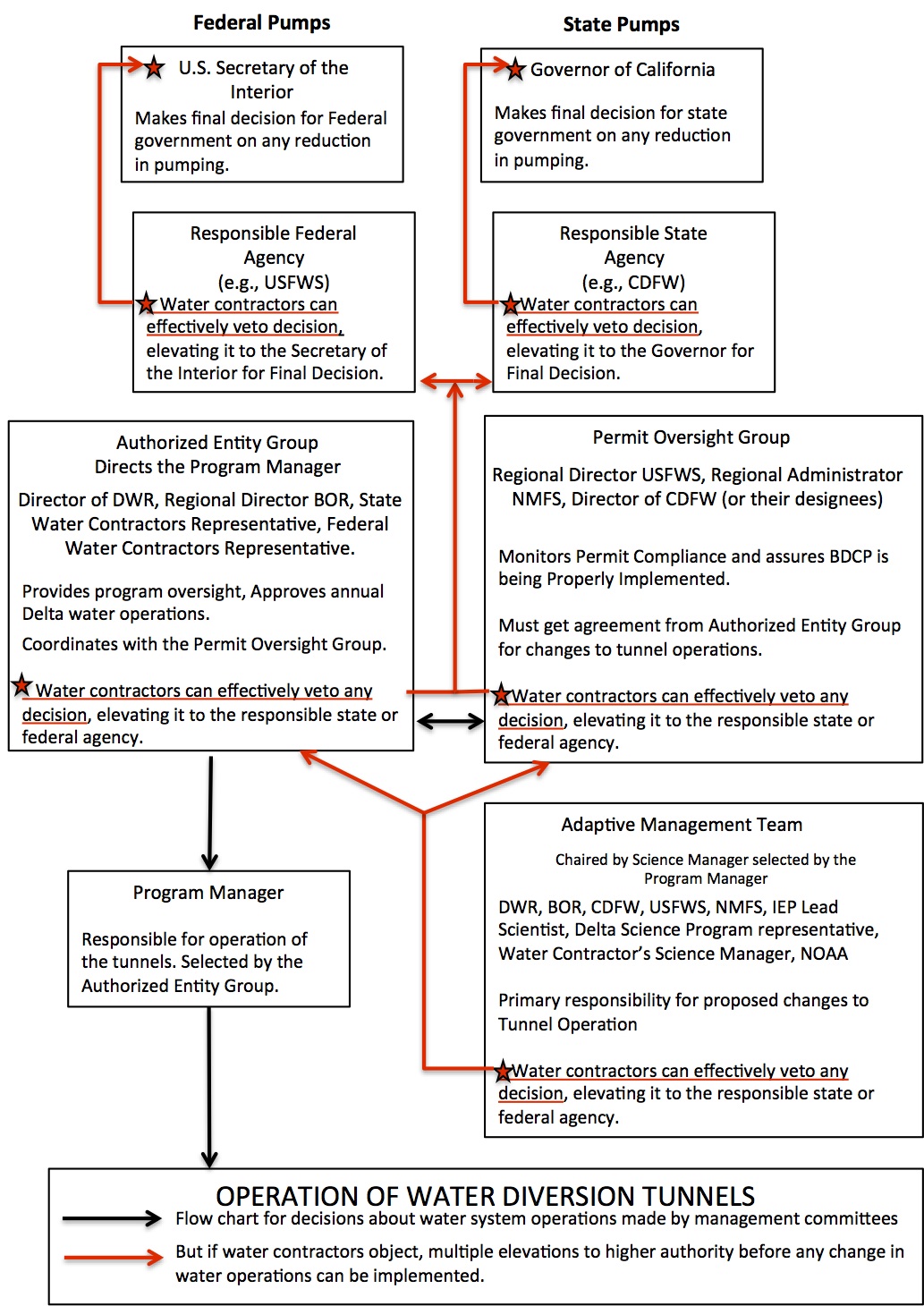
The BDCP claims that they won’t harm Delta waterways because of a new adaptive management approach to water operations. Several management teams will oversee tunnel operations. The California Department of Fish and Wildlife (CDFW) and the U.S. Fish and Wildlife Service (USFWS) will also have seats on the management committees. An Adaptive Management Team will monitor conditions in the Delta and make recommendations for changes in water operations based on any ill effects that might crop up.

Will it work?

No – because no matter what harm the tunnels might cause, it will be virtually impossible to curtail water exports once the tunnels start operation. Because the main backers of the tunnels, the water contractors who will receive water deliveries from the tunnel and sell the water to their urban and agricultural customers, have seats on key committees and can veto decisions they don’t like escalating the decision all the way to either the Governor of California (for the State pump decisions) or the U.S. Secretary of the Interior who reports directly to the President (for Federal pump decisions).
FoxInTheHenhouse

No – That Won’t Work

“What that means,” said Michael Brodsky, Save the California Delta Alliance General Counsel, “is that if the top official at the U.S. Fish and Wildlife Service makes a decision about protecting Salmon that the water contractors don’t like, they can cause the decision to be appealed up and up and up the ladder all the way to the Secretary of the Interior. That will take years at best.”

“In the mean time, the fish suffer.”

For more information, see the April 3, 2012 STCDA Press Release.

Save the Farmers AND the Delta

Listening to the video tape of the March 20th BDCP Public meeting, I heard the comment from a farmer who had found out 4 days prior that the state planned to turn his farm into a “muck” farm. His comments followed a statement by Jerry Meral, Deputy Resources Secretary for the California Natural Resources Agency who chairs the BDCP public meetings, who claimed that they “really” weren’t taking that much farmland out of production for habitat restoration. That the main habitat restoration was north, much near the Yolo Bypass, and the impact was only about $1 million to ag.

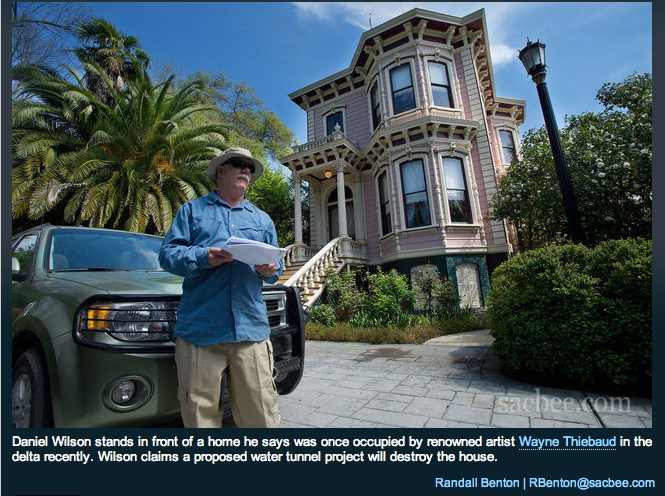
But Delta Farmer Daniel Wilson on Andrus Island countered that claim. “I have two muck sites on my land probably destroying $6 million a year – my fruit packing facility, orchard, and home once occupied by a renowned artist.” (Their beautiful house is shown below.)

FarmerHouse2_SacBee FarmerHouse_SacBee

He also added, “Another point, you are probably going to distroy the town of Walnut Grove because you’re putting a 3.5 million yard leaching plant upwind of the town.” (A town that is listed in the Delta Plan as one of the Delta “Legacy” towns to be preserved and protected.)

Construction and “Muck”

This caused me to wonder what this “Muck” was all about (BDCP term, not ours). What I discovered was very distressing. The route of the Delta Tunnels is right through the heart of the Delta. During construction, they are building 50×300 foot docks – definitely impacting boat transit and any water skiing activity. The will be bringing in transmission lines and lights and pile drivers.

One construction site is on Bacon Island right next to the largest, most popular anchorage in the Delta – Mildred Island. Construction, night lights and pile driving all night all summer – from June 1 to October 31 for who knows how many years. The nighttime lights and pile driving is likely to be easily heard from the smaller but also popular Horseshoe anchorage on Connection Slough. I didn’t get an answer to the question if boating will be affected. But google earth shows prime farmland on Bacon Island. It sounds like in addition to flooding Islands for habitat restoration projects, farms will be disrupted for years during construction.

After construction, they are leaving piles of muck (dirt mixed with foaming agents, chemicals and polymers), hundreds of acres destroyed along this path. In total, approximately 1,600 acres will be covered by piles of smelly muck.

This muck is so bad they need to build a retaining dike around them to “ensure containment” and a complicated system to leach out the toxins. They store the muck in an impervious liner to be sure it doesn’t get into the ground water. I’ve been told that this type of removal and treatment normally requires removing the substance far away from cities and to be professional managed, not just left here and there throughout our Delta, on Delta farms, homes and operation facilities. Will farmers even be able to still farm those lands that remain with this big pile of mess in the middle, roads to it, 60 foot wide shafts down to the pipeline 100 feet below? The Bacon Island muck pile is just upwind of the Mildred Island Anchorage, near Horseshoe Anchorage and not far from Tinsley Island. These waterways are the primary sloughs for weekend boaters, fisherman and water skiiers. I’ve heard this kind of muck dump is like living next to sewage dump.

Smelly Muck next to Discovery Bay

In addition to the smelly site near Walnut Grove, one of the largest sites is about a mile east of Discovery Bay, on Victoria Island farmland, for the entire length of the city! Right in our own back yard. A smelly wastage dump right next to the most populated Delta boating community.

And what if the muck ponds leak? Will toxins get into the ground water or run off into the Delta? The leaching process is to dry it out. What is left afterwards? Dusty remnants blowing our way? Will it contaminate Discovery Bay’s drinking water?

These are some of the many questions that I wanted to go to the April BDCP meeting to ask.

The Plight of the Farmers

In the March 20 meeting, Delta Farmer Daniel Wilson had asked an obvious question: “Why is it going through Grand Island, Tyler Island when it could be Stone Lakes Refuge or Statton island where there are no capital improvements? Do it on public property, not private citizen’s property. I didn’t find out until 4-5 days ago when I saw it on a blurry map! Right now my house is under 20 feet of mud. Another point, you are probably going to distroy the town of Walnut Grove because you’re putting a 3.5 million yard leaching plant upwind of the town.” (A town that is listed in the Delta Plan as one of the heritage Delta towns to be preserved and protected.)

Jerry Meral gave a comment that is becoming similar to many of their responses: “Nothing is final. When people down near Courtland said the forebay is in a bad place, we took that pretty seriously and we ended up proposing to move the forebay to an area that may not welcome it but the impacts will be less. I would like to meet with you directly, go down and see the land.” In other words they are reasonable people, they are willing to be educated and flexible.

It didn’t sound that way when at the March 20 meeting a farmer specifically raised the question about what happens if the BDCP decides that a particular piece of property was needed for habitat restoration and the seller is unwilling to sell and was told that it was within the bounds of the project to use eminent domain to take the property. A farmer later questioned the entire premise of removing farmlands to save the fish. “But farming coexisted with the salmon for years, they flourished with the farming until the 60s and the State Water Project. It is not the farming, it is not the levees, it is the pumping.”

At the April 4th meeting another farmer asked when they would know for sure what lands were at risk. He was told plans could still be changing for a couple of years. He needs to plant vineyards this year – what is the risk? No answer. He asked what if the farmer was unwilling to sell. This time Jerry Meral avoided saying anything about eminant domain. The farmer left the podium with his head down, almost grieving.

A Clifton Court Forebay farmer who is also a school teacher complained that Clifton Court Forebay already put their farms underwater and more is at risk from this new project. Her story of being ignored by the state when their pumping facility caused damage and issues for their current farmlands was heartbreaking. She complained that her classroom is underfunded, it’s a struggle to teach and asked where is the money coming from? We need it in the schools.

Jerry Meral gave one of the standard answers including an air of being totally reasonable, surprise that there could be issues affecting people from their current plans and the offer to come meet with him and he’s sure something can be done to help her current problems with the pumps. As far as the schools, Jerry responded saying well, he couldn’t take money from the BDCP and support the schools. However, that wasn’t actually a truthful question, at least from what we know so far (the later chapters will spell out the funding plan). But to-date the plan has been for the water rate payers to ultimately pay for the tunnel pumping/operations. But the habitat restoration and mitigation would be from a new state water bond. Remember the water bill that Governor Schwarzenegger took off the ballot in 2008 because it would have been voted down and again it was removed from the 2010 ballot? Currently it is misleadingly titled “Safe, Clean, and Reliable Drinking Water Supply Act” planned for the 2014 ballot. That bond is what they plan to have voters vote for to do the actual beneficial side of the BDCP plan. Bond funds that would come out of the General Fund, and yes, take away from the schools. So the farmer was exactly right – it will come down to saving the Delta from the continual and expanded destruction of pumping versus schools.

Plus why after spending hundreds of millions of dollars creating this BDCP plan is it the case that they have no clue about what exists in the Delta: where the farms and homes are, where the cities are, where the scenic waterways are. Why are they waiting for farmers and citizens to read through their thousands and thousands of pages of plan to alert them to the issues?

The plight of the farmers and more pictures is in the Sacramento Bee:
Article: http://www.sacbee.com/2013/04/07/5322193/state-water-tunnel-plans-call.html
Photos: http://www.sacbee.com/2013/04/06/5321873/delta-farmers-concerned-about.html

Impacts including the Boating Community:

At last Thursday’s BDCP (April 4), Chapter 4 describing the construction and muck was to be one of the chapters reviewed at the April 4th meeting. Save the California Delta Alliance met before the meeting and car pooled there. The BDCP reviewed Chapter 4 and called for questions. I was confused because they had not mentioned the words “Construction” or “Muck” in their overview about what Chapter 4 contained. So I raised my questions anyway. Why does the tunnel go through the heart of the Delta? Didn’t they know they are putting a major construction site right next to the most popular anchorage in the South Delta? And leaving a smell muck pile afterwards? And a bigger muck pile next to Discovery Bay! Is it toxic? What if it leaks? What is the risk to our drinking water? etc., etc.

Jerry Meral gave a variation of his standard answer/non-answers – that the exact location of the tunnel and construction is not set in concrete. All will be well.

ConstructionMildred
South Delta impacts from the Construction: Bacon Island/Mildred Anchorage site

Muck!
South Delta Muck Dump Sites: Upwind from Mildred and one just East of Discovery Bay

DBMuck_Distance
And how close will it be? Less than 2 miles from the DB Yacht Club

What good is the “Delta Plan”?

The Delta Plan is supposed to protect the Delta. It is supposed to protect the “Delta as a Place” including communities and farmlands. It has wonderful sections describing the beauty of the waterways best enjoyed by boat, the tranquil anchorages. The sloughs around Mildred and Connection slough are favorite ski runs. Yet they have decided construction should go down the middle. For those of us in the South, they really picked the our favorite waterways for their tunnel building disruption which could go on for years.

The Delta Plan says it recognizes the “Delta as a Place” and boating as an important aspect of the Delta. They talk about the cost benefits of additional recreation in the Delta. Yet this could very well remove our largest, most popular anchorage in the south Delta. Incredible!

Save the California Delta Alliance (www.NoDeltaGates.com) is based in Discovery Bay and working to protect boating, Delta farming, and local community interests for the entire Delta. We would love to have more boating and farming groups contact us to join forces against the Delta Tunnels and all related impacts harmful to our area.

Email Jan McCleery at stcda@nodeltagates.com to get on our mailing list. Let us know if you want to volunteer to do more. Together we can make a difference!

April 4 – Some Changes

We don’t have enough sign-ups to order the buses, but we will have a good showing to attend the meeting and show our concern.

Because there’s only 12-15 of us, we’re changing our game plan and won’t be bringing the signs to this meeting or have a noisy group outside with photos and news reporters. We’d need one or two buses to make a noisy showing. We know a large number of our community want to go – we think we aren’t giving people enough notice and need the buses. So we are going to start taking sign-ups now to do the buses for the next meeting – date not firm but listed as the week of May 6th.

But first, this Thursday, April 4th: We will be there.

Everyone who can should still attend the meeting. At the last meeting, the BDCP asked everyone attending to state their name and affiliation (i.e., Discovery Bay resident or member of Save the California Delta Alliance) so having a group in the audience is still great and shows our interest and concerns and we can cheer/applaud for comments we agree with.

The meeting time is now from 1-5 PM
(previously was 1:30 – 4:30).


1:00 PM Red Lion Hotel Woodlake Conference Center, 500 Leisure Lane, Sacramento, CA 95815

Pre-meeting and Carpooling from the Boardwalk Grill at the Discovery Bay Marina: Michael Brodsky (our legal council) and I will be at the Boardwalk Grill an hour early (10 AM) to brief anyone interested on talking points. We will leave in car pools at 11:00 AM to give us time to get there on time and get seats (the last meeting was crowded). If you plan to meet us and haven’t emailed me, please let me know.

10:00 AM to meet ahead and discuss talking points
10:50 AM to form car pools and leave at 11 AM.

Boardwalk Grill: 5879 Marina Road, Discovery Bay, CA 94505.

As far as getting on the buses …

We think that part of why we aren’t getting the sign-ups is the short notice (or maybe it is because it is during the working day?)

Email me if you would have gotten on the buses this week but couldn’t and why (work, too far, already had other plans/too short a notice, etc.) If it was because the meeting was during the day, what would be better (6:30 some evening or on a Saturday morning). We want to get you all to a meeting or get a meeting to come here to us!

The next meeting will be the week of May 6th and will likely be mid-week during the day in Sacramento. Email me if you want to be counted to “GET ON THE BUS”. We need 40 to hire one bus and it would be great to have at least two buses headed up!

Email Me:

  1. Let me know if you want to meet in Discovery Bay to carpool April 4th and haven’t already responded. Right after this email I’ll mail the current list of attendees to form car pools and see if people want to meet an hour early for talking points.
  2. Let me know if you wanted to go April 4 but couldn’t and why (time, distance, no bus, etc.)
  3. Let me know if you are going to “get on the bus” the first week of May (time/place to be announced but likely during the work week

Jan McCleery, President
Save the California Delta Alliance

Ho, ho, the Tunnels must Go!

The public meeting of the BDCP is Thursday April 4 in Sacramento.

Car pools are being organized in Discovery Bay – 11 to 11:30 at the Boardwalk Grill to meet and drive up. The meeting is from 1:30-4:30 pm at the Red Lion Woodlake Conference Center, 500 Leisure Lane, Sacramento. We need to show we are against the entire tunnel idea!

The 2nd set of BDCP chapters were released yesterday. Just more of the same. Everyone knows that over exports is what is causing the demise of the salmon. It’s the amount of water being removed. That is what the State Water Board’s Delta Flow report stated in August 2010. But it was the wrong answer for the Delta Stewardship Council and the BDCP. Charlton Bonham, director of the state Department of Fish and Wildlife claimed “An immense amount of science has gone into the (plan).” That may be – but it’s bad science if it ignores the key parameter: “How much water does the Delta need?” And the answer is “More than it’s getting today.”

On Capital Public Radio, Amy Quinton reported that

    The new chapters of the Bay Delta Conservation Plan look at the effects of the project on endangered species like Delta Smelt and Chinook salmon.

They are progressing with their same, unscientific proposal to continue to take too much water out of the Delta, flood some islands, and want us to believe there is scientific evidence that then the fish will be happy.

Habitat restoration alone can’t save the Delta

I agree with Bill Jennings:

    Bill Jennings with the California Sportfishing Protection Alliance is highly critical of the project.

    “You can’t deprive an estuary of half its flow and expect it to survive. And frankly, BDCP is essentially a death sentence for one of the great estuaries in the world.”

    Jennings says the proposed tunnels to pump water south would have disastrous effects on fish populations.

Who will pay for habitat restoration and for damages?

In a Mercury News article Paul Burgarino’s report identifies the “catch”:

    Plans call for creation of more than 140,000 acres of new habitat — floodplains, tidal marshes and grasslands — from existing Delta islands at a cost of about $4 billion to be footed by taxpayers.
  1. First, new habitat will not help fish if the water is salty and polluted.
  2. Second, new habitat will not ever be created if the “bill” is from bonds in place of schools or higher taxes. That’s right. The BDCP funds only cover the construction of the new tunnels. The rate payers will have to pay for the higher operational costs of the tunnels. And there’s no money identified for habitat or environment restoration. That will need to be voted on as new bonds or higher taxes!
  3. Third, other estimates claim the amount for just purchasing proposed habitat restoration acreage will be $9 billion, not $4.

And who’s land will they be flooding, anyway?

Jerry Meral at the last BDCP Public Meeting said that if the farmers are unwilling to sell their lands, the state would use eminent domain to take them.

And why?

The BDCP plans to force farmers to sell and then flood their fertile delta farmlands, farmlands that take half the water as desert farms down south, so that mega-corporation farmers living in Beverly Hills and Pacific Heights can get subsidized water and continue to increase the acerage of water-intensive crops like almonds and re-sell their subsidized $20/acre foot water to Mojave Desert developers at $5,000/acre foot. When these huge corporations are making so much profit from Delta water, what will stop them from wanting more and more?

The state can’t afford more almonds and other water-intensive crop expansion!
STOP TAKING OUT TOO MUCH WATER!

The big agri-business corporations have been expanding their water-intensive almond acreage for years (the past 10-15) which is directly responsible for the last 10-15 years’ increase in exports. That has also been compounded by the loss of the Colorado River water for LA but the most significant driver behind the increase is the big corporation almond farms. The increase moved the pumping from “excess” to “too much”, the river reversed flows, and the salmon and other fish populations collapsed.

Isn’t it intuitive?

The amount of acerage of water-intensive almonds goes up:

The amount of water exported goes up:

The salmon decline:

What about our water fowl?

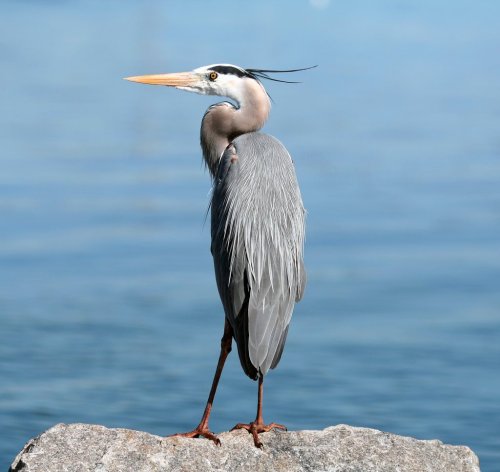
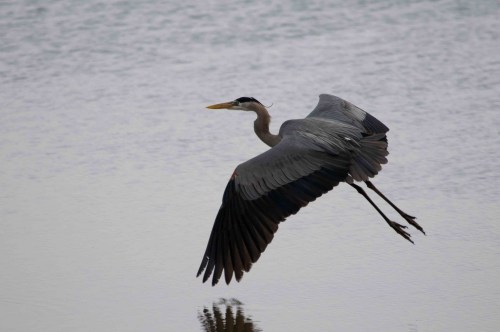
Here’s what really gripes me. I love sitting on my back deck and watching the waterfowl. In last week’s chapters, Appendix 1-A specifically does NOT protect the magnificent blue heron, white egrets, or most other birds in the area, even ones on the “CDFW Watch List”. Part of living in and loving the Delta is our rich and varied, wonderful birdlife. If salt water intrudes and our water becomes polluted, these birds will die or leave. Specifics from Appendix 1-A:

  • Snowy egret and Great egret, GREAT BLUE HERON – even though the report states that their “rookeries are considered sensitive colonial breeding sites for this species and are thus included on the CDFW Special Animals list.” But no reason is provided why they would not be “Yes” on the list.
  • Cackling Goose, Tule white-fronted Goose – “Winters in the Yolo Basin and various locations in the Delta and could be affected by restoration activities” but not “Yes” on the BDCP list.
  • Peregrine Falcon, Prairie Falcon, Bald Eagle, Golden Eagle, Osprey, various hawks. These are not included even though they are on the CDFW Watch List and the plan says they are occasionally observed foraging in the Plan Area, mostly during the winter.
  • “Comorants, Western grebes (small duck)” because they have “no special conservation status”. And not listed at all in the Appendix are our common Mallard ducks or Canadian geese. These aren’t endangered species and many of us don’t like the geese poop on our golf course, but we certainly don’t want to lose sight of them flying in our skies, honking in their V-formations in the evenings, and paddling in our bays. We do have a lot of them now (and I’m sure the duck hunters appreciate that) but I doubt any of us want them to move elsewhere as another impact from the decay of the Delta.

In researching, it’s interesting to me that birds like the herons, egrets, and sandhill cranes need BOTH wetlands to nest in and agricultural lands to forage in. The BDCP puts great stock in converting Delta islands to wetlands for environmental reasons. Yet that causes worries that species like the cranes will be negatively impacted by removing their foraging areas.

It all shows me how delicate the environmental balance is and why humans should stop doing experiments to “correct” the damage that was done by their last experiment. And why the BDCP reliance on “wetlands restoration” as the “fix” for the environmental damage they know the tunnels will cause is more than just risky and naive.

The public meeting of the BDCP is Thursday April 4 in Sacramento.

Car pools are being organized in Discovery Bay – 11 to 11:30 at the Boardwalk Grill to meet and drive up. We need to show we are against the entire tunnel idea!

“Ho ho, the tunnels must go!”

Time to Board the Buses!

At the Town Hall Meeting in February, everyone wanted to “get on the buses” to show Sacramento what we think about their Big Dumb Canal Plan (aka BDCP) – let’s do it at the next BDCP Public Meeting !!!

April 4th, 1:30 PM, Sacramento

We’ll organize car pools. We’ll look into getting buses.

We’ll be sending out more info – but wanted you to “Save the Date”.

BDCP Meeting Notice    1:30-4:30 pm at the Red Lion Woodlake Conference Center, 500 Leisure Lane, Sacramento. (Confirm meeting details and view agenda at the BDCP Website).

How about signs? Let’s make signs like “STOP THE TUNNELS RECALL BROWN”, “Big Dumb Concrete Pipes”, “SAVE THE DELTA STOP THE TUNNELS”. We’ll make some signs for people but anyone creative that wants to make their own, that would be great.

Please contact me if (1) you could drive in case we do car pools and (2) you can attend. I’ll start getting a headcount.

Bus to Sacramento

ToDo!!! Send comments to the State Water Board by March 29th

Is everyone just trying to confuse us??? Originally it sounded like the State Water Resources Control Board (SWRCB or commonly called the State Water Board) Substitute Environmental Document (SED) may be a good thing. At least reading their webpage.

Now we believe it’s a very bad thing from the reports of attendees at the March 20th public hearing. It sounds like the SWRCB is planning to reduce freshwater flows on the San Joaquin River (higher flows have been responsible for starting to improve the return of the salmon and help bring fresher water into the South Delta). In addition, they are raising the amount of salt allowed in the water – salt that gets into the tributaries from the South San Joaquin farms and then ruins Delta farmlands.
Spilled Salt

We need to say “NO!

Please email your comments by March 29th

Examples:

  • We need MORE fresh water released into the San Joaquin, not less. The State Water Board’s own Delta Flows report released in August 2010 called for more fresh water for the Delta!
  • We need LESS salt in the San Joaquin River for use by Delta farmers, not more! The Delta farmers have senior water rights. They deserve the freshest water first, not the South San Joaquin valley farmers who have junior water rights, many of whom are mega-corporations and should not be getting subsidized water, let alone the freshest water. It is those desert farmlands that leech out salts and selenium into the runoff water. Save the Delta farms!

Please send in comments (due March 29th).

SUBMISSION OF WRITTEN COMMENTS

Please include the subject line, “Comment Letter – Bay-Delta Plan SED.”

  • Via email: You may also submit your comments to Ms. Townsend by fax at (916) 341-5620, by email at
    commentletters@waterboards.ca.gov
  • Via snailmail addressed to:
      Jeanine Townsend
      Clerk to the Board
      State Water Resources Control Board
      P.O. Box 100
      Sacramento, CA 95814-0100

Details and Background

The State Water Board is in the final week of comments on its Substitute Environmental Document (SED).

The board’s webpage describes the SEP as proposed changes to the Bay-Delta Plan as:

  1. a new narrative February through June Lower San Joaquin River (LSJR) flow objective applicable to the salmon bearing tributaries to the LSJR (the LSJR, Merced, Tuolumne, and Stanislaus rivers) and an associated program of implementation to support and maintain the natural production of viable native LSJR watershed fish populations migrating through the Delta; and
  2. revised numeric southern Delta salinity objectives and an associated program of implementation to protect agricultural beneficial uses in the southern Delta.

Sounds like positive changes for the Delta – Yes?

HOWEVER, at the March 20 review meeting, it was reported by attendees there that “Westside San Joaquin Valley farmers throwing South Delta farmers under the bus” and saying that at the State Water Resources Control hearing on San Joaquin River Flows as part of the San Francisco Bay/Sacramento-San Joaquin Delta Estuary (Bay-Delta) Program, Phase I, John Rubin, Senior Council for the San Luis Delta-Mendota Water Authority, made a presentation to the State Water Resources Control Board that was an all out attack on the future of farming for South Delta farmers. That the SED calls for 35% unimpaired flows on the San Joaquin River and a weakening of salinity and water quality standards in the South Delta from 0.7 e.c. to 1.0 e.c. (measurements of electrical conductivity used to measure salinity).

This would be a weakening of the standards, not improvements for fish and farmers as, it seems, misleadingly stated on the website.

Furthermore, it was reported that the weakening of standards was

    “not sufficient for San Luis Senior Council Jon Rubin. The bulk of his presentation was predicated on how salinity in the South Delta could be raised to 1.2 or 1.4 e.c., with Delta farmers, according to his science sources, suffering small crop losses. It certainly takes some gumption for Rubin, who represents several districts responsible for loading the San Joaquin River with salt, selenium, and boron and that are pushing for the construction of the peripheral tunnels so they can have the best in water quality and reliability, to expect South Delta farmers to be limited in crop choices and to experience losses in production levels.

    We believe that this is an alarm bell for all Delta and Northern California farmers. If Westside growers are willing to sacrifice senior water rights holders and fellow farmers in the South Delta today, they will come for every other farmers’ water rights and ability to remain productive tomorrow.”

Forum on Delta braces residents for battle against state water tunnel plan

By Paul Burgarino Contra Costa Times

DISCOVERY BAY — The future of the Delta hangs in the balance, and it will take an extensive grass-roots effort to stop state plans that would negatively alter its ecosystem.

That was the message relayed often Wednesday night to a capacity crowd of more than 200 concerned East Contra Costa residents who packed the Discovery Bay Elementary School gymnasium for a town hall forum.

Presented by environmental organization Save the California Delta Alliance, it featured updates on pressing Delta issues from Contra Costa Supervisor Mary Nejedly Piepho, of Discovery Bay, and Assemblyman Jim Frazier, D-Oakley, and what they are doing to curtail a plan that would divert water from the region.

Concerns center around Gov. Jerry Brown’s proposal to build a pair of 37-mile-long tunnels that would convey water from the Sacramento River south of Sacramento near Courtland to Clifton Court Forebay near Byron, bypassing the Delta.

The price tag is unknown, but estimates range from $14 billion to $20 billion. It also is uncertain who would pay for the project.

A draft of Brown’s plan, formally called the Bay Delta Conservancy Plan, is supposed to be released later this month, and environmental documents are slated to come later this year.

Residents opposed to the plan should weigh in early and often, as its approval would not require legislative oversight, said Michael Brodsky, legal counsel for the Delta Alliance.

“(The hearings) need to be like the Watergate hearings,” he said.

Tunnel proponents argue that it would provide water to needy residents in Southern California and farmers in the Central Valley, while being located farther upstream than past plans so the conveyance of Delta water wouldn’t bring salt water in from the bay and alter the ecosystem.

Local lawmakers and most at the meeting disagree.

“It sounds like we are going to be hosed,” said Discovery Bay resident Dana Matthews, adding it is the first time he had really paid attention to the issue. “It’s being disguised so it sounds like it makes environmental sense.”

Bethel Island resident and former harbor owner Richard Robertson said the only way to fight the idea is to air TV commercials in Southern California showing what environmental damage it would do.

Earlier this week, six U.S. representatives who serve the five counties that surround the Delta urged Department of the Interior Secretary Ken Salazar and Department of Commerce Acting Secretary Rebecca Blank to conduct a cost-benefit analysis of alternative proposals to the tunnel plan so they can receive equal consideration.

Rep. Jerry McNerney, D-Stockton, who wrote the letter, said in a news release that not looking at all alternatives is “irresponsible, risky, and a disservice to the taxpayers who will ultimately foot the bill.”

“To destroy one area of California and deprive people of the water resources that they desperately need is completely unacceptable,” he said.

Wednesday’s meeting concluded with a viewing of the film “Over Troubled Waters,” which documents how the estuary is threatened. The film was made by a group called Restore the Delta.

Alliance President Jan McCleery reminded the crowd that residents of Delta communities have rallied before to stop state projects “in their own backyard,” including putting two gates up to protect fish in 2009 and the original Peripheral Canal idea in 1982.

“This group really has a lot of power. Collectively, we can make a difference,” Piepho said.

Contact Paul Burgarino at 925-779-7164. Follow him at Twitter.com/paulburgarino.

Why isn’t anyone looking at desalinization as part of the plan?

Save the California Delta Alliance submitted a formal set of comments in response to the Notice of Proposed Rulemaking Delta Plan. A contingent of concerned citizens traveled to Sacramento Thursday January 24 to show their concern and present comments at the Delta Stewardship Council (DSC) hearing. We told them about our community and boating concerns and questioned why the DSC is not reviewing alternatives to the BDCP/Peripheral Canal.

Various alternatives have been proposed including Dr. Pyke’s concept for a new intake at Sherman Island or restructuring the current location with state-of-the-art fish screens. Or better still, options which avoid removing additional water from the Delta by leveraging the millions of acre feet of water now diverted into the flood control structures on the Sacramento River north of the proposed point of diversion or the Tulare Lake Basin Restoration proposals.

It seems obvious any alternative should include desalinization plants to improve regional self-sufficiency for the Central and Southern portions of the state.

The position the Delta Stewardship Council has taken is that they are responsible for guidelines protecting the Delta and the Bay and Delta Conservation Plan (BDCP) is responsible for the Tunnel project. The DSC says therefore they are only responsible for reviewing the BDCP proposal. That doesn’t make sense to us. That leaves no one in the state looking for better alternatives than exporting even more water out of the Delta after the current level of exports have sent the environment into crisis mode. The BDCP’s plan will increase salinity, deteriorate our water quality, impact the fish and waterfowl. We think the Council can and should evaluate the merits and feasibility of various options.

There are many options much better than huge twin tunnels. One of our Discovery Bay residents, a prior engineer, has offered a new variation that has some unique ideas. I think his ideas combine the best of the best solutions and would save our Delta from the damage we all know would result if the twin tunnels (aka Peripheral Canal) is built.

———————————————–
This is Eric Jensen from Discovery Bay.
My background is in Engineering with my last 20 years at Hewlett-Packard.

I have studied the water problem that faces California and have come up with a solution that will benefit all Californians.

Water solution:
1) Cancel the twin tunnels and instead spend the money to build large desalinization plants inland, close to the existing canal infrastructure. Run them full time, with the excess water being sold to Arizona and Nevada or even further inland.
2) Create water storage solutions for Southern and even Central California [Store excess in Lake Mead, restore the Tulare Lake Basin, replenish ground water]
3) Improve the existing pumps by installing numerous large self cleaning fish filters, saving millions of fish from death at the pumps. This type of filter already exists, you can see one in use near the intersection of Bixler and Denali in Discovery Bay or I can send you photos that I have taken.

Why this the best solution:
1) This eliminates the “all your eggs in one basket” twin tunnel concept, because it prevents the drought situation that is inevitable (look at Kansas wheat today or the Mayan civilization that perished in an extended drought).
2) Population throughout California will continue to increase, as will the need for water. We do not need a different distribution of the existing water, we need more water.
3) Allows for storage of excess water when California has an excess rainfall.

Results:
1) Yes, water will cost more, but the cost will be shared by all Californians not just those using the more expensive per acre foot desalinized water. Selling the excess water will lower Californians cost.
2) We have purchased an “insurance policy” that California will have water during drought, not just for now, but for it’s future generations.
3) With the improved fish filters, the existing pumps can safely send less expensive water south when water is available or to storage during excess years.
4) We have created more water, not fought over the distribution of existing water that will disappear in an extended drought that is inevitable.

Hope you like the concept, thanks,

Eric Jensen

—————————-
References:
Dr. Pyke’s Open Letter August 28, 2012
January 9, 2013 – Dr. Pyke’s Addendum to the Proposal

Lack of Alternatives being Considered

One of the big complaints of the Delta Plan and related processes for “fixing” the Delta is the lack of alternatives being evaluated and presented.

The current plan being advocated by Gov. Brown and the BDCP is the huge massive twin tunnels to export 4 million gallons of water per hour from the Sacramento River to send South which would move the water around the Delta instead of flowing through it. The amount of water the tunnels could remove is basically all of the fresh water from the Sacramento River which would leave the Delta farms and communities surrounded only by brackish, stagnant water – not exactly an environmentally friendly situation.

Mary Piepho, Contra Costa County Supervisor, expressed her concerns last week in a KCBS San Francisco Radio Interview.

Contra Costa Supervisor Worries Gov’s Plan Would Divert Too Much Water To SoCal


“Brown’s nearly $24 billion tunnel system would divert water from farmland and cities.” “They’re focusing on the delta specifically to resolve greater statewide problems. The delta simply does not have the supply, the capacity or the ecosystem to withstand that sort of pressure,” Piepho said. Click here to read the entire article and hear the radio interview first-hand.

This week environmental groups proposed an alternative to the two massive tunnels called the “‘Portfolio-Based’ Single Peripheral Tunnel Proposal” which would export less water than the BDCP plan and still pump some water from the existing Tracy pumps in the South Delta. While this does result in some fresh water flowing through the Delta, Save the California Delta Alliance (STCDA) does not deem that as a viable alternative since it means exporting more water from the already stressed Delta.

The Restore the Delta response to the Single Tunnel Proposal was “We maintain that the best way to restore the Delta is to improve levees to the highest standard, to add habitat to those wide upgraded levees, to restore flows in and through the Delta, to screen the existing pumps properly, in addition to promoting regional self-sufficiency for water development in other parts of the state. If the existing pumps at Tracy remain in use, and a 3000 cfs tunnel is added at Hood, the total export capacity from the Delta would remain at 6 million acre feet. You cannot restore the Delta by taking that much water out of it.”

STCDA response to the Delta Plan calls for the Delta Stewardship Council to consider other alternatives besides the massive tunnels which to-date have been the sole focus of Governor Brown and the BDCP. Thursday the Contra Costa County Supervisors formally called for a wider range of options to be studied.

There are better alternatives. STCDA suggests evaluating better use of spring water runoff, which now overflows into the Yolo Bypass and various Weirs and is not recovered, and instead piping it south to re-charge central valley aquifers. A new proposal has been suggested to build a reservoir on Sherman Island in the West Delta and pipe water from there to the Tracy pumps, thus allowing the fresh water to first flow through the Delta. Proposals have long existed to restore the Tulare Lake basin. And of course water conservation, retiring toxic farmlands that leach salt and selenium, and a plan for regional self-sufficiency seem like the most obvious first steps.

Destroying the Delta can’t be the only alternative for the state’s water issues.

Don’t forget to Save the Date for the STCDA Town Hall Meeting on Delta Water including a free showing of Restore the Delta’s acclaimed movie “Over Troubled Waters.”


Blog Stats

  • 127,625 hits

Support the STCDA

Sign up for Emails

Sign Up Now

Request a New Lawn Sign

Click Here to send an email to the lawn sign committee.

Receive news blog via email.

More Blogs

Educational Books about the Delta

Sassy the Salmon
and
The Fable of the Farmer and the Fish
All ages: K and above
Proceeds go to STCDA