Archive Page 37

Where’s the Press Coverage?

If you want to help get more press coverage, one member suggests Letters to the Editor. See “How to get your Letters to the Editor Published” at the bottom of this post.

Because the citizens of the Delta are protesting and marching – yet where’s the Press?

After the Hood Fire Chief attended a town meeting where Melissa Terry (who is with the North Delta Water Agency and also sits on the board of the Bay Area & Delta Conservation Plan) told Hood residents how their livelihoods would be greatly impacted by the tunnels, the Chief wanted as many “Stop the Tunnel” signs as possible on the roads leading to Courtland for the Courtland Pear Fair last weekend.
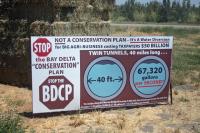
Barbara Daly from Clarksburg manned a booth for STCDA at the Courtland Pear Fair Sunday (thanks again, Barbara!) and said that the people coming into the Fair had seen all the road signs and were full of questions like “What Tunnels?” Our booth and the Restore the Delta’s booth were next to each other and the crowds kept both booths busy all day. Barbara said it was amazing how many people living in that area had no idea about the tunnels or the imminent effect they would have on their lives.

Yet Courtland, Clarksburg, Hood farmers and people who have been following the BDCP plans feel like they are living in “ground zero.” Their quiet, scenic farming communities are where the BDCP is planning to build the massive, multi-story pumping stations and forebay. Family farmers are being threatened with eminent domain. The construction will block farm roads, keeping farmers from getting to market. What are now scenic views will instead be of the hugh industrial structures. Tunnel muck ponds will destroy their pear orchards. As Barbara said, “If the tunnels go through, that will be the end of the Pear Fairs.”

Gene Beley has posted a video taken during the Courtland Pear Fair last weekend (snaps below taken from his video).

The town came together to build floats. They gathered up “Save the Tunnel” signs and made their own to decorate floats and wave in the parade. Check out the video. It looks like about half of the parade was devoted to stopping the tunnels including the Restore the Delta coffin pulled by a specter. But the only thing I’ve seen in the press about the community uprising is a small paragraph in Vacaville’s “The Reporter”. I liked the title, Delta Residents Hit the Streets, but only one real paragraph was devoted to the community protest and the rest about CalTrans removing “Stop the Tunnel” signs illegally.

A community parading to stop the tunnels looks like big news to me. This isn’t a standard protest – this is a real-life community event overtaken by the fear of what these tunnels are about to do to their community and their way of life.

When will the press start covering what these tunnels are going to do to the Delta Communities? The tunnel proponents’ marketing campaign leads people to believe it’s a fish versus farmers battle and the BDCP is the only way to insure clean drinking water to LA and Silicon Valley while saving the fish. Even people living in the affected areas are often unaware of the true tunnel impacts.

We were very happy the Discovery Bay on the bus to Sacramento made the 6 O’clock News in Sacramento thanks to Melinda Meza who lives in Discovery Bay and is a KCRA Sacramento Channel 3 reporter. However, I haven’t seen any follow-on in the press. People massing to go to Sacramento to protest, community events overtaken by the concern about what this huge tunnel project is going to do and yet there is very little press coverage.

Where is the hard-hitting investigative reporting asking: “What are you going to do for people whose farms are taken away by eminent domain, for communities who face economic turndown during this tunnel construction project, for people whose home values will be affected?” Or ask the obvious: “Those are great goals but are they doable without fresh water?” Or better still: “Who will really profit primarily from this boondoggle?”

Where are Woodward and Bernstein?

How can we get more press coverage? One of our press-knowledgable members says we should get more Letters to the Editor in major newspapers.

How to get your Letters to the Editor Published

Here are hints from the SF Chronicle’s Editor on how to get letters to the editor accepted. One thing he looks for is the opportunity for personal perspectives that force readers with very different life experiences to consider another viewpoint. Read his hints.

Then send them off. Here are Links to Newsletters – Where to send your Letter to the Editor with information about maximum number of words, etc.
Tunnel Damage – They won’t just go “Under” the Delta

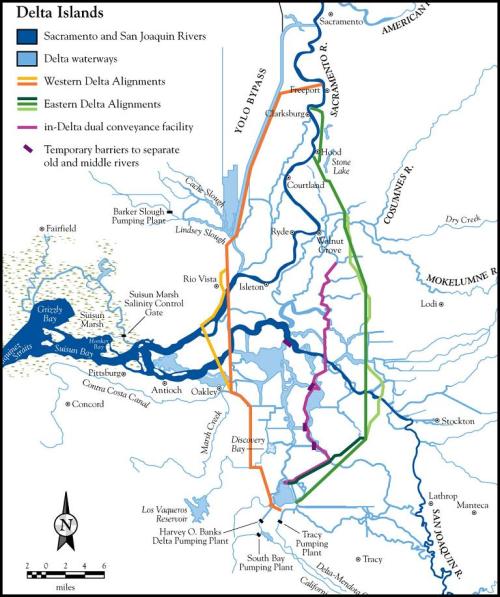
The current configuration of the old “Peripheral Canal” project is now being sold as underground tunnels. The “Peripheral Canal” in 1982 was a plan to build an above-the-ground canal around the Delta near Stockton somewhat where the current BDCP map below shows their so-called “Eastern Alignment” (in green). The PC project was a bad plan because it removed fresh water before it flowed through the Delta and was voted down by a wide margin. The new Tunnel Project is even worse.

The 1982 Peripheral Canal, besides removing much needed fresh water from the Delta, would have had the same pumping intakes that now threaten the lovely communities along the Sacramento River like Clarksburg, Hood, Courtland. However, the old PC would have preserved many of the scenic central waterways (although they would have still ended up filled with brackish salt water and dead fish).

Fast forward to 2013 and the “Peripheral Tunnels” are the current project plan. These tunnels are still referred to as the “Peripheral Tunnels” because they do all of the environmental damage the Peripheral Canal would have imposed. However, they have an even worse effect on the scenic Delta itself. During construction, waterways will be ripped up, the noise of pile drivers 24×7, barges and construction will make it hard for boaters to enjoy a peaceful outing and even harder for birds and wildlife to remain in the area.

The Bay Delta Conservation Plan (BDCP) proposing the new tunnel project studied three alignments as shown in the map below. Besides the Eastern Alignment, a “Western Alignment” that would have gone somewhat around the Delta although I don’t know the impact on Rio Vista and other scenic towns in that area and a through-the-middle “Central Alignment.” Instead of a Canal, they plan to go 150 feet below the Delta. But don’t feel placated that it means less impact to the scenic beauty. The construction is not all “below” the Delta because to build the tunnels requires creating a swath of construction destruction from Hood to the Clifton Court Forebay. The “chosen” alignment is the Central Alignment.

For Delta farmers, boaters and people in the South Delta, the worst choice was the “Central Alignment.” When it was an above-the-ground canal, the plan was to cement-wall in the entire core of the Delta including Mildred Island – virtually wiping out boating in the South Delta. This was for many the worst choice albeit the shortest. Because if the state is trying to preserve the scenic beauty of the Delta, as stated in the Delta Plan, then building cement walls down the middle was a disastrous idea. Some felt appeased hearing that instead of a canal, the new plan was tunnels going “beneath” the Delta. But that is a misconception.

They won’t go under the Delta and leave it’s scenic beauty unharmed. No – the construction project will rip up the entire central portion for 10-20 years and leave smelly tunnel muck in it’s wake.

These new tunnels create all of the environmental damage the canal would have done plus the construction project will destroy numerous scenic waterways including half of the scenic waterways in the South Delta. Huge barges – football size – will be constructed along the 35 mile stretch. Pile driving 24×7, lights, power lines – right next to the Hilton fireworks display area where traditionally thousands of boats anchor out for a week of festivities around the July 4th event which will cause boaters to look elsewhere than boating for that holiday for years. Similarly Mildred Island anchorage will be disrupted with a football size dock next to it, pile driving, lights. It is unlikely that the hundreds of boats, if they can even get into the anchorage, will want to gather there for the big weekends and events such as the Labor Day SeaRay “circle” of over 100 boats each year. When summer weekends and holidays don’t attract boaters to the marinas, businesses will suffer, people will move away.

Delta farmers are threatened from all sides. Many are being told the state can take away their family farms by eminent domain for habitat projects. Some of their farms are planned as tunnel muck sites which would totally destroy their lands, homes and facilities. And for many others still able to keep their farms, the plans to move and close roads needed to get their produce to market will put them out of business.

Melinda Terry, manager of the North Delta Water Agency and participant on the BDCP panels, describes the construction horror in detail in a recent video and write-up in the Central Valley Business Times.

Very little information is offered by the BDCP about why the Central Alignment is the chosen alignment. Perhaps since it’s a bit shorter there’s a cost advantage. But if you are trying to protect a scenic wonderland you don’t put a 10-15 year construction project through it’s heart. If you wanted to restore the Yosemite Valley, would you dig up the floor for 10 years? Bring in power lines, lights, pile drivers 24 x 7? Scare away all of the native species? Of course not.

Yet this is what the Delta Plan is allowing due to its lack of real requirements about what projects need to do to “save” the Delta.

More on the BDCP July 17 Meeting

“Stop the Tunnel” protesters are being seen in many press article pictures covering the BDCP meeting. A very comprehensive article released yesterday in Maven’s Notebook.

Protesters outside the meeting – view Maven’s Notebook to view more photos

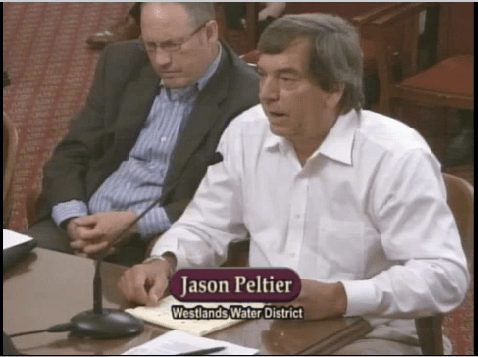
Here, Maven provides an extensive transcript of the first half of the meeting. Sections I find enlightening are Jason Peltier’s (Westlands Water District representative) viewpoints. He totally ignores that fact that because water contracts in California are for 2 to 5 times the amount of water in the estuary and that Westlands only has the lowest tier rights, of course they will NEVER get 100%. He ignores the fact is that his area’s farmers allocations will run from 0% (dry years like 2013) up to maybe 60% of their full contracts (very wet years). I’m not sure what the original concept was when these contracts were issued but if you have the lowest level rights for excess water and your contract is for more water than exists, it seems irresponsible to plan for 100% and assume that there will never be a drought or dry water years. Yet his viewpoint is that their contracts are being “cut … reallocated or reserved to the environment.” As long as there is no acceptance that the amount of water in the Delta is finite, they will obviously continue to take more and more (as they have done the past 20 years increasing almond acreage) until there is no water left.

Related is today’s article that water use is skyrocketing by Tehachapi County farmers due to increased agricultural footprint in that area: Tehachapi News “Water Use Skyrockets”. It seems so irresponsible to continue to expand agricultural acreage in the Central Valley when there already is not enough water in the Delta for the acreage expansions from over the past 10-20 years. Which circles back to the clear fact that any plan needs to start with clarity about how much water is needed to maintain a healthy Delta (i.e., the “Delta Flows”) versus can be exported (the “excess”) and plan from there.

I always find comments by Melinda Terry, North Delta Water Agency worthwhile in these BDCP meetings. In Maven’s Notebook, read Melinda Terry’s comments during the BDCP meeting about the “Funding and Benefits Assumptions” and especially further down under “Questions and Answers Part 2 – Equal Time for Delta Impacts”. Take time to read everything Melinda Terry says there because she points out the real negative impacts that will occur from the construction destruction up and down the Delta to communities, farmers and boating which the BDCP is ignoring.

I also always appreciate Bob Wright, Friends of the River’s comments: “ … This is simply not a permittable project under the endangered species act. To say that taking those kinds of quantities of fresh water away from those fish, including the winter and spring run Chinook salmon, would not adversely modify their critical habitat does not pass the laugh out loud test. … “ Plus Dr. Jeff Michaels, UOP, always provides logical economic input and takes the BDCP to task: “… without a cost allocation, how can you evaluate financial feasibility?” And Dr. Michaels questioned why the tunnel alternative was chosen when “… the through-Delta alternative performed better for all the fish species, which is what this is supposed to be about.”

Maven’s report quits before the great comments by the fellow in the yellow shirt from the American River who tells Jason Peltier to stop saying it’s “between fish and farmers” because the truth is that it’s “people versus people” and his other interesting remarks including that it’s real people, communities, farmers in the Delta are being affected, not just fish. Mike McCleery, Discovery Bay, commented on how from his experience in the commercial sector, the BDCP’s low return-on-investment even before inflation and overruns makes it an unreasonable project to pursue from a financial standpoint; how no Delta levee has ever fallen down during an earthquake, even in 1906; and asked why Dr. Pyke’s proposed newer technology of permeable layers could not be used at Clifton Court Forebay to protect fish to allow continuance of the current through-Delta option rather than add any new tunnels. Michael Brodsky, STCDA Legal Council, caught the panel in a previous misstatement: their claim that environmental protection would be available even after a take permit was issued because the permit could be withdrawn later if the agencies did not manage pumping operations effectively and that permits have been withdrawn in the past. Brodsky’s research revealed that according to Fish & Game, no take permit has ever been revoked in California and the example stated at the previous BDCP meeting was erroneous. Brodsky also re-iterated and expanded on his objection to the BDCP “adaptive management” structure and why it cannot protect the co-equal goals as long as water contractors like Peltier have veto power. From Peltier’s statements made earlier in the meeting Peltier clearly does not believe that fish need fresh water. Thus the logical assumption is that Westlands would always use its veto power along every step of the process which would negate any objections made by Fish & Game or others trying to protect the salmon.

Webcast of the entire meeting.

Earlier Press pixs about the protest:
Original Channel 3 write-up and video: http://www.kcra.com/news/discovery-bay-residents-protest-twin-tunnel-project/-/11797728/21024494/-/127pxic/-/index.html

A bad day at the office for Jason Peltier greeted by protesters outside the BDCP Meeting (includes video): http://www.centralvalleybusinesstimes.com/stories/001/?ID=23838

Discovery Bay got “On the Bus”

The Discovery Bay’s “Get On the Bus” event filled the bus plus got great TV coverage – thanks to Melinda Meza and KCRA Sacramento Channel 3 for showing up at both Discovery Bay and Sacramento! Amanda Dove and her kids did a great job on camera. See more from KCRA TV.

The DWR rep Nancy Vogel who was also interviewed by KCRA gave the party line that the BDCP is going to “restore the habitat” even though WE all know the main thing fish need is fresh water and that is what the BDCP plan will be removing.

The construction project, tunnel muck, and lack of fresh water will seriously impact all Delta communities and Delta farmers. Let alone the poor farmers who’s farms are being threatened to be taken away by eminent domain.

It was great to see Discovery Bay getting notice on TV because for us, like the rest of the people living in the Delta area, it’s about our way of life on the Delta.

Getting on the bus (photo by KCRA)


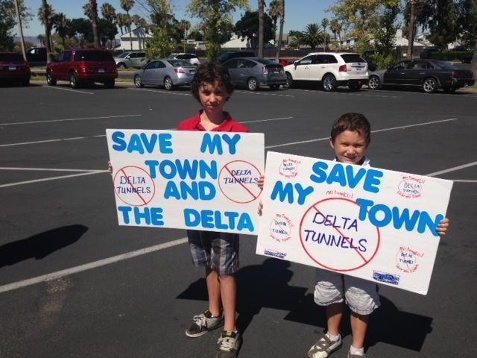
Even the kids came out to protest (photo by KCRA)


Discovery Bay citizens outside the BDCP meeting (photo by R. Wisdom, DB Press)


“Stop the Tunnels” signs line the BDCP meeting walls (photo by R. Wisdom, DB Press)

CalTrans’ Sign Removal

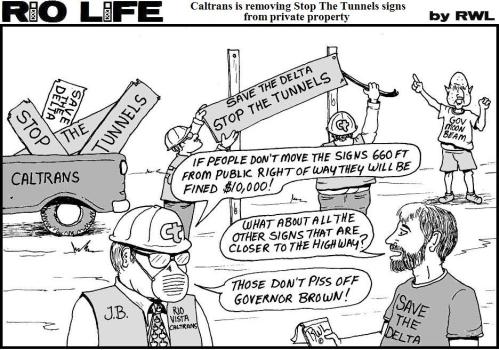
CalTrans workers have been removing “Stop the Tunnels” signs from private property near highways. (Note: This does not affect our home lawn signs unless they are on a state highway). Our STCDA legal council is reviewing the legality of CalTrans’ actions.

A Rio Vista paper, the River News-Herald, ran a hilarious cartoon about the sign confiscation caper:


The story came to light when a farmer who was displaying “Stop the Tunnel” signs on his private property on Highway 160 called Restore the Delta to report the “theft”. Originally, CalTrans sited a Code section regarding removal of political signs which raised the question why these would be considered “political” signs when the regulation quoted by CalTrans says a “temporary political sign” is a sign that encourages a particular vote in a scheduled election. No doubt the tunnels are a political issue, but the state plans to build them without a public or legislative vote. Later CalTrans quoted Business and Professions Codes sections 5403, 5405 and 5405.3 which may have some relevance although we wonder why CalTrans leaves the big, annoying Westlands and agribusiness farm signs such as “Congress-Created Dust Bowl” that have been along I-5 for years by tunnel supporters. Obviously the cartoon creator has the same question in mind and provides his answer to the question.

We will let you know when we find out if this action is even legal.

The debacle also caught the attention of Alex Breitler, RecordNet: Caltrans’ sign removal irks Delta backers.

Let us know if you want your own “Save our Delta/Stop the Tunnels” sign by clicking on the “Display a Lawn Sign” link on the right.

A View of America’s Rivers

Here’s a neat graphic of the relative size of America’s rivers. The Sacramento doesn’t look so big here. Which makes it important to note that to note that the Sacramento-San Joaquin system (40,000 cfs) carries about twice the flow of the Colorado under natural conditions (20,000 cfs). No wonder the Delta is in crisis.
pacinst-americas-rivers
View the entire article.

Wave of suits hits Delta Plan

This week Save the California Delta Alliance joined with numerous other entities including environmental groups, commercial fishermen, water diverters and local governments in protesting the Delta Stewardship Council’s adoption of the Delta Plan. To view the STCDA Law Suit Filing click here.

The STCDA suit represents the interests of the large number of members in Discovery Bay, who “own waterfront homes with attached docks in the Delta”, and others who “swim, fish, boat, water-ski, wakeboard and otherwise recreate in the Delta. STCDA members earn their livings in Bay-Delta related businesses including marinas, fishing enterprises, water sports enterprises, Delta waterfront real estate agencies, and many other Bay-Delta related enterprises.” It stated that STCDA also represents the wider spectrum of membership including other Delta communities and the Bay.

Like the other suits, we object that the Delta Stewardship Council did not start with the scientific Delta Flows as directed by the Legislature. The Delta Flows are needed to identify how much water is available for export and how much must flow through the Delta to sustain it. The State Water Resources Control Board did produce its Delta Flow report in August 2010 but the answer was that the Delta needed less water exported out, not more. That was the wrong answer for the DSC so they have ignored the Delta Flows.

Our suit was able to take the Delta Stewardship Council to task for not specifically taking a position with regards to the still ‘on-hold’ Two-Gates Fish Protection Demonstration Project and The Plan makes no recommendations regarding them. As the last email to the membership noted, the Bacon Island Bridge is undergoing a one-month maintenance down-time in October during which, if the two-gates had been installed in 2009 as planned, Discovery Bay boats would not be able to come or go during that entire month. In addition, on Memorial Day, there was a tragic accident south of Mildred Island where a truck ran off the road into the slough and several people were missing. We were not allowed to pass through that slough to get from Mildred Island, through the Bacon Island Bridge to Discovery Bay due to the rescue operation and had to go the long way up Middle River and down Old River where the Two Gates would have not allowed us to return home with our grandbaby after the long weekend. We need to remain diligent to insure that gates do not get installed throughout the Delta, blocking navigation and causing other issues.

Our lawsuit further pointed out that the council has abdicated its responsibility to consider broad policy alternatives to “Big Conveyance” and have not followed the legislature’s mandate to “expand statewide water storage”. At prior DSC meetings we had requested the council consider a meaningful re-operation and conjuctive use strategy yet nothing is included in the Delta Plan and that the billions spent on the tunnels would be better spent on a series of smaller groundwater recharge projects that would be much less locally disruptive, spare Delta communities from annihilation, and would actually achieve the goals of providing a more reliable water supply to the state, restoring the Bay-Delta ecosystem, and expanding statewide storage capacity as mandated by the legislature. The re-operation and conjuctive use alternative is the one we have been raising money to hire scientists to help defend.

We are fortunate to have Michael Brodsky as a Discovery Bay resident and STCDA legal council. He once again has donated his time and expertise, working long hours and last weekend to put this suit together pro bono. Thank you again, Mr. Brodsky!

Links to news coverage of the law suits:

Display a Lawn Sign

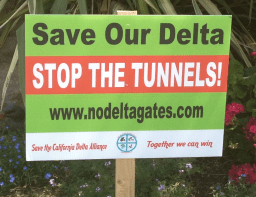
We are ordering more of our red & green “Stop the Tunnels!” signs seen in Discovery Bay and beyond!

STCDA Lawn Sign
We are happy to see that they have been springing up throughout Discovery Bay and beyond – along Highway 160 and up to Clarksburg, Hood, and Sacramento. Some have even been spotted in the Bay area and down south!

How can I get one?

Please click the “Display a Lawn Sign” link on the right side of the http://www.nodeltatunnels.com/ website or email “volunteers@nodeltagates.com”.

Include:

    Your Name
    Address
    Phone #

so our volunteers can get you a sign. We are delivering in the Delta area but if you live elsewhere, please let our volunteers know if you can pick it up.

A small donation to cover the expenses is appreciated ($8.00) but not required. We are happy to have you display our signs and show your support for the cause. Together we can make a difference!

P.S. – More on the buses to Sacramento will be sent out soon for those of you who have volunteered to “Get on the Bus!” If you want your name added to the list to find out more details, please email “volunteers@NoDeltaGates.com”, include your name, address and phone # and say you want to “Get on the Bus!”

DSC approves the Delta Plan

Delta Stewardship Council logo
Today the Delta Stewardship Council met to review the final Delta Plan and approved it, voting 7-0.

There were speakers from the Sierra Watershed, State and Federal water contractors and Department of Fish & Wildlife, Water Branch who mostly commended the work done on the Delta Plan and recommended adoption.

However, there were very strong objections raised during the public comment period from environmental groups. Bill Jennings, California Sportfishing Protection Alliance, CSPA, reminded the panel that currently there are water rights for five times the amount of available water in the watershed. “This is really the source of the California Water Crisis but this is not discussed or analyzed in the Delta plan. In 2010 the Legislature directed the SWRCB to prepare the Delta Flows. The state board concluded that substantial increases – 75% of Delta outflow – should be outflow. How can you have a comprehensive plan if you don’t acknowledge the reality that there is a conundrum there? You had this golden opportunity to set forth the standards and attainment of how those standard would be met. That might have given us a glimmer of hope. Instead we are looking at at least 8 lawsuits about how we are going to restore this estuary before we destroy it.”

Nick DiCroce from the Environmental Water Caucus added that the Delta Plan “paves the way for a BDCP project which in it’s current state will compound the degradation of the Delta.” He recommended the council “adopt a policy that each project submitted to the DSC be required to satisfy three analytical steps to be certified by the Delta Plan: (1) Water availability analysis (2) Cost benefit analysis and (3) Public trust balance analysis.”

Two Oakley citizens spoke. Ms. Skoog had never attended a DSC meeting before but raised concerns with the tunnel project, whether anything of it’s size had ever been built before under a fragile estuary and raised concerns about project costs and results, citing the Bay Bridge’s overruns and although it’s goal was to be earthquake-proof, we now find it is not. Paul Segar from Oakley compared building the tunnels before managing the need for more water than exists as “we are hemorrhaging the use of water in our cities and our farms. And it occurs to me we are doing open heart surgery before stopping the bleeding. It will be very expensive operation unless we stop the bleeding by penalizing misuse and encouraging smarter use of water especially southern farms that are growing in the desert regions.”

Mr Charles Gardner, Delta Vision Foundation encouraged adoption of the plan but said the council needs to address a number of the key issues we really need to address in the near term such as the levees, the performance measures, the finance plan and above all the implementation committee.

Gary Bobker, Bay Institute and NRDC, commended the way the plan does a good job of describing the Delta as a place. But stated that it is missing clarity about the outcomes and performance measurements; hence the current Delta Plan will not solve the problem of reducing the pressure on the Delta Ecosystem and reducing the risk to the Delta.

Councilwomen Miller, Stockton, urged the council to not approve the plan; rather to continue to work with local stakeholders to bring forth a plan that works for all.

The Council then voted to approved the plan, 7-0.

Senate Hearing on the BDCP

On May 14, the California Senate held a Joint Hearing by the Senate Natural resources and Water Committee and the Select Committee on The Sacramento-San Joaquin Delta BDCP. Seven BDCP stakeholders were invited to speak including Metropolitan Water District, Westlands Water District, Sacramento County Representative, Contra Cost Water Representative, Natural Resources Defense Council (NRDC) Representative among others.

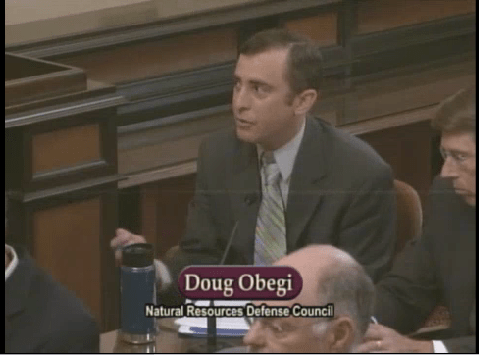
Most interesting was the dichotomy between Jason Peltier, Westlands Water District, and the Doug Obegi, the NRDC Representative. Also noteworthy was the extent of angst expressed by the Sacramento County representative, Don Nottoli, while describing in detail how the tunnel construction destruction would affect the Delta residents, towns, waterways, farmers, etc. To hear the video recording, <a href="Joint Hearing by the Senate Natural resources and Water Committee and the Select Committee on The Sacramento-San Joaquin Delta BDCP<a href="Click here.

Mr. Peltier described the massive BDCP document and defended the fact that in the BDCP there will be mistakes, errors, mis-statements and policy issues. Maps will change, analysis will evolve.

He went on to say that the BDCP will be kind of a living document in many ways. He felt that this body of work reflects our best use science as we know it and added “Some will say the science is inadequate. They are correct in that.”

Mr. Peltier then painted a picture of the Delta and ecosystem as so complex that no one could possibly know how it can or should function. He said that the body of Delta experts and scientists often don’t know what they see right in front of them. He commented on the “red flag” letters from the fish agencies and read an excerpt from the National Oceanic and Atmospheric Administration’s National Marine Fisheries Service (NMFS) comments and then replied to those comments as follows: “My translation of that [report] is a question – how has it, how is it and how will it function in the future – this Delta ecosystem? Is that at all possible for us to understand how this ecosystem works?” Then he criticized those agencies’ objections by saying “It’s been their responsibility for decades.”

Regarding the fish decline, Mr. Peltier offered, “It’s a combination of everything. We don’t know the answer. What we do know is the pump-centric regulatory operations have failed. We have 20 years of evidence to that end. That is why we want to take a comprehensive ecosystem approach. This may be too complex but the simplistic approach hasn’t produced results.”

[STCDA interjection – It isn’t the “simplistic approach” that has failed, it is the continued increase in export levels over the past years that has caused the Delta crisis.]

While Jason Peltier felt the Delta ecosystem was just too, too complicated for anyone to comprehend, Doug Obegi Staff Attorney for the NRDC had a much clearer view.

Mr. Obegi stated that the state has been solely focused on maximizing the exports from the Delta whereas most reports acknowledge we need to reduce exports from the Delta. That the current flows are not sustainable. As the SWRCB found in 2010, the current water flows are inadequate to confirm the public trust. We need to reduce reliance on the Delta and invest in alternatives. On the water supply side, the BDCP is not meeting the risks. Does it means more water from the Delta? Does it mean physical reliability? Ultimately we need to also make the existing pumps more reliable. We need to invest in alternatives. None of the alternatives in the BDCP include investments in local supplies, no investments in levee improvements. Mr. Obegi advocates the portfolio alternative supported by the 5 county supervisors.

[Note: The portfolio alternative proposed by the NRDC still includes a new northern intake, albeit only 3,000 CFS. STCDA still worries about the construction size and impacts of any new intake and resulting pipeline which may go directly through the Delta. Instead, new sources should be sought including the Tulare Lake Basin or other south-of-delta ground water recharge for the central valley and desalination for southern California coupled with increased conservation (agriculture in the desert as well as urban) and recycling.]

Mr. Obegi felt there is a better path than the BDCP is on – to reduce reliance on the Delta and invest in new sources, levees and a smaller conveyance. Massive investments in the Delta [tunnels] could constrain rate payers in funding conservation and recycling investments in their areas.

An interesting exchange between Mr. Peltier and Mr. Obegi during the question period further illustrated the issue. Mr. Peltier asked “A question for Doug who repeatedly advocates we need to reduce the water we get from the Delta. We’ve had 40, 60, 90% cutbacks. Is your vision 50,70, 100% cutbacks in the future? Is that the success for you?”

Mr. Obegi’s response again clarified that the BDCP is only focused on exporting water, not a big picture solution: “I don’t measure success by water supply from the Delta but how we invest in water conservation, etc. Even during years when Westlands has been cut back, the state exported all that water from the environment. The state increased their exports. The environment kind of got screwed and you [Westlands] kind of got screwed. Ultimately I think Westlands is in a tough spot. Part of why we included storage [in NRDC’s portfolio alternative] is we looked when Kern got surplus water but because Westlands doesn’t have storage it makes it difficult to have growers plan around it. If you had more south of Delta storage you’d be able to do [better planning]”.

Senator Fran Pavley asks the $64,000 question – “Why is it so hard to get the science right on the Delta Flows?

One answer was that it’s a moving target. Salmon spend 2, 3 or 4 years out in the ocean exposed to other factors. And you need several life cycles for statistical data to drive to a conclusion.

Doug Obegi counters “This is the best studied estuary in the world. The real challenge is that the biological science is less hard than the political science. Even the regulators in their private moments have concern that we can’t have a project that exports less than ‘fill in the blank’. ‘The documents put out by the BDCP have always been developed by the water contractors and their scientists.”

Jason Peltier, Westlands again disagreed with “Please don’t fall into the trap of looking for scientific certainty. We aren’t going to find it. I disagree with Doug that the scientists know what we need in terms of flow. I totally disagree with that.”

Sen. Pavley added “I was struck by the editorial that the PPIC survey by top independent scientists who supposedly have expertise in Delta issues and 80 percent of them felt that flows was the major issue and [on the other hand] the exporters in general were mostly looking at invasive species or ammonia or some other reasons why the flow doesn’t need to be the primary reason. It seems too many red flags are going up that we are going to have to approach the delta flow question.”

Lois Welk adds that unless the Delta stakeholders are at the table there will be no resolution to the problem. In the past there have been no Delta stakeholders in the process.

Senator Galgiani says why the Delta can’t be at the table is today there is only one option that is being discussed which isn’t acceptable to the Delta stakeholders and that is the Delta Tunnels. She would like to look at the tunnels plus some other projects side by side to evaluate what we should be doing.

Westlands talked about the human side of the problem but then stated: “We’ve given a lot of money and water to the environment over the past years. Are we ready to give more? No.”


Blog Stats

  • 127,624 hits

Support the STCDA

Sign up for Emails

Sign Up Now

Request a New Lawn Sign

Click Here to send an email to the lawn sign committee.

Receive news blog via email.

More Blogs

Educational Books about the Delta

Sassy the Salmon
and
The Fable of the Farmer and the Fish
All ages: K and above
Proceeds go to STCDA