Archive Page 30

What’s Wrong with More Dams?

The legislature is considering raising three dams and two new dams. Dams to be raisesd are Shasta, Los Vaqueros and San Luis. New dams are proposed at Temperance Flat dam and Sites dam.

Let’s analyze each on their own merits. Environmental groups will always be opposed to any dam because of the impacts to animals, plants and scenic beauty of the area. Those who favor industry and growth over the environment would argue the merits of growing more crops and having more water available for droughts.

Ignoring the environmental pros/cons, what are the other issues.

Shasta Expansion
Shasta hasn’t been anywhere near full in years and years. Plus, the expansion plan would flood many of the remaining sacred sites of the Winnemem Wintu Tribe that weren’t inundated by the construction of Shasta Dam in the 1940s. IndiansOpposeCanal
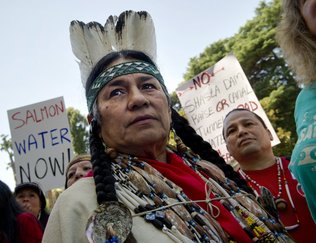
Beware of trickery here. Proponents are trying to use an environmental claim saying that expanding Shasta would increase the water available for release to help protect salmon during drought years. Sounds nice. But NOAA has already found that salmon need to go up above Shasta Dam to the McCloud because of climate change. The dam raise would flood more than 7 miles of cold water spawning grounds on the McCloud River, Squaw Creek, and the Sacramento River. Instead of a higher dam, the salmon need fish ladders installed.

Los Vaqueros Expansion
I haven’t uncovered any negatives to this project. The water is removed after flowing through the Delta at Rock Slough and north of Clifton Court Forebay. Unlike the State and Federal pumps further south, the county’s intakes have more modern fish screens plus the facility was smartly built to extract water parallel to the flowing river so fish are not harmed.

Having more water in Los Vaqueros can better serve the East Bay. If more water is available from Los Vaqueros, then Silicon Valley wouldn’t need to use San Luis water, improving regional self-reliance. Currently, Silicon Valley leaders are often heard in support of the Delta Tunnels.

San Luis Expansion
The dam is on the Ortigalita fault near the San Andreas fault. The dam needs to be shored up already to avoid earthquake issues. The requested $360 million provides only 6% more water but repairs the existing dam. The reservoir has no natural water flow – all water is from the Delta. Seems like a bad idea to me. A better idea would be to restore the Tulare Lake Basin, a huge natural lake that requires no new dams, no additional power for pumping, and would recharge the Central Valley aquifers like it use to. That would be a win-win. More on Tulare Lake below.

New Temperance Flat Dam
Temperance Flat would be on the San Joaquin River. Does the San Joaquin have any more water to give? It is already polluted from the Central Valley farms. The once millions of salmon are down to a handful. That river needs a big recycling plant built to clean up the farm water runoff and convert it back to fresh clean water for the Delta, not more water removed.
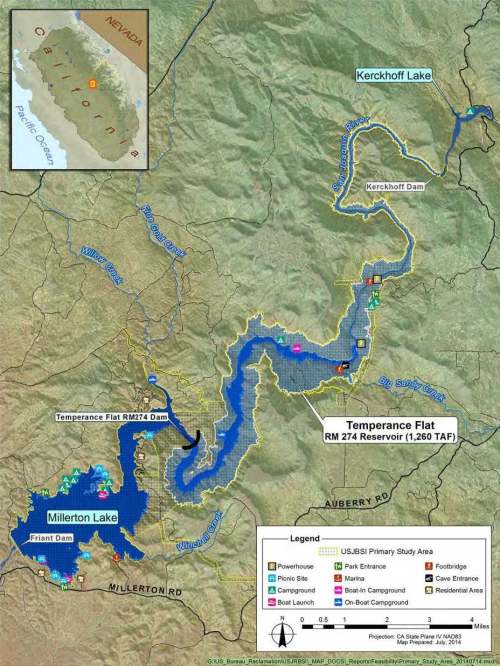
Long regarded as the most crazy dam idea in California (for over half a century, the existing dams and canals totally dried up the San Joaquin River downstream of Fresno in most years), the project to squeeze the last pittance of water from the river is enthusiastically backed by local politicians who successfully fought for billions of dollars for this dam in the 2014 California Water Bond (Proposition 1). In fact, they held the bond hostage in the California legislature until funding for the dam was made possible in the bond. See http://www.friendsoftheriver.org/site/PageServer?pagename=temperanceflat.

New Sites Dam
Sites would divert more water from the Sacramento River.

An analysis by Friends of the River reports that Significant water diversions from the Sacramento River to fill Sites Reservoir could result in substantial adverse impacts on the river’s ecosystem. Flow impacts from Sites diversions are often downplayed by proponents since they will occur during high winter flows. But current minimum flows for the Sacramento River will allow significant diversions throughout much of the year. One perfectly legal diversion scenario could take up to 67% of the average flow of the Sacramento River during the month of April.

Also, the reservoir is located in a region that naturally produces selenium and high amounts of metals and other potential pollutants. There also could be abandoned mercury mines in the reservoir footprint. Definitely sounds like a bad idea to me.

Restore Tulare Lake
Instead of raising Shasta and San Luis and building Temperance and Sites, why is no one proposing restoring Tulare Lake? It would be cheaper than any new dam, replenish Central Valley aquifers, re-create a huge bird habitat, restore an area that used to house people, birds and wildlife. It would be minimal cost – part of it returns periodically due to flood and a small amount has occurred due to restoration efforts. However, to provide real benefits, more restoration is needed for the lake to be year-round and to restore the aquifers. You can have twice the surface storage for 1/5th the cost – or 20 cents on the dollar. The restoration of just 10% of the historic Tulare Lake would be nearly twice the surface storage capacity of Temperance Flat. It would be a recreational feature for central valley communities. The land it would flood is at most a few very poor communities without adequate drinking water and farmland.

What happened to it? It was dried up by dams built by early cotton farmers to reclaim the land. In the process they killed the local Indian tribes.

Why not restore it? Ah yes, because that would mean flooding much of the land that is now J.G. Boswell’s cotton empire. I say restoring Tulare Lake would be REAL regional self-sufficiency. It would provide all of the water the Central Valley farmers need while restoring the aquifers at small cost to change some canals and no ongoing maintenance cost.

Find out more about Tulare Lake and potential restoration:
More dams and less review

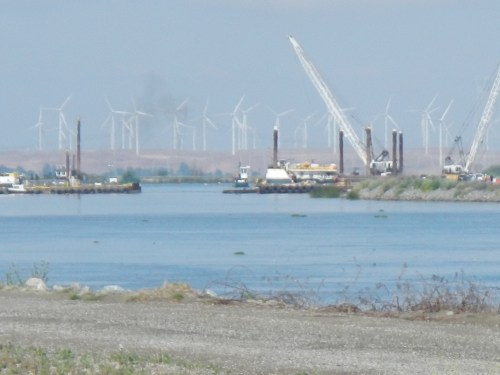
Now that the state was able to install the False River Dam without due process, someone seems to think there’s a window open.

Two Announcement today from Mary Piepho’s Office (Contra Costa County Supervisor):

Additional Water Storage Facilities Proposed
An amendment to the FY2016 Energy and Water Appropriations Bill instructs the Bureau of Reclamation to finish and submit feasibility studies for three dam expansion projects and two dam creation proposals by specific deadlines.

Proposed by Congressman David Valadao (CA-21), the amendment requires a timeline for completion, draft, environmental impact statement, and final environmental impact statement, and a Record of Decision to be completed for the Shasta expansion and Temperance Flat dam by December 31, 2015; the Los Vaqueros expansion and Sites dam by November 30, 2016; and the San Luis dam expansion by December 31, 2017. The amendment passed the Appropriations Committee on Wednesday and will proceed next to the Floor for consideration:
http://www.acwa.com/news/federal-relations/valadao-offers-amendment-energy-and-water-appropriations-bill

Chipping Away at CEQA
Another bill, AB 311, a bill intended to speed up the environmental review process for new water storage facilities by making changes to the California Environmental Quality Act (CEQA), passed to the Committee on Natural Resources. State Assemblymember Kristin Olsen (R-Modesto), a co-author on the bill, says the bill addressees “abuse” within the environmental review process, but David Pettit of the Natural Resources Defense Counsil refers to the bill as “chipping away at CEQA”
http://www.dailynews.com/general-news/20150416/california-assembly-members-push-to-speed-up-water-storage-construction

False River Dam Begins

So frustrating.

I saw the Channel 7 newscast tonight at 6 PM. The Bethel Island municipal district’s manager was quoted complaining about the economic impact the False River Dam would cause to Bethel Island. BI is being taken off-the-map since now the heavy boat traffic from the west (Benicia, Pittsburg, Antioch) to the south Delta (Mildred Island, Discovery Bay) will bypass Bethel Island. It is disastrous for them.

UNFORTUNATELY, Channel 7’s concluding line was “Some win, some lose. All for a greater good.”

So the conclusion of the news station was the “greater good” was to get more water to the CV farmers!

Group files lawsuit against the False River Dam

Group files lawsuit against the False River Dam (“emergency drought barrier”). They are claiming that the state circumvented environmental law to build the dam and claim the barrier will in fact increase salinity levels by pushing seawater into other areas of the delta and will harm smelt, Chinook salmon and other protected fish species.

Read more here.

What about Bethel Island?

Congratulations to the North Delta C.A.R.E.S. community action group led by Anna Swensen and Barbara Daly and its allies who caused the DWR to abandoned their plan to put two of the three water barriers (dams) across North Delta sloughs and is now only going to use just one. They have abandoned barriers across lower Steamboat Slough and Miner Slough locations–a great victory for the fish and farmers in the North Delta.

HOWEVER, what about the rancher on Bradford Island and the entire community of Bethel Island, working to continue their recent economic recovery? BI is finally able to move ahead on their big project where the levee was breeched years ago (on purpose) to build homes on the water to support BI’s economy. The BI manager said the False River Dam is like condemning the town of Bethel Island.

The Central Valley corporate farmers win – the False River Dam is being installed.


Read more about Bethel Island’s new project in the Discovery Bay Press article.

False River Dam to be Installed


The State announced it’s plan today to spend $28 million to install a dam in False River for 5 months. (The two dams in the North Delta are not going to be installed this year.) The claim is the dam is needed to keep salt water from intruding into the Delta tainting fresh water used for drinking water. The alternative to the dam is to manage the water supplies to the corporate farmers in the Central Valley like they are supposed to be doing according to the legislature’s co-equal goals.

The permit application process is underway, and DWR hopes to begin installation of the emergency barrier on May 8. It will be erected across West False River, between Jersey and Bradford Islands just west of Franks Tract. This action will be taken even with the significant impacts they will cause.

The dam will be annoying to boaters having to go the long way around to travel west of there to Antioch, Benicia and San Francisco. The impacts are much more significant for Bethel Island and the owner of Bradford Island.

The DWR dares to have this statement on their website: “Based on an environmental analysis and more than nine months of discussion with Delta residents and water district managers, DWR concluded that through environmental commitments and mitigation, the emergency drought barriers would not have significant environmental impacts.”

Really? Yes, there have been discussions. But no one has been listened to and the concerns not addressed. And how could they have concluded there will be no environmental impacts?

At a meeting mid February with Paul Marshall from the DWR in Clarksburg, many concerns were raised. The Bethel Island representative explained that Bethel Island’s economy is based on being on the primary path between the Delta and points west. He said after the economic downturn, Bethel Island is just starting to make an economic recovery and stated, “The economic impacts on my island are huge. You might as well be doing a public condemnation of the value of our island.”
He also had concerns that the dam will be changing the water flows dramatically and which undercut their already fragile levees. “You will rip docks that were never designed for these flows. It’s almost an insult. Your economic impact study for our island is almost nonexistent.”

The Bradford Reclamation District representative added, “I would like to demand a public hearing of the False River Barrier.” She added, “One ferry is the single access to the island of Bradford. What are you going to do to be sure these folks can always get to their homes.” She also noted that millions of dollars of public funds is being committed without a cost benefits analysis.

There have been numerous requests for the DWR to go to Bethel Island over the past year to meet with owners there plus the nearby farmers. The DWR was asked point blank at the meeting, “Are you or are you not going to have a meeting in Bethel Island over the False River Dam?”

He responded, “No – at this point we hadn’t seen the absolute need for it.”

Really?

That’s the way it is. First they said they only needed to produce a Negative Declaration and not go through the EIR process. Obviously that was not correct. Now, instead of addressing the numerous comment letters and input received, they are just going to go ahead and install the thing.

Today’s announcement can be found here

Follow the Important Facts

There’s an interesting Op-Ed in the Sacramento Bee today: To respond to California’s drought, we need to follow the facts by Bruce Maiman, a part-time host on KFBK radio.

He adjoins us to, “Beware simple reactions to complex issues.” I would like to add for readers to “Eschew misleading facts and figures.”

He lost my full confidence in his opinion piece when he started with, “For instance, critics of Big Agriculture like to say that farms use 80 percent of water, but sometimes gloss over that that number refers only to water for human purposes. Of California’s total water, about half is devoted to urban and agricultural use, while the other half goes to environmental purposes.” He then goes on to say, ““The No. 1 user of water in California are trees in the Sierra Nevada.”

First, where is the relevance? Unless someone is going to start advocating clear cutting the entire Sierra Nevada range (which would, of course, be not only sill causing massive mud slides and disasters, but also would be a horrible environmental mess). Much of the water in California evaporates from trees. But unless he is advocating humans find a way to suck the evaporating water out of the air to reuse (which would, admittedly, be a neat trick except then it wouldn’t return as rainfall), saying agriculture uses only 40 percent of the water makes no sense in the debate of controlling who gets how much water. That doesn’t justify ignoring agriculture when trying to solve the water crisis.

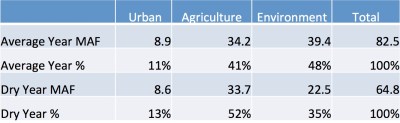
Second, his numbers are only valid in a year with average precipitation. In dry years, the environment only gets 35% of all water because more ground water is withdrawn. In dry years, agriculture still takes nearly as much (drafting from the ground water when Delta exports aren’t available) hence in dry years agriculture uses 52% of all available water.

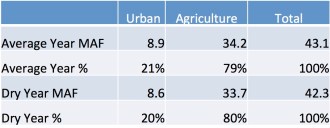
It’s much clearer and more straightforward to use the percent of non-environmental water in the discussions. In normal years, agriculture uses approximately 80% of all available water. In dry years agriculture uses approximately 80% of all available water. Straightforward, simple, correct.

Water Usage Including the Environment:

Water Usage Excluding the Environment:

I’m with him on these comments:

    You also hear claims that most of California’s rainfall “washes out to sea” because “liberal environmentalists” have prevented the state from building necessary dams and reservoirs.

    “That’s not the least bit true,” Andrew Fahlund, deputy director of the California Water Foundation, told me. Those outflows keep ocean water from contaminating critical freshwater supplies.

Yes! Water flowing through the Delta to the San Francisco Bay and beyond is not wasted!

However, he then goes on to state there is little reason to pick on fracking which only uses 100 million acre feet (MAF) and says total water is 93 trillion AF. I assume that is the number of total water includes the Colorado River and ground water.

If we focus on the Delta alone, in an average year, the amount exported from the Delta is 5 MAF. This year, in the forth year of a major drought, those exports need to be limited to 1 MAF or 1500 CFS. However, fracking remains an issue. The 100 MAF is a LOT for fracking; particularly when fracking contaminates the already tainted and undrinkable ground water in the Central Valley.

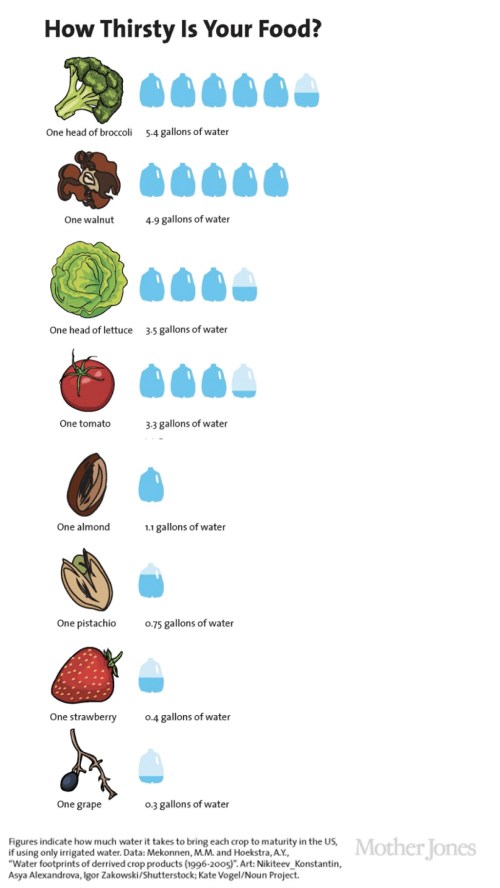
Then he derails again when talking about food production. He tries to combat the almond-growers opponents who say “Almonds are the new demon seed. One gallon to grow a single almond!” by adding, “But walnuts require five. So does broccoli.”

He could also mention that lettuce takes 3.5 gallons. See the list below.

Is that a fair use of numbers? Not really. A single almond may require “only” one gallon of water but, according to the California Farm Bureau, one “serving” of almonds requires 80 gallons of water while one serving of lettuce only 2.9 gallon. Similarly, if a head of broccoli is 5 gallons, one serving would be around 2 gallons. Me, I’d rather have a serving of vegetables on my plate than a pile of almonds.

Where is a priority to put healthy fresh vegetables on Californian’s plates in these facts and figures? As well as for the rest of the country. We keep hearing agriculture saying that if they don’t get their water food prices will go higher. However, I have noticed during these years of drought a significant increase in vegetables at the store that are shipped from Mexico or Costa Rica. I don’t mind getting almonds from overseas. I do worry about getting my lettuce and broccoli from Mexico.

On the other hand, Mr. Maiman is right-on about cattle. Cattle is by far the largest user of water. The grains provided (alfalfa, wheat) are the largest consumers of water. Seventy percent of the alfalfa grown is for dairy cows. The rest is shipped to Asia. Add to that the gallons cows consume and yes, we have a big problem. That is why some are calling for the happy California dairy cows to go back to Wisconsin where there is plentiful rain.

I agree that, “California farmers have been very responsive to economic opportunities, but have also adapted to new technologies to be more efficient. Farmers produce 33 percent more in crops by weight, per unit of water, than they did 20 years ago.” I’ll applaud their improvements but disagree with him that it is the main point to be made. Efficiently using water but then expanding almond orchards into the desert with the water saved doesn’t help California save water.

The amount of water allocated to agriculture (including dairy farms) needs to be reduced.. That isn’t the only action the state needs to take to resolve the drought – but it is a necessary action to avoid losing the Central Valley aquifers and save the Delta.

State moves ahead with 3 Delta Dams, bypassing Comment Evaluation Requirement


Brown is pushing ahead to bypass the environmental review/comment period on the Three Delta Dams to install the three barriers in the Delta, one on False River and the other two farther north, that could last up to eight months.

Anna Swenson, a volunteer with North Delta C.A.R.E.S., called the barriers a “water grab” and “crime.”

“It’s the largest estuary in the West and they’re going to destroy it,” Swenson said. “Why are farmers in the Central Valley given more priority than the state of California?”

Read the entire article here – San Jose Mercury News.

Gov. Brown drops Delta Restoration from the Delta Tunnel Plans


File: In this photo taken Monday, Sept. 23, 2013, a boat cruises down the Delta Cross Channel between the Sacramento River and Snodgrass Slough near Walnut Grove, Calif. (Rich Pedroncelli/AP)

In the Mercury News this week, Gov. Jerry Brown has billed his $25 billion plan to build two massive tunnels under the Delta as a way to not just make it easier to move water from north to south, but also increase the reliability of water supplies and bring back salmon and other endangered species.

But now the Brown administration is proposing a major and politically risky change: dropping a 50-year guarantee to restore the Sacramento-San Joaquin River Delta’s environment.

Read more at the Mercury News, Delta Tunnels Major Changes…

People are Asking the Right Questions

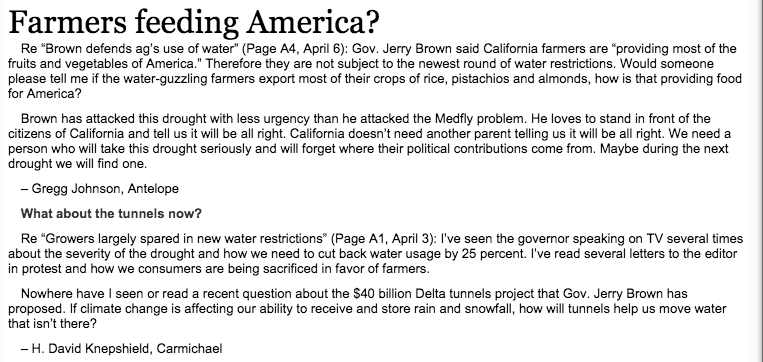
Editorial cartoon and letters to the editor in today’s Sacramento Bee.

Brown

LTE

SaladBar


Blog Stats

  • 130,140 hits

Support the STCDA

Sign up for Emails

Sign Up Now

Request a New Lawn Sign

Click Here to send an email to the lawn sign committee.

Receive news blog via email.

More Blogs

Educational Books about the Delta

Sassy the Salmon
and
The Fable of the Farmer and the Fish
All ages: K and above
Proceeds go to STCDA