Archive Page 18

When you Shop at Amazon – STCDA gets a Donation from Amazon!

Save the California Delta Alliance is now one of the sponsored charities for Amazon! For any product you buy there, Amazon will make a donation to STCDA!

But first, you need to register Save the California Delta Alliance as your Amazon preferred charity. It’s as easy as 1-2-3.

  1. First, go to smile.amazon.com. The first time you go to smile.amazon.com, it will ask you to name your favorite charity. Pick us! Type “Save the California Delta Alliance” in the box and click “Search”:
    Amazon-step1
  2. Second, “Select” Save the California Delta Alliance in Discovery Bay, CA:
    Amazon-step2
  3. Third, you will then be told that you’ve selected STCDA as your charity and remind you to always go to smile.amazon.com (instead of http://www.amazon.com) and Amazon will make a donation to us. Click the “Yes” checkbox and click the button to start shopping:
    Amazon-step3

You will then be reminded to always go to smile.amazon.com for your purchases. They also give you an optional way to add smile.amazon.com to your favorites:
Amazon-Optional

NOTE: If you forget and start shopping have items in your cart, just type “smile.amazon.com” before you check out. Your items will still be there and STCDA will get a donation.

Thank you for your support!

WaterFix Hearing: Tunnels not being designed to withstand maximum earthquake in the Delta


Sacramento — Part 2 of the State Water Resources Control Board’s Hearing on the WaterFix Water Right Change Petition (aka Delta tunnels) has been ongoing since February 22, 2018. On March 14,15, and 16, 2018, the County of San Joaquin, the San Joaquin County Flood Control and Water Conservation District, Local Agencies of the North Delta, and the South and Central Delta Water Agencies presented testimony by a geotechnical engineer and the principal engineer for many of the Reclamation Districts in the Delta. The engineers testified on the inadequacy of the preliminary engineering for the Delta tunnels, and the resulting risks to the project, and to people and property in the Delta.

Read California Water Research’s full report here: https://cah2oresearch.com/2018/03/20/waterfix-hearing-tunnels-not-being-designed-to-withstand-maximum-earthquake-in-the-delta/

More on Resnick and Almonds

We haven’t heard from “On the Public Record” for a while – but this blog really is special:

Thoughts on Araxs Kingdom (Stewart Resnick and Almonds)”. As everyone said, “Mark Arax’s reporting on the Resnicks‘ involvement in Kern is wonderful.”

From the article:

A couple things surprised me. I just didn’t expect an illegal, self-installed pipeline. When I talk about how hard it is to move water, I wasn’t expecting someone with infinite money, nor completely unpermitted small-scale infrastructure. I never imagined a public agency doing that, yet Dudley Ridge WD and Lost Hills WD allowed it (more on that later).

I was also surprised to read that Wonderful doesn’t hassle with precision agriculture. I think I remember from Arax’s book, King of California, that the Boswell Farming Company paid a lot of attention to detail. At a recent irrigation conference, I was surprised at the extent of technology some farming companies use to improve their yields or their profit margins. I wonder what is being lost by their acceptance of “mediocre” yields; they might be missing the first few years of declining yields from salinity

***

Stewart Resnick appears to have zero understanding of climate change. His description of a five-year drought as a surprising piece of bad luck and not the aridification that the past twenty years of climate modeling has consistently predicted means that he still doesn’t appreciate it. Stewart Resnick says that he has hired good people, but if none of them have been planning for climate change (aridification and loss of chilling hours) then they are not doing their jobs.

Franks Tract Draft Proposal

We just received the draft proposal from the California Fish & Wildlife on the study being funded by Metropolitan Water District to alter Franks Tract. Stated goals are to decrease salinity influx (so they can pump more water than they should down south) and to improve Delta Smelt habitat (so there’s less pressure to stop the pumps due to the Smelt getting caught in them).

I will post my review as soon as I can, but wanted to let you all take a peak now.

FranksSummarySecondDraft3-13-2018v.

I’ll study it more, but the opening remarks set me off (sorry).

“Franks Tract is located in the heart of the Delta near the confluence of the Sacramento and San Joaquin Rivers. This 3,300 acre flooded island is a hot spot for invasive plants and native fish predators, not to mention a hydrodynamic conduit for saltwater intrusion into waterways used to convey freshwater supplies to cities and agriculture. Franks Tract is also one of the least subsided, and largest, islands in the Central Delta and a strong candidate for partial restoration.”

So the “predators” are bass (which the economy of Bethel Island and much of Northern California relies on). And the only reason there’s saltwater intrusion through Franks Tract is because they are exporting too much fresh water via the pumps. Grrrr. This is not science, this is all political.

Okay – I’ll take a few deep breaths and then will do a more objective review.

“Drought” is a misleading term

We should probably stop calling it “drought”: John Fleck, author of “Water is for Fighting Over (and Other Myths about Water in the West)” writes, “Colorado River Basin Managers are working on what they call a “Drought Contingency Plan” to reduce water use, but that’s probably a bad name to describe what’s going on: We should probably stop calling it ‘drought.’ “
desertusfw

I think the same thing applies here, in California.

He goes on to explain in his white paper (read more here), that to most people, the word drought contains two concepts. The first is the lack of available water, primarily a function of below normal precipitation. Second is the notion that the condition is temporary – a deviation from a norm that is expected to eventually return. Aridity, in contrast, refers to a dryness that is permanent, and is a function of natural (and presumably stable) climatic conditions. He argues that perhaps a better term is aridification, which describes a period of transition to an increasingly water scarce environment—an evolving new baseline around which future extreme events (droughts and floods) will occur.

In another recent blog, “Understanding California’s Water Culture, Rina Valetti who received her Ph.D. in Art History created a recent art display depicting the effect of water on California, and saying “Water is a cultural commodity.”

She goes on to say, “We’re always teetering on that edge between scarcity and excess. What’s enough? What’s not enough? We develop water supplies that create the need that the supply is purporting to meet. It’s a conundrum. And California’s water culture exemplifies the conundrum.”

I agree. By making Central Valley farmers feel that they are entitled to more water (via paper contracts) than exists in the system, we have lead them on into expanding almond orchards ad infinitum. That has created the demand to continue to export more and more water, more than the Delta can afford to loose.

We need to admit that we live in an arid climate, that not only can’t we continue to try to export more water via the Delta Tunnels or any other means, the fact is we need to start to reduce exports now and balance the expectation with the reality of the future projected drying trends throughout the West.

Water Conservation is a Good Thing

The State Water Board is proposing common-sense conservation rules, like not letting water run down the sidewalk into the storm drain (i.e., using a shut-off on the hose when washing your car). It makes sense. California is becoming more arid every year (even though there may be a year here or there with more water the overall trend is drying).

This didn’t surprise me: Groups concerned about the proposed conservation rules includes the state’s farm lobby. They fear rules on urban water usage could eventually lead to regulations on the types of crops farmers can irrigate. “There’s the potential they’ll make similar decisions encroaching on agriculture,” Mike Wade of the California Farm Water Coalition said in an interview.

Haha – That’s EXACTLY what needs to happen. Central Valley rich corporate farmers have been profiting from water-thirsty almonds grown in the middle of the desert for far too long. Conservation is the best way to start to improve California’s long-term water picture.

Read more here: http://www.sacbee.com/news/state/california/water-and-drought/article205092679.html#emlnl=Alerts_Newsletter#storylink=cpy

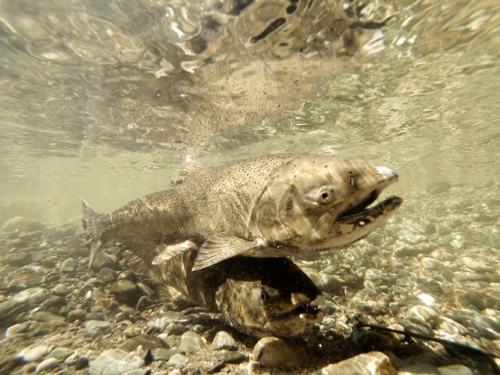
How the tunnels will save fish – I don’t think so

KMG_gopro_fish_140431

Our infamous Peter Moyle once again publishes a report, New report claims tunnels could help save native species, that favors the tunnels. Unfortunately, Moyle’s research often seems to be slanted.

Here are my problems with this latest report.

First, Moyle received guidance and direction in this effort by Metropolitan Water District, the agency pushing the tunnels forward.

Second, a great deal of his analysis is based on habitat restoration: “Achieving this goal,” [saving native fish from extinction] “according to the report, will require restoring a great deal of riverside habitat in the northern and western Delta. Saving the native fish, the report says, will also probably require building the Delta tunnels, or something resembling them.”

Third, it is based on the status quo continuing. Boyle claims that “We predicted they’d go extinct if present trends continue,” he said. “The new report is a plan to make present trends not continue.”

But I say, why not first do the obvious. Fish need water. The pumps are exporting too much water. Why not cut back to the levels approved by the legislature and levels dictated by the Delta Flow requirements first? All true scientists agree that is the most likely and safest way to stop their demise and reverse this horrible decline of so many fish species in the Delta.

Then he returns to EcoRestore: Moyle points to the other part of the solution, EcoRestore: “The new report outlines a state-mandated project called EcoRestore, initially introduced several years ago as a mitigation to the Delta tunnels project. EcoRestore would protect or revive about 30,000 acres in the Delta region – mainly floodplain and inter-tidal habitat. ”

The problem? EcoRestore was named and then shelved. There has been no work done on the project, no EIR, no Habitat Conservation Plan, no evaluation, no analysis, no review. In 2014, the state split the BDCP into it’s two halves: EcoRestore (the environmental half) and WaterFix (the tunnel half) and then moved ahead only with WaterFix. There’s no funding, nothing for EcoRestore.

“People know what the fish need,” Moyle said.

He’s right on that. Fish need fresh water. It’s time for the state to start providing that.

Boyle continues: “The status quo is not sustainable; it will result in the likely collapse of many remaining stocks of desirable fishes even with large investment in restoration projects,” the new report warns, referring to the existing water diversion system.

Right again – status quo is not sustainable. Step one is cutting back on exports. No other hocus pocus will accomplish anything.

March 7 Update

Updates since our last post Feb. 17.

A lot of hubbub is going on, but nothing that has changed in the process since our last update.

Some people were disappointed that the judge turned down a recent lawsuit the City of Sacramento and other cities and counties to stop the The State Water Resource Control Board Part II Hearings due to the ex-parte communications Save the California Delta Alliance (STCDA) had uncovered in early February.

But as our Legal Council, Michael Brodsky, said: “It is very difficult to prevail in a lawsuit against an administrative agency during the middle of the agency’s process. The general rule is that you have to wait until the agency makes its final decision on the whole matter and then go to court with all issues at one time.”

“In administrative law this is known as the ‘finality rule.’ ”

That being said, we would have loved it if they had prevailed and if the judge had stopped the Hearings. It was worth a try!

That ruling does, however, not change our course of action.

The SWRCB Hearings have resumed, albeit a few weeks later than they planned due to our findings of ex-parte communications and due to the Department of Water Resources (DWR) flip-flopping between one or two tunnels and variations thereof. But bottom line, we’re still on-plan. STCDA has submitted testimonies and are prepared to testify at the Part II Hearings to raise our strong objections to them ripping up the Delta during this construction project, ruining legacy communities in the North Delta and boating communities in the South Delta; dumping tunnel muck everywhere as they go. And, as always, STCDA is opposed to the end result of tunnels routing water around the Delta instead of through it, destroying farms, fish, and communities in the Delta.

The good news from finding the DWR/SWRCB colluded during the Part I hearings, is that we will have a much stronger case if the SWRCB actually issues a permit. A judge will not look kindly on their permit approval when they colluded and then continued anyway. So our “Stay” request strengthened our future law suit. It’s too bad they keep marching along, wasting everyone’s time and money, but we are still confident we have the law on our side once we get to the lawsuit period (which needs to wait until they have actually issued a permit.

HOWEVER, we need more donations for this next phase! Your donations are greatly appreciated. Click on the Donate button on the http://www.NoDeltaGates.com or on our FaceBook page or send a check made out to “STCDA” and mail to STCDA, P.O. Box 1760, Discovery Bay, CA 94505.

Other Hubbub: Metropolitan Water Distict (MWD) is considering funding more of the tunnel project so they can build both tunnels up-front instead of one now and then raise money for another later. They are working on a plan to charge the other farmers that are on the CVP water to help offset their costs. Whether they will/can do that is a question. And even if they can, that doesn’t make the tunnels cost effective for them or anyone.

There is no Financial Analysis for two tunnels or even one tunnel now and one later. Dr. Sunding did his one-tunnel cost/benefit analysis that we posted about here: https://nodeltagates.com/2018/02/18/review-of-the-cost-and-benefits-analysis-continued-the-earthquake-bogey/and everyone have shot full of holes. Dr. Sunding, once again, did a very poor financial analysis – really bad. He ignores all the negative economics, overblown the risk to earthquake, etc., and misses the point. He says that they will get cost benefit from more water, but a more recent report agrees – there will be no more water from the tunnels than they are getting now. The reductions in exports that will be coming are going to come regardless of where they take out the water. The smoke and mirrors they are hoping for, hoping to fool environmentalists, scientists, and judges about the negative impact of exporting too much, are just not going to work this time.

Summary: STCDA is on-track and preparing our data to stop them, but need your support. Please donate!

STCDA’s Feb 17 update in case you missed it:

Summary of Recent Events

Review of the “Cost and Benefits Analysis” Continued – The Earthquake Bogey

CaliforniaDelta

I forgot to add in my prior review Review of the New Cost and Benefits Analysis one very important criticism. My husband Mike pointed out this error in the analysis on the first Cost & Benefit Analysis David Sunding did back when it the tunnel plan was being called the Bay and Delta Conservation Plan (BDCP). And that is the “earthquake bogey,” a term coined by Dr. Robert Pyke. A recent paper on the subject is here: “Update on the Earthquake Bogey”.

The “rumor” of earthquakes in the Delta have long been one of the phony justifications used to build the tunnels.

Dr. Pyke’s points, which I totally concur with, are:

  1. It is wrong to assume a near-term repeat of the 1906 earthquake on the San Andreas fault. “The big one.” Such an earthquake has a mean recurrence interval of 200-300 years, (so before the year 2106 or at a minimum 2206) so that it is not necessarily imminent, but it will recur in due course and is a much greater threat to the dams of the Santa Clara Valley Water District which are close to the San Andreas fault than it is for the Delta Levee System, which is miles away.
  2. The risk of damage to the levee system from earthquakes is less than the risk of damage to the existing pumping plants and aqueducts which lie along the various segments of the Central Valley Coast Ranges thrust fault (on which the Coalinga earthquake occurred). That is what DWR, Reclamation, and the State and federal water contractors should be worried about.

Yet, Dr. Sunding in his earlier Cost and Benefits Analysis claimed a 2 percent chance/year of “the big one.” First, that is too high a percentage. But second, in his prior analysis and repeated in this one is the assumption that a magnitude 6.7 on the Hayward Fault would cause a projected average of 24 flooded islands.

So let’s think about this. 24 flooded islands?

  • When was the last time a levee failed due to an earthquake? Oh, let me think about it. Let’s see . . . never.
  • How often do levees even break? Well we did have some minor levees break during the big storms during 2016 (no major flooding of important farmland, etc. – just some minor islands where the levees aren’t maintained. Before that? Jones Tract 2004. That’s 14 years ago !!! And that wasn’t due to an earthquake. They still don’t know why it failed.
  • And what happened when it failed? Well, the farmers probably had quite a fright but as far as the water supply – no impact, nada.

Let’s face it folks – this is a made up scare tactic to get L.A. urban users to panic and say, “Gee – we’d better build those tunnels or we might be drinking salt water when the ‘big one’ hits.”

And Sunding weighs the earthquake bogie heavily into his Cost and Benefit Analysis. We could have an earthquake (even though there are no active faults in the Delta). It could damage some levees. But Sunding’s arguments and analysis are bogus.

Why Save the Delta?

A personal perspective . . .10448717_10204505844510001_7595069425801879790_o

I had the good fortune of attending a birthday party last night for a dear man in our yacht club who has struggled with cancer for years. We all love him so much. If anyone can beat Stage 4 cancer, it’s John. He’s the most upbeat, optimistic, amazing person I know. And his wife, Cheryl, has also battled cancer. Wow.

People were talking at the event and I was chatting with Jean (Jean and John are boating friends of ours). They still work (bummer, says the retired person). They live in Silicon Valley during the week and come to their Delta home Friday night until either Sunday night or Monday morning, depending on work schedules.

We talked about how it feels arriving in Discovery Bay on the weekends. It’s like all the stress falls away. It’s an “Ahhhh” moment.

I don’t know why exactly, why this place is so special.

I was reminiscing with Jean about when Mike & I commuted on weekends. We’d sold our Sunnyvale house earlier than planned and we were both still working. So we thought we could just stay in a Mountain View apartment during the week.

Well, apartment living when you’ve had your own house for years just isn’t fun. We could hear the closet doors closing in the unit next to ours. And people coming down the stairs. Lucy, our yellow lab, hated it. She destroyed all the blinds the first day we left her. Anyway, after six months we gave up and moved full time to the Delta and commuted back to our jobs. That’s tough.

But every Friday, when we drove the 2-3 hours to Discovery Bay and turned off Highway 4 onto Discovery Bay Blvd., there’s like a feeling. All the tension drains out and you go, “Ahhh.” We ended up moving full time to DB before we retired and just commuting back and forth. That was better.

What is it out here in the Delta, that makes us go “Ahhhh?”

When we first moved to our new home, we had an Open House event. One of my friends from work, Chanan, drove out from Sunnyvale with his family. He was on our back deck and we started chatting. He said that when driving out he couldn’t figure out why we’d moved so far away (knowing I was still commuting in/out every day). As they drove over Vasco Road, past the windmills, then dropped down and there were cows and farms and he said he wondered again what we were doing way out here. Then he got to the house and was sitting on the back deck and there was the water, the Delta, and the “Ahhhh,” and he said, “I get it now.”

That’s what so many people say.

Before we built our house, we were snow skiing one weekend with my daughter and her fiancee and talking about the lot we’d bought in Discovery Bay and hoped to build on one day.

“Where’s Discovery Bay?” Shane, our son-in-law asked.

We can drop by there and show you on our way home,” we offered.

So we took the route from skiing to Silicon Valley via Hwy 4 and pulled into Discovery Bay. The sun had set. We pulled into Drakes Drive and stopped at our vacant lot. Everyone got out and we walked through the dirt/weed lot to the back, to the water. We all stood there a moment, looking at the calm water, the Stockton lights in the distance, the peace, the quiet. And Shane said “Ahhhh. I get it now.”

What is it worth, saving the Delta? It’s worth everything.


Blog Stats

  • 126,146 hits

Support the STCDA

Sign up for Emails

Sign Up Now

Request a New Lawn Sign

Click Here to send an email to the lawn sign committee.

Receive news blog via email.

More Blogs

Educational Books about the Delta

Sassy the Salmon
and
The Fable of the Farmer and the Fish
All ages: K and above
Proceeds go to STCDA