Paying Off Delta Communities will not Save the Delta

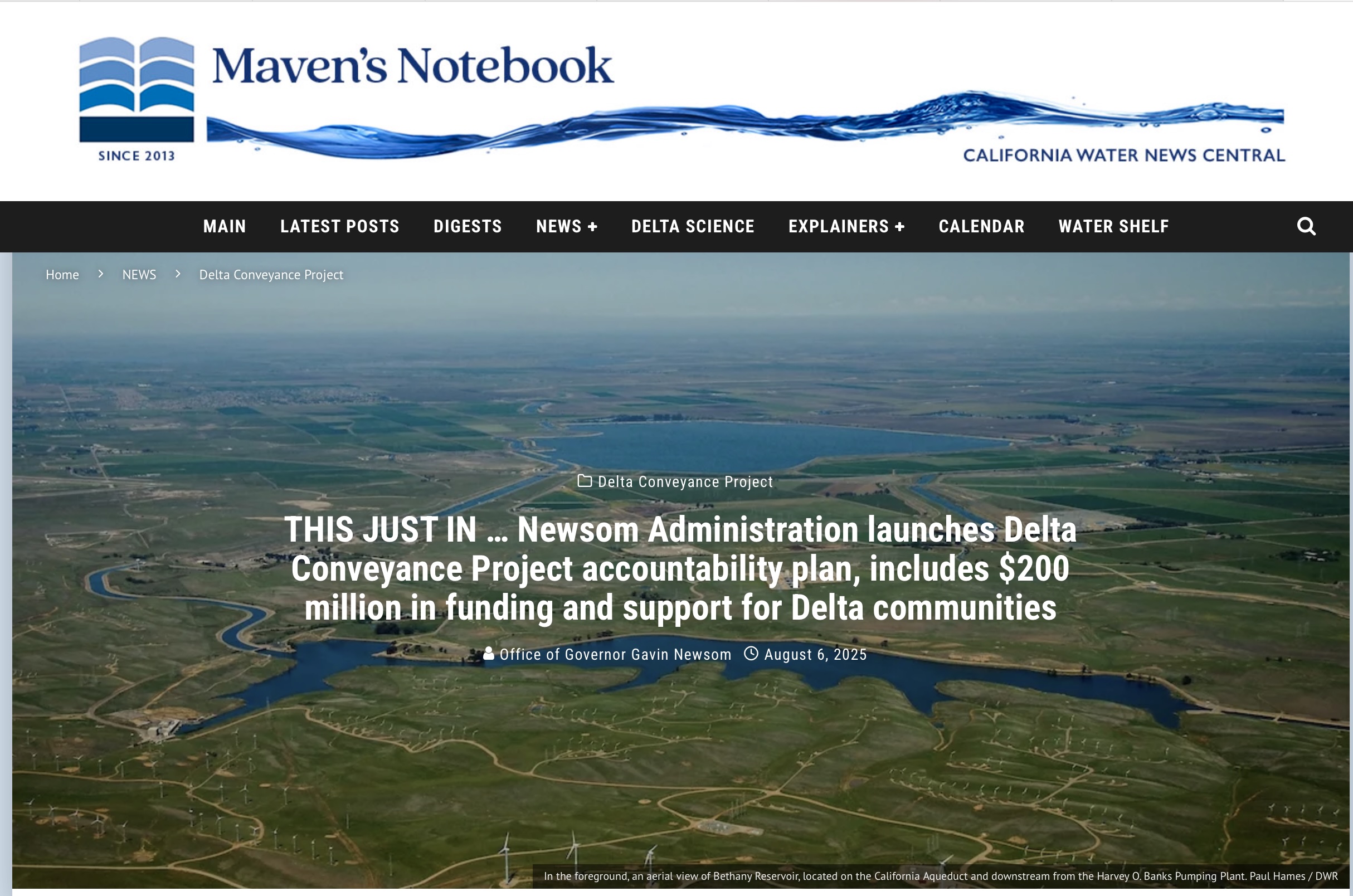
Governor Newsom and the California Department of Water Resources announced a series of actions that will “ensure accountability and transparency” for potentially impacted communities during construction of the Delta Conveyance Project, a critical piece of the state’s water and climate adaptation strategy.

Lies, lies, and more lies.

They are saying they are doing what Delta communities want because they listen to us. But the truth is, everything they are doing to reduce impacts (e.g., elimination of barges which STCDA fought for to keep the Delta open for boating) is because they were told they were going to lose to us (the Delta communities, like Discovery Bay) and the project would never be approved if they didn’t give up fighting us and do what we demanded in our STCDA lawsuit.  They fought everything tooth and nail until they were forced to give in; and will continue to fight against anything for Delta communities until they are forced to give up again.

But Delta Communities don’t want a “buy-out.” We want them to not pump out the fresh water from the Sacramento River around the Delta that would cause more water pollution, kill the water fowl, and finally cause the salmon and other fish species to go extinct.

We want them to not dig up the town of Hope and destroy it. Their $200 million will not give an entire community their homes and businesses back. We want them to not destroy sacred Native American lands, not to destroy important wildlife wetlands.

We want them to kill this decades-old pipe dream that is now antiquated and will destroy the Delta ecosystem. A project that creates no new water!!!

We want them to instead invest in projects to protect and restore the Delta like levee maintenance and projects to reduce water needs across the state like recycling, conservation, and desalination. Projects that would actually increase the amount of available water in the state..

In a timely article in CalMatters by Devon Provo, https://calmatters.org/commentary/2025/08/delta-water-tunnel-project-california/, she writes about the Eaton Fire and long-standing human errors in handling water in the state. There it began with the LA Aqueduct and the draining of Owens Valley, creating an environmental disaster. “Instead of investing in local solutions like stormwater capture, recycled water and fire stewardship, Los Angeles prioritized importing water, urban sprawl, and fire suppression practices throughout the 20th century, leaving it increasingly vulnerable to disaster.”

She writes, “This legacy didn’t spark the Eaton Fire, but it seeded conditions that allowed it to spread and devastate. Eventually the truth catches up to us. The land remembers what we try to forget. 

“Meanwhile, policymakers rely on public amnesia. The governor’s latest push to secure legislative approval for the Delta Conveyance before the session ends in September risks repeating history. The success of this water diversion megaproject hinges on the same myth of control, the illusion that humans stand apart from the very ecosystems that sustain us, that futile attempts at domination can shield us from the fragile, uncomfortable reality of our interdependence with nature.

“A tragedy like the Eaton Fire reminds us that true leadership begins with humility, with the courage to take a hard look at ourselves and admit that we’re in a relationship with living systems, not in charge.”

Paying off Delta communities will not save the Delta.

Write to your California Legislators today. Tell them to oppose Gov. Newsom’s Delta Conveyance Project!

True Delta Tunnel Costs Exposed!

The California Water Impact Network‘s Press release exposes that the Delta Tunnel would cost $60-$100 billion  not the $20 billion DWR has been falsely claiming. CWIN press release below:

July 14, 2025

FOR IMMEDIATE RELEASE

C-WIN Submits Damning Testimony on the DCP

Project is Overvalued, Under-Analyzed, and a Massive Blow to Ratepayers and the Environment

The California Water Impact Network has submitted written testimony and a detailed report to a State Water Board hearing excoriating Governor Newsom’s proposed Delta Water Conveyance Project (DCP).

“Our testimony and full report were prepared by ECOnorthwest, a leading environmental economics research firm, and it documents how the DCP simply doesn’t pencil out,” said Carolee Krieger, C-WIN’s executive director. “ECONorthwest estimates that if it ends up getting built, the DCP could cost anywhere from $60 to over $100 billion.” That is 3-5 times higher than the approximately $20 billion that the Department of Water Resources has been falsely claiming.

“Like the MAGA budget, the DCP represents a massive transfer of money from working Americans to powerful corporations and wealthy plutocrats,” said Gomberg. “The DCP will basically exist to provide guaranteed revenues for Southern California water agencies and to maximize profits for almond and pistachio producers in Kern County, with most of the costs borne by Southern California ratepayers and taxpayers. Their children and grandchildren will still be paying the interest and operating costs of this massive boondoggle decades from now.”

The ECONorthwest testimony, prepared by Dr. Mark Buckley, details multiple flaws with the DCP, including:

Cost Overruns and Affordability

The Oroville spillway restoration was supposed to cost $200 million. It ended up costing $1.1 billion – 450% higher. Estimated costs for the California High Speed Rail were $33 billion, with real costs now standing at about $128 billion and rising. DWR’s low-ball cost estimate for the DCP similarly fails to account for multiple sources of uncertainty and financial risks. With inevitable cost overruns and water rates rising quickly, the DCP could force many households, both urban and rural, to choose between paying for water and other basic needs.

Opportunity Costs 

A project that could end up costing well over $60 billion negates the possibility of other investments in conservation, local supplies such as recycled water and stormwater capture, and retirement of agricultural land.

Overestimated Municipal Water Demand

Urban water use is steadily declining as Californians become more waterwise. Moreover, California’s population growth is slowing in part due to climate change-induced cost of living impacts, including increased insurance rates. The cherry-picked forecast water demand scenario used to justify the DCP therefore has no basis in reality.

Fishery Collapse

Economic losses from salmon fishery impacts would range between present value $1.1 and $2.6 billion over the lifetime of the DCP.

The ECOnorthwest report also documents flaws in DWR’s assessment of seismic benefits and agricultural impacts, further undermining their justifications for the DCP.

“It is time to put this fever dream to bed and the ECONorthwest report proves why,” said Gomberg.

Read the full testimony and report.

CONTACT

Max Gomberg

(415) 310-7013

maxgombergca@gmail.com

Christina Speed

C-WIN Communications Director

info.cwin@gmail.com

www.c-win.org

The California Water Impact Network is a state-wide organization that advocates for the equitable and sustainable use of California’s freshwater resources for all Californians.

STCDA Attorney Michael Brodsky Interviewed on CBS News About Water Debate

On Tuesday, January 28, CBS News reporter Wilson Walker interviewed Save the California Delta Alliance’s attorney, Michael Brodsky, about the state’s water supply and President Trump’s recent comments.

January 28, 2025, By Wilson Walker

https://www.cbsnews.com/sanfrancisco/news/californias-water-system-thrust-into-the-national-spotlight-by-president-trump/

California’s water system has remained a complex topic and was recently put into the spotlight by President Donald Trump’s comments. 

“This is the intake for the Central Valley Project, the federal system that takes water from the Delta and distributes it to farmers in the Central Valley,” explained Michael Brodsky, drifting past the gates that keep plants and debris out of the intake system.

It’s one of the valves at the center of the California water discussion. 

“This is a project that the federal government controls,” Brodsky explained. “It’s operated by the United States Bureau of Reclamation and the president certainly has a sway over how this is operated.”

Just a few minutes away, there is another. But it’s less a valve and more of a giant straw.

“The other is the state of California, which has its own separate canal system called the State Water Project,” Brodsky said. “That supplies water to the Central Valley and all the way to Southern California, and this is the point where it’s removed from the Delta.”

And just a bit farther up the Old River there is yet another straw, this one for more than a half million people in the Bay Area.

“This is the one of the intakes for the Contra Costa Water District,” Brodsky said of the pumps just off the river. “So the water that’s taken from the Delta here supplies drinking water for a good portion of Contra Costa County.”

Brodsky is legal counsel for the Save the California Delta Alliance. He said the freshwater pool that’s so critical to so much of California simply has too many straws.

“The technical term is right now the Delta and the Sacramento River system are oversubscribed,” he said. “More people have rights to take more water than the system can possibly support.”

“Open up the pumps and the valves in the north,” Trump said recently. “We want to get that water flowing down here as quickly as possible.”

As for the President’s executive order, the fish in the title would presumably be the federally protected smelt. But saving those tiny fish isn’t just about preserving them, it’s also about preserving a freshwater delta against the push of a rising sea.

“And the more water is diverted from the Sacramento River from the Delta, the farther upstream and the saltier the Delta gets,” Brodsky said of the longstanding scientific consensus. “Eventually to the point where water can’t be used for agriculture and can’t be used for drinking water.”

And the smelt debate flows into another critique of California water policy.

“President Trump talked about millions and billions of gallons of water going out to sea and he blamed that on the Delta smelt,” Brodsky said. “The main reason why a whole lot of water goes out to see that might be put to other uses is because we have nowhere to put it. We don’t have any storage. We don’t have the reservoir capacity, and we don’t have the capacity to recharge ground water in the Central Valley where it could be stored.”

For his part, Brodsky said there are some possible ways out of this stalemate over Delta water, but he said the real answers lie much farther south.

“We cannot continue to send an unlimited supply of water to Los Angeles,” he said. “And it makes sense to look at other ways to supply Los Angeles with water.”

And while it’s unclear exactly how the President might change this conversation, Brodsky said the state’s notoriously complex water challenges have some simple truths.

“At one level, though, it’s pretty simple,” Brodsky said of the California water. “With the infrastructure we have right now, we can’t take any more water out of the Delta system without harming our Northern California farmers, our Northern California cities, and the environment.”

The Bay Area is already living with the implications of all this. In Antioch, for example, they’re building a desalination plant for the water they pull out of the river, anticipating changes as the Pacific pushes in. The Delta tunnel debate is part of this, just like the periphery canals proposed back in the 80s. This is a generational stalemate over California water. So how might Trump change the course of things? That, right now, is anybody’s guess.

STCDA President Interviewed on CBS about Delta Conveyance Project

On January 13, Save the California Delta Alliance’s President, Karen Mann, spoke to CBS News about the flaws in the state’s water tunnel project. Watch below for the full video, or click the link here: https://www.cbsnews.com/sanfrancisco/news/santa-clara-valley-water-districts-votes-to-support-delta-tunnel-project/.

Sacramento News & Review: State suffers another legal loss in its effort to build controversial Delta Tunnel

July 22, 2024. By SN&R staff

In late June, a Sacramento County Judge ruled that the California Department of Water Resources, or DWR, had to suspend its efforts to conduct geotechnical “exploratory drilling” on private property across the Delta.

Agents for DWR had wanted to get onto peoples’ land and start boring holes in the soil as part of laying the groundwork for Governor Gavin Newsom’s highly controversial Delta Tunnel.

The struggle that farmers and homeowners in the estuary engaged in to keep DWR away from their gates goes back at least for years. At one point, it was contentious enough that Sacramento County went as far as to seek a restraining order against DWR employees on behalf of property owners between Hood and Courtland.

On June 20, Judge Stephen Acquisto ruled that DWR cannot encroach on private citizens’ property and begin trenching, testing pits, staging activities and installing monitoring devices, as the Newsom administration had hoped to do. The judge blocked these plans by granting an injunction that was petitioned for by local governments, tribal organizations, environmental nonprofits and various fishery groups.

According to the attorneys who pulled off this legal win – Thomas Keeling, Osha Meserve and Roger Moore – the judge agreed that DWR’s intentions would be violating the 2009 Delta Reform Act.

For those battling to stop the proposed tunnel, which critics say will kill businesses in the Delta, destroy its farmlands and collapse its eco-system, this was the second big legal win against the Newsom administration since January: In the previous victory, Sacramento County judge Kenneth C. Mennemeier Jr. had ruled that DWR lacks the authority to issue revenue bonds to help finance the estimated $20 billion it will take to build the project.

Now, the legal developments on June 20 mean the project’s monetary and geotechnical prep work are both in limbo.

Nevertheless, Newsom continues to publicly champion the tunnel, a project that’s at the top of the wish list for some of his largest campaign donors, though it is opposed by virtually every environmental protection group in the state.

Read the article here: https://sacramento.newsreview.com/2024/07/22/state-suffers-another-legal-loss-in-its-effort-built-controversial-delta-tunnel/

Court Issues Preliminary Injunction Halting Geotechnical Investigations for the Tunnel Project

On June 20, 2024, the Sacramento County Superior Court stopped the California Department of Water Resources (DWR) from undertaking further geotechnical investigations implementing the Delta Conveyance Project (DCP, better know as the “Delta Tunnels”) until DWR files a certification of consistency with the Delta Stewardship Council as required under the Sacramento-San Joaquin Delta Reform Act of 2009 (Delta Reform Act). The DCP will, among other things, include two new intake facilities on the Sacramento River in the north Delta near the community of Hood, and a concrete-lined tunnel and associated vertical tunnel shafts to convey water from the intakes 45 miles to the Bethany Reservoir Pumping Plant and Surge Basin located south of the State Water Project’s Clifton Court Forebay. The geotechnical investigations would have included thousands of borings, trenching, installation of monitoring devices, test pits, and other tests throughout the Delta and along the path of the proposed DCP facilities to gather information for further project design and construction. The DCP final environmental impact report identified over 70 significant impacts relating to the geotechnical activities and the need for over 90 related mitigation measures.

Read more at https://somachlaw.com/policy-alert/court-issues-preliminary-injunction-halting-geotechnical-investigations-for-the-delta-conveyance-project/

Sacramento News & Review reports on ‘flawed’ benefits analysis by Newsom administration

The Sacramento News & Review published an excellent article on May 21 on DWR’s recent “Benefit-Cost” analysis of the Delta Conveyane Project, highlighting the environmental and economic flaws of the report. Read the full article here.

University of the Pacific Economist Dr. Jeffrey Michaels critiques DWR’s recent “Benefit-Cost” analysis of the Delta Conveyance Project

University of the Pacific Director of Public Policy studies, Dr. Jeffrey Michaels, released a letter to the Metropolitan Water District (MET) critiquing the Department of Water Resources recent “Cost-Benefit” report, critiquing the report for making “extreme assumptions” and pointing out several miscalculations.

Read his official letter below and additional comments on DWR and economic analysis on Dr. Michael’s blog here.

STCDA Board Member Files Protest against Delta Tunnel intake on behalf of town of Hood on environmental justice grounds

STCDA Board member and attorney Michael Brodsky filed a petition to the state Water Resources Control Board protesting the placement of the Delta Conveyance Project intake tunnels in the town of Hood. Brodsky cited the Department of Water Resources (DWR)’s unlawful discrimination and violation of environmental justice principals.

The Hood Community Council and Hood community members had objected repeatedly to DWR’s placement of the intakes at Hood during DWR’s planning process. Yet DWR refused to meet with Hood representatives and refused to discuss Hood’s grievances about intake site selection.

Frustrated and appalled, Hood Community Council Chairman Mario Moreno organized a door-to-door campaign in September 2021 gathering signatures on the Hood Declaration of Protest Against the Delta Conveyance Project by the People of Hood. Long-time Hood resident Eddie Magana helped with the signature gathering. The Declaration bears signatures representing virtually the entire community. The Declaration was addressed to Governor Newsom and was sent to the Governor, the Delta Conveyance Design and Construction Authority (“DCA”), California Resources Secretary Wade Crowfoot, and DWR. The Declaration begins:

[W]e object, condemn, and oppose the environmental racism being visited upon our community, the majority Latino town of Hood, by your engineers, lawyers, and consultants in the planning of the Delta Conveyance Project.

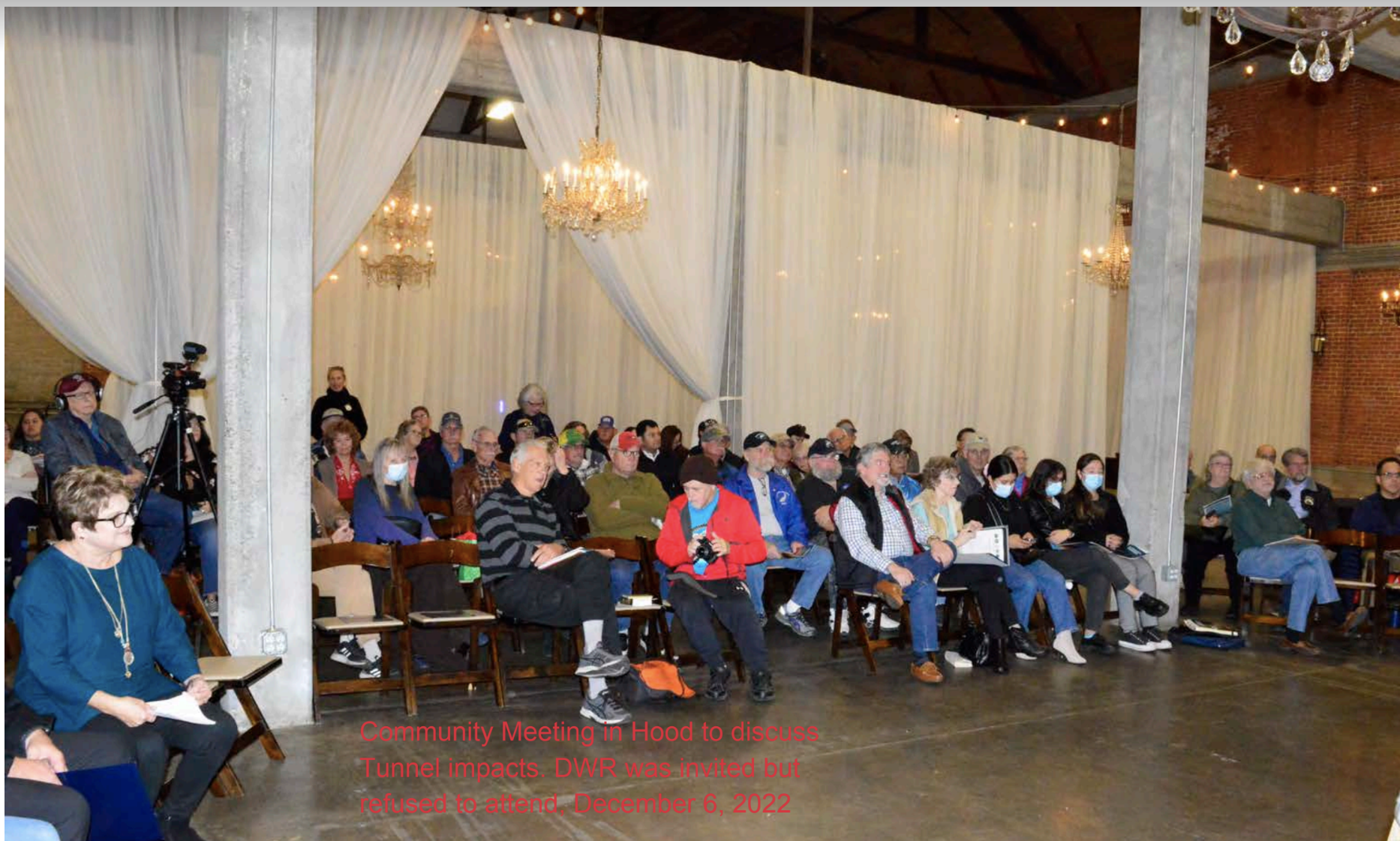
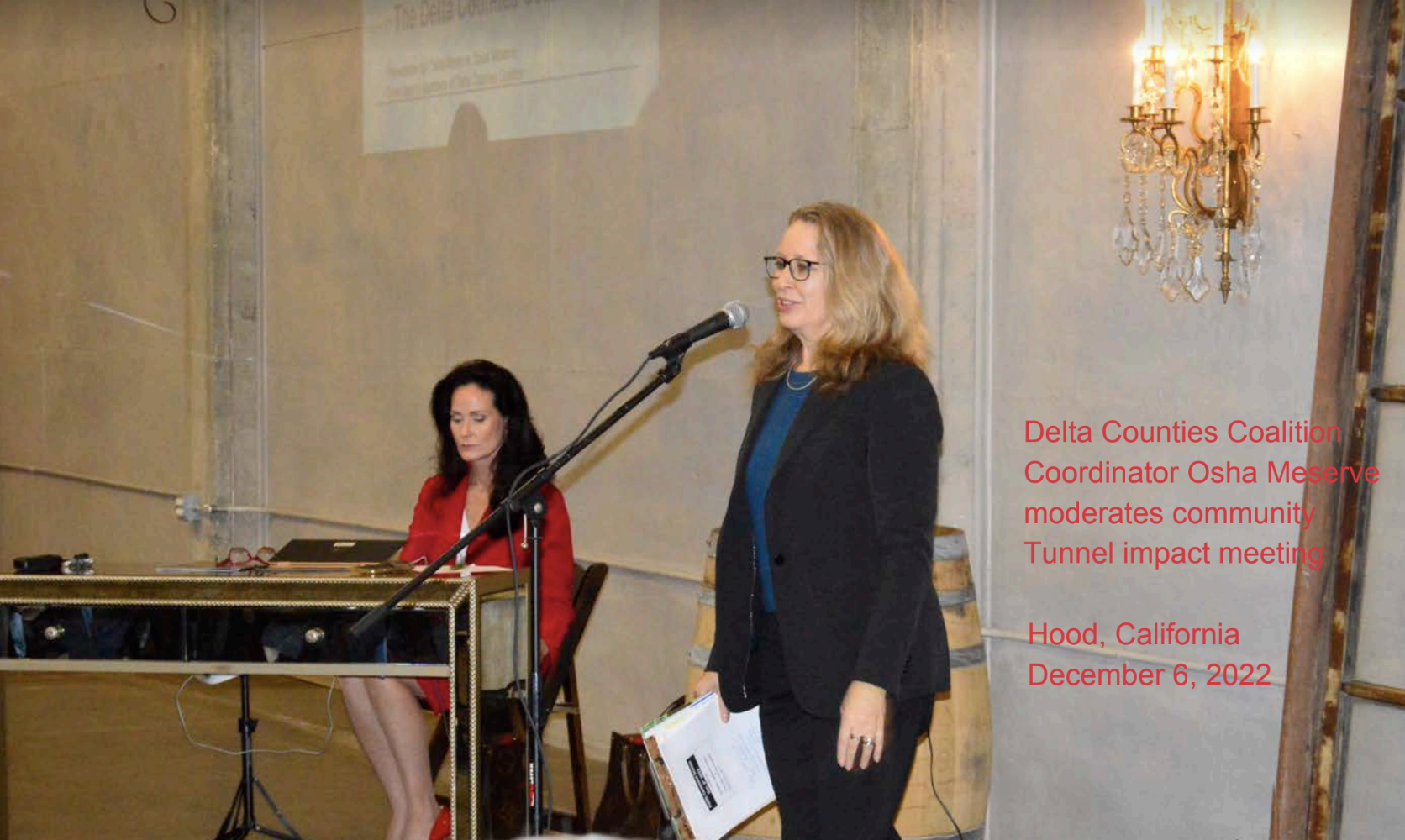
The Hood community, in cooperation with local elected officials, organized a community meeting in Hood on December 6, 2022, to air concerns over the Project; including the disparate impacts on Hood. DWR was invited to attend. DWR refused to attend the meeting. The meeting was well attended, with over one hundred people participating.

The September 2021, Hood Declaration of Protest, endorsed by the 104 households of Hood, aptly sums up what DWR perpetrated on Hood, hiding behind a mask of environmental justice:

Your engineers ignore the plight of our community and insist on locating two gigantic intakes a few hundred yards from the heart of our tiny town. Our pleas to your engineers to move the intakes to anywhere else among hundreds of miles of riverbank fall on deaf ears; they insist we must suffer the impacts of six or more years of heavy construction activity, the daily invasion of thousands of construction workers, that we must breathe the pollution of tons of diesel exhaust from thousands of trucks, the noise, the dust, the blockage of our roads—we cannot survive this onslaught and our town will become a ghost town.

We inform you that your “environmental justice” consultants are but a tool to perpetuate environmental racism. “We have reached out far and wide to minority communities and conducted oh so many meetings and surveys, yes we have” your consultants refrain. But we cannot discuss with you moving the intakes that destroy your town, “they must be here,” say your engineers. Then “all is well,” say your consultants because we have done so much outreach and held so many meetings.

And on it goes, the charade of justice. We demand real justice: do not obliterate our poor brown community: move the intakes.

DWR’s discriminatory conduct and the unfair obliteration of Hood are not in the public interest.

The Project significantly harms public trust values. The Project degrades the Delta Environment and contributes to salt water intrusion into the Delta. Public trust values negatively impacted include water quality in the Delta, air quality in the area of Hood, including within the 1,000 foot impact zone surrounding the intakes and at the Hood Franklin Road Highway 5 interchange. The Project exacerbates climate change and harms the atmosphere; a public trust value. Intake construction negatively impacts navigation in the Sacramento River adjacent to Hood. The long-term health of the Delta ecology, including fish, plants, and other species cannot survive the continued exports embodied in approval of the DCP. The Project will exacerbate Microcystis, Egeria Densa, and other invasive floating and submerged aquatic vegetation.

Take action!

Make your voice heard by writing a letter or email to Governor Newsom demanding they end the Delta Conveyance Project and work toward REAL solutions to provide water for Californians!

Send in Comments

  • Email the Governor online at: www.gov.ca.gov/contact/
  • Mail:
    • Governor Gavin Newsom
      1021 O Street, Suite 9000
      Sacramento, CA 95814

DWR issues “new” report on Tunnel in desperate move to keep project alive

After multiple failed attempts to get the Delta tunnels built since 2006, the state Department of Water Resources (DWR) came out with yet another report touting the supposed benefits of the tunnel. On May 16, DWR released their “Benefit-Cost Analysis”, stating “billions in benefits.”

Cost benefit NOT there

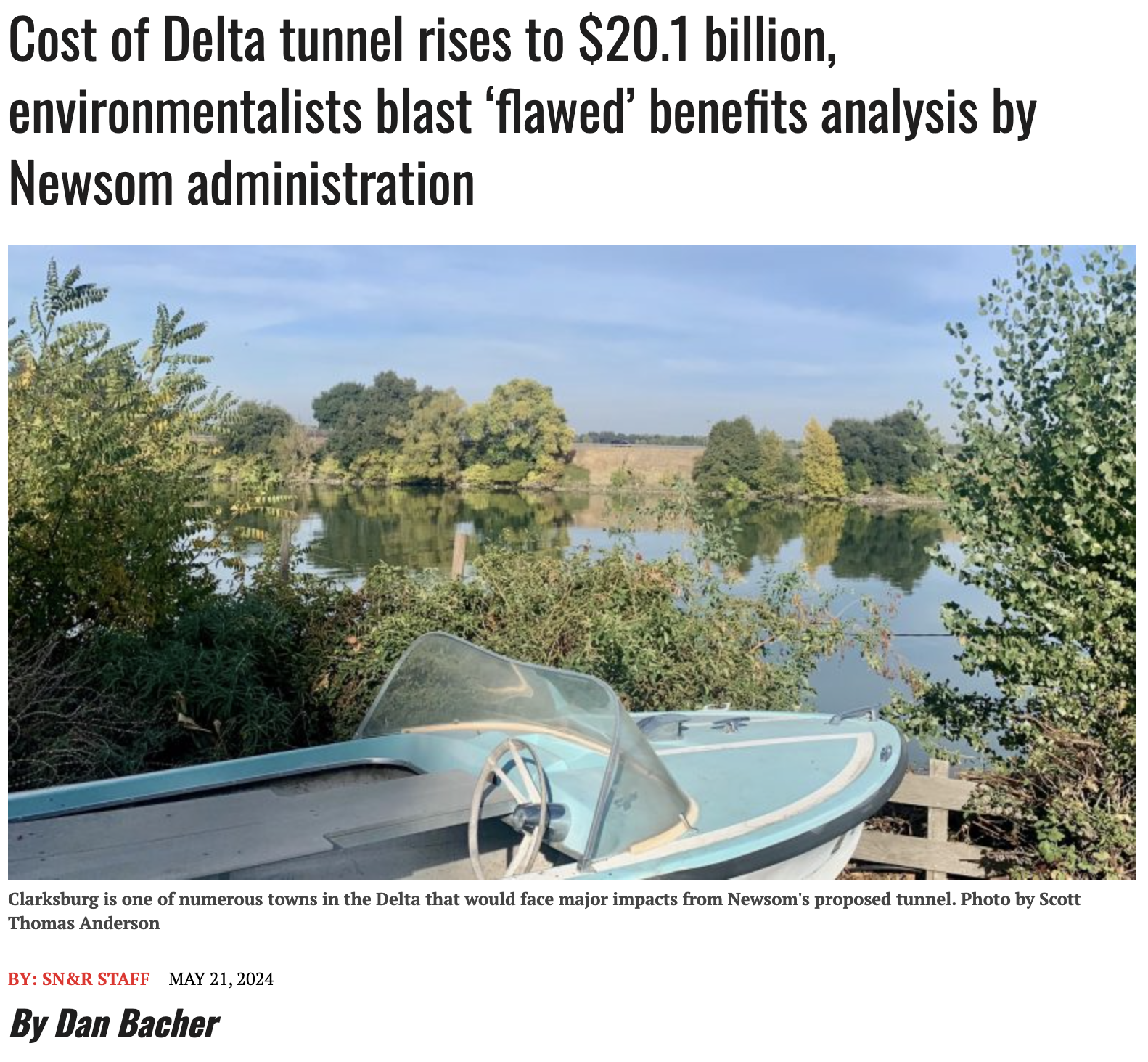
According to CalMatters reporter Rachel Becker, “The new estimate for the Delta tunnel project — which would transform the massive water system that sends Northern California water south to farms and cities — is $4 billion higher than a 2020 estimate.”

(The article pictured above appeared in CalMatters on May 16, 2024).

The article quoted Peter Gleick, co-founder of the Pacific Institute, who pointed out, “This project gets more expensive every single time a new version is proposed, and this type of project has never been brought to completion under budget,” he said. “Water conservation and efficiency improvements are far cheaper than the Delta project.” 

Dr. Jeffrey Michael, professor of Public Policy of McGeorge School of Law and Univerasity of the Pacific, commented after the DWR’s outrageous “Benefits-Cost Analysis” came out, pointing out the fallacious benefits claimed by DWR in their report. He points out: “How do we get from $20 billion to $33 billion urban water supply value, especially when the new project has a lower increase in water deliveries?  In other words, this report shows 50% more value from 50% less water.”

The report is more of the same sugar-coated false claims by DWR to try to push the destructive tunnel project through.

Energy Inefficient and Environmentally destructive

DWR’s stated purpose for the Delta Conveyance Project “is to restore and protect the reliability of water deliveries…” Yet there are many more cost effective and reliable ways to achieve that purpose than building a tunnel that will cost at least $20,000,000,000 and probably much more, pulling water from the Delta region. There are many more cost effective ways to achieve that basic purpose that also have multiple benefits and less environmental impact. Yet the only alternatives studied are a tunnel under the Delta.

The “Delta Conveyance Project” – the new name DWR gave the tunnel project after multiple failed attempts, due to widespread consensus against the tunnel from farmers, Delta communities and environmentalists – will continue the gargantuan task of pumping billions of gallons of water over a mountain range, the Tehachapi mountains, to Southern California. That is the most energy intensive way to supply water imaginable!

Additionally, the Delta watershed supports about 80% of the state’s commercial salmon fishery, which was cancelled this year for the second time in a row because of plummeting populations. Scott Artis, executive director of the Golden State Salmon Association, said in a recent statement, “Bravo, Governor, for turning healthy rivers and estuaries into a punchline that harms tens of thousands of families, businesses and employees across California and Oregon.” He points out, “What better way to address declining salmon populations than by draining their homes?”

Threatens fresh water supplies in the Delta

Rising sea levels will require that more water be allowed to flow through the Delta in order prevent salinity to maintain the fresh water balance in the Delta. Yet no alternative was studied that would address salt water intrusion by strengthening the levies and operating the SWP in the way it was designed to be operated: to repel salt water from the Delta. DWR says they will move the intakes upstream. Moving the intakes upstream to address salt water intrusion abandons the Delta to salt water!

Reducing exports by phasing out deliveries south of the Tehachapi Mountains would provide more available water to devote to environmental flows and at the same time would make deliveries to central valley farmers more reliable. Studies show that the City of Los Angeles can wean itself entirely off of imported water at the latest by 2050, and probably earlier.

Harmful to communities

The “alternative” tunnel intakes that DWR has analyzed are ALL destructive to communities along the Delta. They are now planning the intake station in the small and historic community of Hood, located in near Sacramento. The Hood Community Council and Hood community members objected repeatedly to DWR’s placement of the intakes at Hood during DWR’s planning process. DWR refused to meet with Hood representatives and refused to discuss Hood’s grievances about intake site selection.

Frustrated and appalled, Hood Community Council Chairman Mario Moreno organized a door-to-door campaign in September 2021 gathering signatures on the Hood Declaration of Protest Against the Delta Conveyance Project by the People of Hood. The Hood community, in cooperation with local elected officials, organized a community meeting in Hood on December 6, 2022, to air concerns over the Project; including the disparate impacts on Hood. DWR was invited to attend. DWR refused to attend the meeting. The meeting was well attended, with over one hundred people participating.

The Hood Declaration of Protest, endorsed by the 104 households of Hood, stated:

Your engineers ignore the plight of our community and insist on locating two gigantic intakes a few hundred yards from the heart of our tiny town. Our pleas to your engineers to move the intakes to anywhere else among hundreds of miles of riverbank fall on deaf ears; they insist we must suffer the impacts of six or more years of heavy construction activity, the daily invasion of thousands of construction workers, that we must breathe the pollution of tons of diesel exhaust from thousands of trucks, the noise, the dust, the blockage of our roads—we cannot survive this onslaught and our town will become a ghost town.

Jon Rosenfield, science director of San Francisco Baykeeper, called it “just the latest version of a plain old water grab.” 

Take action!

Make your voice heard by writing a letter or email to Governor Newsom demanding they end the Delta Conveyance Project and work toward REAL solutions to provide water for Californians!

Send in Comments

  • Email the Governor online at: www.gov.ca.gov/contact/
  • Mail:
    • Governor Gavin Newsom
      1021 O Street, Suite 9000
      Sacramento, CA 95814


Blog Stats

  • 126,128 hits

Support the STCDA

Sign up for Emails

Sign Up Now

Request a New Lawn Sign

Click Here to send an email to the lawn sign committee.

Receive news blog via email.

More Blogs

Educational Books about the Delta

Sassy the Salmon
and
The Fable of the Farmer and the Fish
All ages: K and above
Proceeds go to STCDA