Archive for the 'Tunnel(s)' Category


Muck is still Muck

When the pre-draft version of the BDCP came out last spring, one area that caused quite a stir was the exposure that the plan was going to extract tons of tunnel “muck” (their term, not mine) that was mud combined with foaming agents, plastics, and other “stuff” used in the drilling process. This muck had to be stored in hugh muck ponds for drying. Muck is smelly, nasty stuff it was so bad that to ensure that underlying groundwater is not contaminated, these muck ponds be lined with an impervious liner to make sure it didn’t seep into the ground water.

One farmer discovered his farm and beautiful Victorian home was planned to be under a muck pond. Discovery Bay citizens were dismayed to see a stinky muck pond within a mile of their community. Boaters were unhappy to see a muck pond just west of the primary South Delta anchorage, Mildred Island. People drove to Stockton to attend the BDCP meetings and complained loudly.

A few months ago, the BDCP posted a nice glossy flyer about all of the neat things you could do with tunnel muck. They heard the ruckus about muck and renamed it, “reusable tunnel material” or RTM. They brochure claimed it was great to build habitat, build up farm lands that had settled, good for levee walls. A wonder material. Wow. All is well. I expected the next release of the BDCP Plan to describe how they would be removing or reusing the material.

The new final “Draft” BDCP Plan was released Monday December 9th so I grabbed chapter 4 to read how they were going to transport the muck, er I mean reusable tunnel material, out of the Delta or put it to good use.

Surprise, surprise. Chapter 4 is EXACTLY the same wording as the prior version EXCEPT the word “muck” is replaced by “RTM”.

What’s that called again? Oh yes, putting lipstick on a pig. Or in this case, a muck pond.

Isn’t that the same maneuver as calling the Peripheral Canals “smaller underground tunnels”? It does sound better even though their capacity is still 15,000 CFS with the addition of a couple of pumps (the entire Sacramento River), going “under” causes huge construction damage through the heart of the Delta, and the end result is the same: water the Delta needs to remain healthy will bypass the Delta to support big, powerful agribusiness farmers making huge profits sending almonds to Asia.

Your Questions Unanswered

The “In Delta” meetings appear to have been just a scam so that the tunnel proponents could claim they are listening to the Delta citizens. “People Showed Up for the In-Delta Meeting”

Did we get answers? No!

It’s been over 3 months since the meetings so I did a survey of our members asking the question: “If you attended one of the In-Delta meetings August/September (e.g., at the Brentwood Library), can you let me know if you did, what meeting, and if you have received any responses back to your questions/comments.”

Guess what! The result was UNANIMOUS. No one received answers, not one! Surprise, surprise.

A couple of people received email directing them to a BDCP site titled “Your Questions Answered.” That page now has a short list of sixteen questions and answers, none addressing any of the concerns and comments I heard while there. And only sixteen! The page says “Each week we will compile common questions and issues and address them below.” The first In-Delta meeting was August 22. That was 15 weeks ago. So with all of their staffers, they can only address one question a week? Maybe they’ll have more time now that their 30,000 page EIR is being released tomorrow.

Obviously, the questions they “answer” are questions the DWR wants to reply to with their “Newspeak” answers.

Are these Our questions?

One of the latest questions added is “How will the BDCP protect water supplies in the event of an earthquake or levee failure?” That is OBVIOUSLY a trumped up question. First, how to protect the supplies of water being shipped away from us is definitely NOT one of the the top-of-mind concerns from the In-Delta community. Second, no one who lives in the Delta is worried about the bogey earthquake risk made up by the water contractors.

I could be wrong – please let me know if that was one of your questions/concerns.

The entire list of questions we supposedly asked is below. If you asked any of those, go to the BDCP Your Questions Answered website and click the question to see if the answer is a real answer or just another example of Newspeak. Because to me, this page is yet another brainwashing tactic by the state.

  • Will the BDCP affect upstream reservoirs or cause “dead pool” conditions?
  • Can the BDCP Drain the Sacramento River?
  • Would BDCP Divert More Water from the Delta?
  • Is a Biological Opinion required prior to the release of the Draft BDCP? – NEW!
  • How has the BDCP ensured transparency in its planning?
  • How will the BDCP protect water supplies in the event of an earthquake or levee failure? – NEW
  • How will the BDCP address the Delta’s resiliency and adaptability to the effects of climate change?
  • How would BDCP construction affect sandhill cranes in the Delta?
  • Would the BDCP Benefit All 57 Species It Would Cover?
  • What is the California Water Action Plan, and how does the BDCP fit into it?
  • Why can’t the BDCP be replaced by desalination?
  • Will the federal government shutdown impact the BDCP?
  • Will the BDCP impact private wells in the Delta?
  • Will the BDCP impact groundwater levels in the Delta?
  • Will water pumped from the Delta be used for fracking in the Central Valley?
  • How Can a New Water Diversion Help the Delta?

Do you “Buy” their Answers?

Every write-up on that page is just more Newspeak.

If you read their answer about Sandhill Cranes, notice that while in the first sentence the refer to both the Greater Sandhill Crane and the Lesser Sandhill Crane (both are endangered), throughout the rest of the write-up they narrowly focus on how they hope to protect only the Greater Sandhill Crane. The Lesser Sandhill Crane is also inexplicably missing from their list of “57 Covered Species” along with the Great Blue Heron, Snowy Egret and others. Do they know that those are at risk from their construction project or from deteriorating water quality so are avoiding including them in the EIR? I don’t know. I’ve asked, but gotten no direct answer. It makes you wonder.

Meanwhile the BDCP Media Carnival Continues

While the Delta Community got bogus “In-Delta” meetings, meanwhile John Laird, Jerry Meral and others continue to attend various Central Valley farm meetings and speak at other venues to sell the tunnel plan with resulting press coverage. We’ve seen busloads of LA reporters touring the Delta. We’ve seen the media blitz below and expenses being paid for (probably by the taxpayers) to convince the urban communities that they need these tunnels.
Only the Free Press can Counteract the BDCP Marketing Campaign

Hopefully more mainstream Press reports will expose the facts like Linda Yee’s Channel 5 Delta 2-Part special and recent SJ Mercury News editorial that says that the Bay Delta Conservation Plan (BDCP) (aka Delta Tunnels) is the wrong solution for California’s water woes and recommends the readers “follow the money.”

They seem to have plenty of money for media blitzing:
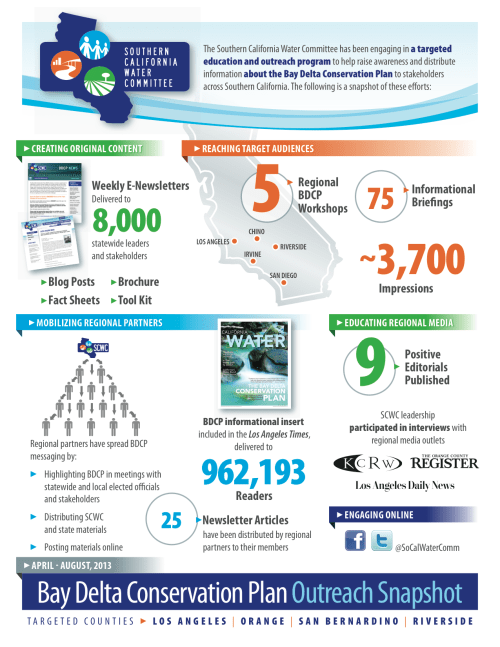
SCWC_BDCP_Snapshot_April-Aug_Final.

Newspeak 2013

In every “pro-tunnel” newspaper article I’ve been reading lately, many of the now familiar false statements are quoted and re-quoted. I’ve heard them so often, it’s starting to sound like Newspeak from Orwell’s “Nineteen Eighty-Four“.

The purpose of Newspeak was, of course, to control thought – especially any thoughts against the state.

  Newspeak

What Newspeak do we hear from the BDCP proponents? As you read press articles with quotes from the governor or his representatives, Department of Water Resources (DWR), water contractors or their mouth-pieces (e.g., the California Farm Water Coalition), count how many of these statements you hear. You can also see them on the BDCP Website.

  • Newspeak 1: “No new water would be taken from the Delta should the tunnels be constructed”.

    Actual: Fresh water will bypass the Delta estuary before it can flow through to be used for fish, farms, communities and recreation; leaving salty polluted water instead.

    This Newspeak was heard most recently from John Laird just last week at a meeting in Yuba City.

    Why is it Newspeak? If you build massive tunnels above the Delta to divert water around the Delta, that’s “taking water from the Delta”.

  • Newspeak 2: The tunnels will result in similar level of water deliveries as currently ‘permitted’.

    Actual: They plan to export more water than they can now. And the current level of exports is killing the estuary.

    First, when they say a “similar level of water deliveries as currently permitted.”, how do you pronounce “permitted”? Is it “per-mit‘-ted” meaning that they will be controlled by environmental and other laws to the amount they are allowed to take? Or “per‘-mit-ted” meaning the amount their permits or contracts allow. Because the latter means they can take all of the water in the Sacramento because their paper water contracts are for more water than exists. See Paper Water.

  • Newspeak 3: “Water is literally going down the drain.”

    Actual: Water flowing through the estuary gives life to salmon and birds, irrigation for Delta farmers, drinking water for Delta communities, clean fresh water for recreational enjoyment and continues on to keep the San Francisco Bay fresh and healthy.

    Water flowing through the Delta is NOT going “down the drain. This Newspeak was most recently found in Yuba City congressional candidate Dan Logue’s campaign pamphlet as “The Problem.” We’ve heard it from Jason Peltier, the Westlands Water representative, at BDCP Meetings. There seems to be an odd view that water should not flow through the estuary. Should we turn all of nature into concrete pipes? Is that the only way to not be wasteful?

  • Newspeak 4: “The BDCP is needed to supply water to 40 million urban users.”

    Actual: The BDCP creates no new water for urban users. But the urban users will pay for it.

    During all of 2013, the two LA reservoirs, Pyramid and Castaic were at over 100 percent of average and about 90 percent capacity. No risk there. In addition, while San Luis (used by Silicon Valley urban users) fell so low that algae formed, the Kern Water Bank was at 88 percent with plenty of water to supply the Silicon Valley users who have priority water rights. Of course, throughout the state, (a) increased conservation and (b) local water sources (recycling, desalination) are highly recommended and needed long-term. The BDCP does nothing for the urban users.

  • Newspeak 5: The tunnels can’t drain the Sacramento River.

    Actual: The tunnels DO have the capacity to drain the Sacramento. And between the expansion possible for farming in the desert plus fracking needs, the Central Valley special interests’ need is unbounded.

    From the BDCP “Questions and Answers” website: “Operation of the BDCP water delivery system could not drain the Delta rivers and channels dry. The BDCP only would be permitted to operate with regulatory protections, including river water levels and flow, which would be determined based upon how much water is actually available in the system, the presence of threatened fish species, and water quality standards.

    However, that is true today and we are continually finding out that the operations aren’t protecting the fish species (see recent “Feds may have harmed Salmon River Salmon” article (again). It took a court battle this summer to have water released from the Trinity to protect salmon, and then it was only a portion of the recommended amount. The State Water Resources Control Board is continually pressured to reduce their standards for salinity and flow in the South Delta, impacting farmers and the state keeps managing reservoir flow to aid the Central Valley farmers, not the Northern communities, the Delta farmers nor the environment.

    If the tunnels have the capacity to drain the Sacramento River (which two 40-foot tunnels have), the risk is huge that eventually they will drain the river.

  • Newspeak 6: The BDCP is needed to protect the state’s water supply from risk of earthquakes and the aging levee system.

    Actual: There is no real risk of earthquakes in the Delta and no valid concern about massive levees failures.
    The “earthquake bogey” is a made-up concern. See the facts in Dr. Pyke’s comment letter. He also reports that the levees are in good shape.

    The real earthquake risk to the state’s water supply is in the South: The risks to the Aqueduct (which crosses the San Andreas fault), the San Luis Reservoir (which has fissures), and the Central Valley’s Success Lake Reservoir (which is currently only 10% full due to seismic concerns). Besides earthquakes in the Central Valley, other significant risks are from sinkholes showing up due to groundwater depletion in the Central Valley.

  • Newspeak 7: The BDCP will benefit 57 species.

    Actual: It will NOT benefit 57 species and furthermore, there are many species it ignores.

    This Newspeak really irks me.

    • First, the misnomer of calling a Tunnel Plan a “Conservation Plan”.
    • Second, the claim that there is anything in the BDCP that can help the Delta species when the freshwater is removed and taken around the Delta instead of flowing through it. All of the “habitat projects” listed in the plan are speculative, unproven, and based on faulty science.
      Great Blue Heron
        • Third the fact that some of our favorite threatened species are left out: The great blue heron, snowy white egret, lesser sandhill crane. Even the fate of our local ducks and geese are not protected by the plan.


      The primary purpose of the BDCP and Delta Tunnels is to supply more water for continued expansion of almond acreage in the Central Valley to send to Asia, for water-thirsty cotton, fracking and for big L.A. developers to expand housing developments in the LA desert. I.e., for profits, profits, profits.

      Everything else is Newspeak.

The Earthquake Bogey

This is a great letter comment letter written by Dr. Pyke to the State Water Resources Control Board criticizing the recent California Water Action Plan specifically regarding the risk of earthquakes in the Delta and the status of the Delta levee system.

Because of course, there is no big risk of an earthquake taking the levees down and the Delta levees are not all ready to fall down, like Westlands Water District, Metropolitan Water District and others wanting the tunnels would like you to believe.

If you want to have the ammunition to counter people who say the tunnels are needed to protect the exports from earthquakes, i.e., the “earthquake bogey”, hear it from the expert. He even calls out the paragraph in the plan that states the risk as “gobbledegook”. A great read and very informative!

Getting the word out

We asked for more media involvement and Linda Yee, KPIX Channel 5 News picked up the gauntlet, producing a two-part series that aired Friday November 15th. The first covered Delta farmer (Hemley Farms), boaters (McCleery’s on the Delta), businessmen (Bill Pease at his marina) and community concerns in the video taken at the second BDCP In-Delta meeting at the Brentwood Library (including John and Diana Senter and Bob Ackerly).

The second piece features Bobby Brown, bass fisherman, and Linda Yee does a good job exposing Paramount Farms’ role including the Resnicks and their primary ownership of the Kern Water Bank.

Only the Free Press can counteract the BDCP Marketing Campaign

BDCP Marketing Campaign is now in Full Swing

While the citizens in Northern California who will be most affected by the Bay Delta “Conservation” Plan (BDCP) Peripheral Tunnels get “checkbox” public outreach meetings, here’s what the citizens in Southern California are getting to “sell” them on the idea:
BDCP_OutreachSnapshot_0905

We’ve been asking for regional BDCP Workshops or local meetings for months. Five regional workshops and 75 information meetings are now planned in Southern California. Almost 1 million “educational inserts” (myth marketing) included in LA newspapers.

We need the Press

When this much money is being spent on marketing the myths and hype from the tunnel proponents, Northern California must rely on the Press to expose the truth about the tunnels. Northern California groups cannot match the money being spent by the water contractors to sell their Peripheral Tunnel idea.

Grassroots community organizations like Save the California Delta Alliance, environmental organizations and others have been working around-the-clock trying to get the word out, get the press involved, and inform the citizens of Northern California about the Bay Delta “Conservation” Plan (BDCP) Peripheral Tunnels and the impacts they will cause to our area of the state.

Yet still, many attendees at last Saturday’s Tomato Festival in Brentwood had no idea what the Tunnels were or how they would be affected!

What is being done by the State or the BDCP to educate the people who will be effected by the Tunnels? Nothing!

The BDCP public outreach group announced “In Delta” meetings in places like Brentwood and others to allow Delta citizens to come in “as a resource for Delta citizens and community members who are in need of additional information or would like to provide input to the BDCP effort” (according to their website). The actual events were not informative as reported last week People Showed Up for the In-Delta Meeting. We got no answers and DWR reps tried to keep Central Valley Times reporter/photographer Gene Beley from taping the public meeting – see Brown Administration Bars Reporter From Filming Public Meeting On Tunnels.

In the North, attempts are being made to keep people from even knowing about the tunnels with removal of signs and not allowing the Press at public meetings while the water contractor’s marketing machine is busily trying to sell the masses in the South on the fallacy of how good the tunnels will be for them.

Thank you to the Central Valley Business Times, Daily Kos and reporters like Gene Beley, Alex Breitler, and Dan Batcher (and others – sorry if I missed you) who go out on a limb and run controversial pieces criticizing the BDCP and exposing the myths.

We now need even more hard-hitting investigative reporting in major newspapers and on the TV to expose the facts behind the myths to all Californians.

People Showed Up for the In-Delta Meeting

And what did they get? “I’ll get back to you on that,” “sorry I can’t be more helpful,” and “I’ll send that comment in.”

I arrived at the Bay Delta Conservation Plan (BDCP) In-Delta Meeting for Discovery Bay, held in the Brentwood Library, on Tuesday September 3. There was already a crowd there. At least 20 people were ahead of me on the waiting list. There were citizens from Brentwood, Discovery Bay. There were farmers, business people, marina owners.

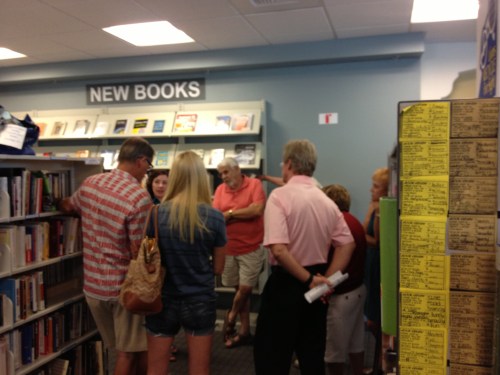
The meeting was hosted by Brian Heiland, a DWR engineer and two consultants from URS Corporation, Tiffany and Jackie. Jackie had people sign in and had boxes of the nice glossy BDCP literature. She was explaining the process to the folks there: Sign in and then Brian would take one-on-ones and Tiffany would be taking some people in groups. (Shown below a small group meeting in the stacks). My first thought was that the small library was a very strange venue for a public meeting.

Gene Beley was on-hand to video the interactions. The hosts weren’t very happy with his videoing. Brian refused to provide any feedback when being taped. Jackie expressed that they were not providing any public information, rather only to give the people a chance to express their feedback.

I don’t fault the young people there doing their best. But this was not a true “In-Delta Meeting” and not what we had been asking for, needing, or what the Delta citizens deserve. The fault for causing citizens, farmers, and business people wasted time and aggravation lies with the DWR and BDCP managers who decided on this format and venue. It obviously was more of an attempt to check the “public outreach” checkbox than to truly interact with and provide information to the concerned citizens who will be so impacted by the Delta Tunnels project.

Here’s Gene’s video showing a group that split off and offered great suggestions and ideas including the Discovery Bay CSD representative Bill Pease who also owns River’s End Marina; Tom Huppler, an engineer by profession who lives in Discovery Bay; Eric Jensen from Discovery Bay, an Engineer proposing desalination as a viable alternative; and the Save the California Delta Alliance Secretary, LaVeta Gibbs. The USR Corporation Consultant’s main feedback was “I’m happy to pass that on.” Here is Gene’s write-up in the Central Valley Business Times. We all should give Doug Caldwell, the Editor of Central Valley Business Times a big “thank you” for always being willing to post the latest, cutting edge information about what is really happening with the Delta Tunnels Project. Sign up for his FREE newsletter 6 days a week by looking at the top of the masthead to subscribe and fill out the email information.

Since Karen Mann and I spent probably 15-20 minutes talking about Delta issues with Brian which resulted in just a few sentences he wrote on a one-page form, I am less than confident that all of our concerns and issues will be recorded or responded to.

Various people suggested to the DWR reps that they need to come to Discovery Bay in a larger venue and that they needed to have the right people who can answer the questions. Specifically, we need Jerry Meral and David Sunding to show up to ask questions about the construction impacts, long-term water quality impacts in the South Delta, and the economic impacts to South Delta communities which is now missing from the State Economic Report. I asked Brian to let me know when we could hold a meeting with them in attendance and we could certainly arrange the right time and place.

When I walked out, a librarian said to me “It sure was noisy in there today.”

Other Video from Gene Beley:
Oakley City Council member Diane Burgis and Brentwood resident, Jim Panagopoulos.

Changes in Tunnel Plans

Updated 8/16/13

Breaking News:

The BDCP is proposing altering the tunnel path which they say is to reduce the impact on the farming towns and farmers in the north. Some changes were announced as improvements on the impacts on the towns of Hood, Courtland, Clarksburg and possibly Walnut Grove. For example, the pumping station will be 30 feet high instead of 60 feet, slightly lessoning the impact on those town’s scenic views but still over 3 stories high.

The BDCP’s new plan is to leave less tunnel muck in the Delta and now Daniel Wilson, the farmer who was threatened to lose his home and fruit packing plants, is out of danger. But Wilson was quoted in the Sacramento Bee as still opposing the project because of other fundamental changes it poses, including altered Sacramento River flows and water quality, and disruption of roads, traffic and scenery.

Read more here: http://www.sacbee.com/2013/08/15/5652161/water-plan-may-shift-delta-tunnels.html#storylink=cpy

Some believe it was motivated more by the need to reduce costs to keep the contractors involved. The new plan cuts the total path from 35 miles to 30 miles and reduces some of the acreage mitigation costs from muck storage by finding uses for it (a new release claims muck will now be “reusable tunnel material”).

THE BAD NEWS:

There is no change in the route through the South Delta. The plan will still cut the South Delta in half impacting marinas, restaurants, boating and recreation. The new route goes through Staten Island, the 9,100-acre island between two forks of the Mokelumne River that California taxpayers spent $32 million to preserve the island as wildlife habitat and may be a disaster for sandhill cranes. While the new plan removes some of the muck areas, there is now an even bigger muck pond shown south of Discovery Bay.

In addition, the long-term water quality issues, salmon issues, and other negative impacts from the tunnels remain.

Updated map: http://baydeltaconservationplan.com/Libraries/Dynamic_Document_Library/Map_of_Proposed_BDCP_Changes_8-15-13.sflb.ashx

New BDCP “Fact Sheet”

A new Bay Delta Conservation Plan (BDCP) “Fact Sheet” was released today by the State Water Contractors.
The “Fact Sheet” is Bogus

  • The “alternative” that the Fact Sheet claims Delta Stakeholders are advocating for is a made-up alternative. None of the alternate proposals that have been submitted have indicated that the solution is to solely upgrade levees. While several proposals include ongoing maintenance of levees, strengthening some, none suggest that huge upgrades throughout the Delta are required or necessary. The “Fact Sheet” presents a bogus alternative to replace all of the levees in the Delta with massive (significantly wider and higher) levees.

  • This made-up “alternative” more closely resembles the BDCP’s own 2009 Peripheral Canal “Through-Delta” alignment, building a huge isolated canal through the middle of the Delta including an “armored corridor” and numerous gates to funnel fresh water from Hood to the pumps and keep any salt water from the ocean out. This Peripheral Canal alternative was resoundingly rejected by Delta stakeholders during early BDCP workshops; hence the BDCP chose their tunnel idea instead.

  • The current BDCP proposal, the “Tunnel Plan”, will result in an enormous amount of “tunnel muck” being produced (a BDCP term, not mine). In the BDCP’s Final Draft Plan this “tunnel muck” is described, in detail, as being toxic and needing to be stored in lined ponds to keep it from leaching into the ground water table and away from sensitive habitat areas. However, now this “Fact Sheet” is trying to sell us that this toxic mud is actually “material for valuable uses in the Delta.”

Calling this a “Fact Sheet” is a complete misnomer.

What do Delta Stakeholders Advocate

There are several alternative proposals that are being offered as better solutions than the BDCP. See the side panel “ALTERNATIVE PROPOSALS” to view proposals that have been offered by Rep. John Garamendi and others.

The Delta Stakeholder alternatives are not, as the “Fact Sheet” claims, of narrow scope and limited benefits. Levee maintenance is only one piece of Garamendi’s and others’ proposals.

However, the levee system needs to be maintained to protect the $20 billion in infrastructure (railroads, gas lines, power facilities, highways) and 4 million people who live in the Delta. Most of the levees are now in good shape; some have been recently upgraded. Over the years, levee heights may need to be raised due to higher water levels from global warming, but the water rise would occur so slowly that a normal maintenance program can easily keep them of adequate height. Many feel this ongoing levee maintenance costs should be shared by the contractors. The Garamendi proposal states: “The BDCP has neither a plan nor funding for the maintenance of the levees that are crucial for their proposed water conveyance system.”

When did toxic tunnel muck become such a great commodity?

In Chapter 4 of the BDCP Final Draft Plan (issued March 2013), we read:

    “Tunnel muck generated by the boring process is a plastic mix consisting of soil cuttings and soil conditioning agents (water, air, bentonite, foaming agents, and/or polymers/ biopolymers). Before the muck, or elements of the muck, can be reused or returned to the environment, the muck must be managed and, at a minimum, go through a drying/water‐ solids separation process and a possible physical or chemical treatment. The daily volume of muck withdrawn from the tunneling operations is estimated at approximately 7,000 cubic yards per day.”

    “Spoils and tunnel muck … areas will be located away from sensitive habitat areas. To ensure that underlying groundwater is not contaminated, the muck ponds will be lined with an impervious membrane.”

In the BDCP “Fact Sheet”, they are now claiming that:

    “Tunneling creates material for valuable uses in the Delta. The tunneling aspect of the BDCP is expected to produce about 24 million cubic yards of material for potential reuses nearby such as habitat restoration and levee strengthening.”

So which is it? Is tunnel muck toxic to be located away from sensitive habitat areas or useful to build sensitive habitat areas? Did the BDCP get such strong push-back from Delta stakeholders who were being told they would be left with acres and acres of toxic, smelly muck piles throughout the Delta that they decided they needed to change their “marketing”? Or is Chapter 4 of the BDCP Final Plan completely wrong as to how the tunnels will be drilled?

Update
Yes indeed, between March and August they have updated their collateral and now, instead of tunnel muck which was “plastic mix consisting of soil cuttings and soil conditioning agents (water, air, bentonite, foaming agents, and/or polymers/ biopolymers)”, their new materials now describe “reusable tunnel material … Water and biodegradable, ecofriendly soil conditioners are mixed with the soils to create a toothpastelike material [which] will be tested and evaluated to determine suitability for various reuse options.” I guess it doesn’t need to dry out any longer and does that mean it won’t be smelly? It’s good if they can make that happen.

Fact or Fiction?

See what you think about this very odd BDCP “Fact Sheet”.

“Fun” with “Facts”

Contrary to the BDCP “Fact Sheet” claim, the BDCP is primarily a narrowly scoped “Tunnel Plan”. It’s always fun to see how marketing positions things. When I worked in the software world, our Marketing guru was excellent at finding the right way to position our product against the other guys. The water contractors apparently have a large marketing budget. So for fun, I took the “Fact Sheet’s” marketing and spun it.

Theirs:
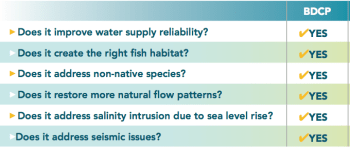
Mine:
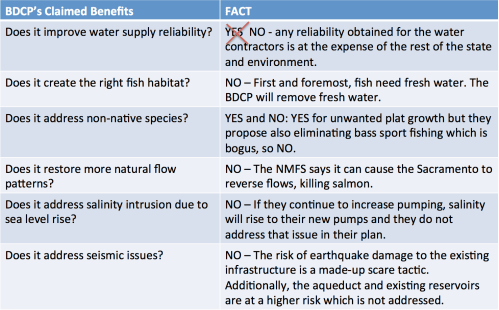
Correction 8/24/13: The Fact Sheet was published by the water contractors, not the BDCP.

Update 9/25/13: The original chart showed a YES for “Does the BDCP increase reliability” but today we need to change even that to a big “NO”. According to Dr. Jeff Michaels, UOP, discussing the response of Dr. Meral to questions in public meetings said that taxpayers would need to agree to pay for even more habitat or water flows from upstream sources if needed to achieve BDCP recovery goals and comply with the ESA. This is due to the regulatory assurances in BDCP limiting additional contributions of water or money from the water contractors.”So this conceptual idea is a nice illustration of how the BDCP reduces regulatory uncertainty for the water contractors by increasing regulatory uncertainty for taxpayers, upstream water users, and the environment. And that transfer of risk is why I have not included any value for regulatory certainty in statewide benefit-cost analysis. If you want to count the value of this risk reduction benefit to the contractors, you also have to value the cost of the risk increase to upstream interests, taxpayers, the environment and the Delta. The BDCP economic studies released this summer do not provide this balanced assessment.”

State Economic Plan’s Factual Flaw

This Letter to the Editor from Jerry Cadagan (copied below) should be published in every newspaper in the state: http://www.thereporter.com/letters/ci_23839272/letter-study-gets-pay-fact-wrong:

Paul Burgarino’s article about Gov. Brown’s economic study of his Peripheral Tunnels project (“Study: Delta tunnels would net $5 billion benefit,” Aug. 6) includes many reasons to question the professionalism of the economic work, including unfounded assumptions about the amount of water to be delivered, and uncertainty regarding needed voter-approved bond funding for portions of the project.
Those problems alone should doom the proposed project.

But there is a major factual flaw that is bound to sink prospects for the tunnels project. Twice in the study, it is explicitly stated that “the state and federal water contractors have committed to funding 100 percent of the construction and operation of ” the tunnels.

In coming up with all the rosy economic predictions, the study authors must have assumed those contactors would pay the $16.3 billion involved. The problem is simply that the quoted language is flat wrong; the water contractors have not committed to pay those costs. The study results are meaningless, given that major fault.

And if the state and federal water contractors (many of them being south-of-Delta mega agri-business firms) don’t pay the $16.3 billion in construction and operating costs, who do you suppose will end up paying them? Look no further; just go to the nearest mirror.

Jerry Cadagan
Sonora


Blog Stats

  • 126,307 hits

Support the STCDA

Sign up for Emails

Sign Up Now

Request a New Lawn Sign

Click Here to send an email to the lawn sign committee.

Receive news blog via email.

More Blogs

Educational Books about the Delta

Sassy the Salmon
and
The Fable of the Farmer and the Fish
All ages: K and above
Proceeds go to STCDA