Archive for the 'Tunnel(s)' Category


Report on the November 15th Delta Stewardship Council

The November 15th DSC meeting was attended by a Discovery Bay representative. Here are a few key points from the meeting to be aware of the current projects and plans under way:

  • The Meadows Restoration: They are looking at various areas in the Delta where habitat restoration projects can begin within about 5 years. McCormick Tract is on the top of their list and this is where The Meadows is located. After the presentation about restoration opportunities there (which was rather vague), I asked the presenter how this would affect recreational boating and anchorage in the meadows. She said “That’s a really good question.” Then she said she didn’t think it would have any negative impact on boating and might even increase the size of the anchorage and add some additional sloughs in there for boats to meander around. She added that it would be more prone to winter flooding and the area might not be usable for boating during winter storms. There were about forty people at the meeting representing various interest groups. There was no one else there with any interest in boating. Bottom line: this needs to be watched closely and steered in a direction that won’t hurt (and might even help) boating interests.

  • Invasive Species (bass or weeds?): They are working on a short list of invasive species that should be controlled. They have money to do this long term. The representative from the Metropolitan Water District of Los Angeles (who is at every meeting) made clear that he thinks the stripped bass to be an invasive species that should be eradicated because it eats Delta Smelt. The Council did not get so far as to talk about what species should be on the list but directed staff to work on it more. At a break our representative talked to one of the council members about this. He said that they had previously considered eradicating stripped bass but had rejected the idea. [Note: We previously reported that in February, 2012, the California Fish and Game Commission took final action to reject the Department of Fish and Game’s controversial proposed changes to striped bass regulations. Commission President Jim Kellogg, as his last piece of business in his two year term as President, declared striped bass a native species.] He also said that egeria densa would certainly be considered when they get that far in the process.

  • Peripheral Canal (Delta Tunnels): The folks who are pushing the canal will soon release their Environmental Impact Report (maybe before the end of the year). At this stage, the Delta Stewardship Council will review the report and make comments. There was a discussion of what areas they would comment on. The MWD rep said that they shouldn’t bother making a thorough review of the EIR and let’s just get started building the canal.

  • Delta Independent Science Board: The ISB is very important. They are the ones who wrote the scientific report that was highly critical of 2-Gates. They report to the Delta Stewardship Council but are supposed to be entirely independent and not subject to any agenda or political pressure. They will review the peripheral canal EIR, write a report about it and send it to the Delta Stewardship Council. They will meet on November 30 to discuss how they will go about reviewing the EIR when it comes out. In discussions with their scientist who as at the meeting, it is clear that they would welcome and use comments from the public flagging areas that they should look at. There is yet another independent science panel that also looks at the “effects analysis” of the canal.

A Delta Weekend

After updating the STCDA nodeltagates.com website on Friday, my husband and I went to the Restore The Delta documentary “Over Troubled Waters” in downtown Brentwood. If anyone in California thinks the Delta Tunnels (aka Peripheral Canal) is a good idea for anyone except large-scale agri-corporations and millionaires like Stewart Resnick, they need to see this film. It’s also a good refresher for those of us who have been following the water situation in Northern California to be armed with real facts and figures for discussions with friends and neighbors.

The film is making rounds throughout California and is a participant in this year’s 9th Annual Artivist Film Festival to be held November 1-4 in Hollywood, California. Restore the Delta has now been recognized as the scientific expert representing Delta issues as an NGO member of the United Nations Department of Public Information (UN-DPI). I bought a copy of the movie to loan if you want to see it. Have a viewing party. Or pick up a copy yourselves for only $20 at a showing or from Restore the Delta.

We then walked out of the theater and the Farmers Market was still going on in Main Street. We bought great, fresh produce from the local Delta farmers. These are the same multigenerational farmers on the richest soil in California who are the farmers the Delta Tunnels will destroy so that we can get our produce from outside the US while the Westlands desert farms produce cotton and almonds and rice to ship to Asia.
Brentwood Farmers Market Produce
Local Delta Farmers – Brentwood Farmers Market Produce

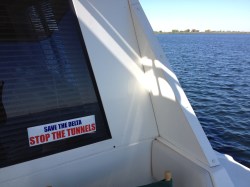
We then took our boat out to anchor overnight in Mildred Island. As usual, it was calm, wonderful. Hundreds of birds. Only two other boats. Put our “Save the Delta – Stop the Tunnels” sticker we got at the screening on our boat – put one on our car, too.

Save the Delta - Stop the Tunnels Sunset Over Mt. Diablo
Stop the Tunnels at Mildred Island Sunset over Mt. Diablo from Mildred Is.


It will all be gone if the Delta Tunnels proceed.

Over Troubled Waters

The Delta is still in danger, make no mistake, and it’s time to pay keen attention to what is happening.

Restore the Delta has created a new documentary “Over Troubled Waters” and showings began in September. It is narrated by Ed Begley, Jr. and is a MUST SEE. See http://overtroubledwaters.org/buy-tickets/ for upcoming show times and locations.

The next showing is Saturday October 6th in Brentwood, CA at 10:00 AM. A Question & Answer session follows at 11:15.

What: Over Troubled Waters
Doors open at 10:00am, Screening 10:30am, Q&A 11:15am
Where: Delta Cinema, 641 1st Street, Brentwood
When: Saturday, October 6, 2012

Tickets: ADMISSION TO THIS EVENT IS FREE, FIRST COME FIRST SEATED.

See Over Troubled Waters: Sustainable Water Advocates, Premiere Film on Water Wars for more information on the film.

See http://overtroubledwaters.org/buy-tickets/ for all show times and locations.

Some thoughts on the delta tunnels (Jon Carroll, SFGate)

Good SF Gate article in August, 2012:

“I cannot believe that Jerry Brown is trying to sell these delta tunnels as a really good idea. They’re not. Their potential for environmental damage is almost incalculable. The only good thing about them is that fracking is not involved.

“These tunnels are designed to move water across the Sacramento-San Joaquin River Delta area and away from the delta itself, which uses water to, like, produce rivers and streams and sloughs and marshes, all of them good for the ecosystem. It’s a fragile system at best, having survived various assaults on its integrity over the years, but this thing … you just know something is going to go wrong.

“And once it goes wrong, it’s going to be hard to stop. It’s hubris over common sense, an attempt to build our way out of a problem we can’t escape: too many people, too little water. That’s a problem now; that’ll be a problem if this multibillion-dollar boondoggle is ever finished.”

Read the entire article.

New Video “A Costly Mistake”

Just received an email from Restore the Delta advertising the new, important video summarizing the real issues with the new Delta Tunnels proposal (replacing the prior Peripheral Canal above-ground proposal) and who will benefit.

See A Costly Mistake

——————email from Salmon Now————————————-

A Costly Mistake (4:54)

A Costly Mistake, Salmon Water Now’s new video, continues the conversation about water, the proposed peripheral canal, and the long-term objectives of those pushing hardest for getting it built.

Putting irrigation water on the toxic dirt on the West side of the Central Valley was not a very good idea 70 years ago. The video looks at the history of how the Central Valley Project came to be and asks a simple question – do we really want to make another costly mistake in the name of industrial agriculture?

The push to approve, fund, and build the peripheral canal is moving at wrap speed. There are so many reasons to stop it, or at the very least slow it down. But, It seems to be the intent of Governor Brown to move forward with the plan, no matter the consequences to the environment and California’s fiscal health. 

A Costly Mistake joins the list of recent Salmon Water Now videos that raise serious questions about this impending boondoggle. To see all of the videos on the canal we’ve done, visit our Kill the Canal Channel on Vimeo where all of them are posted in one place for easy selection.

Meanwhile, You can watch A Costly Mistake directly on YouTube or Vimeo:

YouTube: http://www.youtube.com/watch?v=iUxJBYHlxKM&hd=1

Vimeo: https://vimeo.com/45269520 

Bruce Tokars

Salmon Water Now

btokars@salmonwaternow.org

www.salmonwaternow.org

Press Release – Congressmen Oppose Immediate BDCP Decision

California Members of Congress Demand that the Bay Delta Conservation Plan Be Fair and Equitable
Call the current delay the “the last, best opportunity” to improve the far-reaching plan

Washington, D.C. – Calling the most recent BDCP delay the “last, best opportunity to stand up to… unreasonable demands,” Reps. Jerry McNerney (CA-11), George Miller (CA-7), Mike Thompson (CA-1), Doris Matsui (CA-5), and John Garamendi (CA-10) called for specific steps to be taken for the BDCP to move forward in a fair and transparent manner. The five members from the California congressional delegation have been vocal in calling for changes to the BDCP and have demanded that any plan has significant input from the Bay-Delta region.

In letters sent today to Governor Jerry Brown and Secretary of the Interior Ken Salazar, the lawmakers said, “We recognize that some are now calling for an immediate decision, but we believe that it is critical to get this right; a rushed and inadequate Bay-Delta planning effort will lead to increased litigation, uncertainty, and expense.”

“I will not accept any plan for the Delta that is harmful to the farmers, families, and small business owners in the Delta region. To date, the planning process for Delta water has been unduly influenced by wealthy water contractors from south of the Delta who would steal our water, costing us millions of dollars and countless jobs. This delay provides an opportunity for the state and federal governments to stand up to the water contractors and ensure that the BDCP includes the input of our region. I will continue to fight against any measures that would destroy the Delta and our way of life,” said Rep. Jerry McNerney.

“More than five years into this process, the Bay Delta Conservation Plan still hasn’t met basic legal or scientific requirements,” said Rep. George Miller. “This is the last chance to fix it, and that’s why this delay is so important: it gives the scientists time to get it right. The Bay-Delta’s health is key to California’s future – we can either work out a good plan that reduces reliance on the Delta, or we can end up with increased litigation, uncertainty, and expense.”

“So far in this process we’ve seen too many back-door deals that put the interests of South-of-Delta water contractors before our farmers, fishermen and local communities. Many of our families and small businesses that depend on the Delta would have their livelihood stripped away and the Delta’s diverse wildlife would be destroyed if these politically driven deals were put in place. Federal and state officials need to use this delay to come up with fair and transparent plan that is based on sound science so that our communities, businesses, fish, wildlife and environment in the Delta and north of the Delta are not harmed,” said Rep. Mike Thompson.

“A 50-year permit needs to be done not only right, but with due diligence and equitable treatment to all those affected. I want to see the federal and state agencies take this opportunity to put forward a process and a plan for the Delta region that recognizes the input they’ve received not just from south of Delta interests, but north of Delta interests as well. Our state can’t afford to get this wrong,” said Rep. Doris Matsui.

“As the lynchpin of California’s water system, the economic and environmental sustainability of the Sacramento-San Joaquin Delta must be made front and center in this discussion. It’s the law,” said Rep. John Garamendi. “In addition, using the best available science, we must focus on conservation, storage, and recycling to preserve our state’s ecosystems and to meet the water needs of nearly 40 million Californians.”

The full text of the letter is below.
——————————————————

May 16, 2012

The Honorable Ken Salazar
Secretary
Department of the Interior
1849 C Street, NW
Washington, DC 20240

Dear Secretary Salazar:

We write in response to the recently-announced delay in the timeline for releasing additional details of the proposed Bay Delta Conservation Plan (BDCP). We believe that acknowledging the need for changes and additional scientific review is an important first step towards transforming the BDCP into a plan that meets state and federal legal requirements and into a process that is fair, transparent, and inclusive of communities in the Delta region and Northern California. We recognize that some are now calling for an immediate decision, but we believe that it is critical to get this right; a rushed and inadequate Bay-Delta planning effort will lead to increased litigation, uncertainty, and expense.

As you know, we have raised many objections during the skewed process that has led to this point. We have reached out to state and federal officials repeatedly, as a group and as individuals, to express our view that the BDCP is failing to adequately address the needs of our constituents and the health of the Bay-Delta ecosystem. Our concerns have been largely reinforced by numerous independent analyses and the release of draft environmental documents which show that the leading BDCP proposal will not meet biological goals and may even lead to the extinction of several species, including some of California’s iconic salmon runs. The recent “red flag” comments from state and federal agencies are just the latest indication that the BDCP must be overhauled if it is to be successful.

We also understand that, despite the many flaws with the BDCP, state and federal agencies still hope to make a significant announcement on the plan this summer. We would like to reemphasize our conviction that, before making a determination of a preferred project, state and federal agencies have an obligation to ensure that the BDCP will:

Vigorously and meaningfully engage local officials from the Bay-Delta region and Northern California in the BDCP process.

  • Reflect the best available scientific understanding of the Bay-Delta ecosystem’s needs as required by state law, including the reduction of water diversions from the Bay-Delta.
  • Demonstrate an understanding of the economic issues identified by the Delta Protection Commission’s Economic Sustainability Plan for the Sacramento-San Joaquin River Delta.
  • Fully analyze a complete range of alternatives, including non-diversion alternatives, the State Water Resource Control Board’s alternative, and proposals put forth by experts from the Delta and Northern California. A cost-benefit analysis of each alternative should also be conducted.
  • Define and meet biological goals and ensure that the preferred BDCP proposal is fully consistent with the best available science and relevant federal and state environmental laws.
    Protect water quality and reliability for farmers and communities in the Delta and Northern California.
  • Rebuild the Bay-Delta’s fisheries and the thousands of jobs they sustain.
    Preserve flood protection for communities in the Delta and Northern California and include a focus on levee improvements.
  • Commit to choosing, clearly and with intent, the “least environmentally damaging practicable alternative” as federal law requires.
  • Meet the requirements of state law by including alternative water supplies as a way to increase water supply reliability and reduce dependence on the Delta.

Our constituents have repeatedly demonstrated that they are ready, willing, and able to participate in a BDCP process that is truly collaborative and transparent. Despite the good intentions of our constituents, the BDCP has been dominated by south-of-Delta contractors with a long history of opposing balanced solutions to the challenges facing California’s water system.

The recently-announced delay in the BDCP may represent the last, best opportunity to stand up to the unreasonable demands of south-of-Delta water contractors and change the BDCP into a plan that can enjoy support throughout the entire state of California.

Thank you for your attention to this letter. We look forward to your response.

Sincerely,

Congressman Jerry McNerney
Congressman George Miller
Congressman Mike Thompson
Congresswoman Doris Matsui
Congressman John Garamendi

Senate Panel Hears from Angry Delta Residents on Delta Plan and Peripheral Canal

SENATE PANEL HEARS FROM ANGRY DELTA RESIDENTS ON DELTA PLAN AND PERIPHERAL CANAL
(reported by Michael Brodsky who attended the meeting representing STCDA)

Sacramento March 13, 2012.

The California Senate Committee on Natural Resources and Water held an oversight hearing at the Capitol Tuesday morning to hear about progress in developing the Delta Plan and to hear about the planning process for the Peripheral Canal.

As expected, California and federal officials painted a rosy picture. Roger Paterson, Assistant General Manager for the Metropolitan Water District of Southern California, told the senators that a new Peripheral Canal would be good for the Delta. He denied that there was any water grab driven by souther California interests underway. He said that Delta residents should rest easy because MWD has the best interests of the environment at heart.

When it came time for public comment, the senators heard a very different story. Speaker after speaker complained that plans to build the Peripheral Canal were secretive, that the science underlying the supposed environmental benefits of the canal was faulty, and that MWD and the other water contractors were being given secret access to the process leaving the public in the dark.

The panel also heard criticism of the Delta Plan, in particular that the Delta Plan favors increased water exports to southern California with no meaningful requirements for water conservation. The Delta Plan, being developed by a newly minted government agency called the Delta Stewardship Council, will be the master plan for the Delta for decades to come.

The Peripheral Canal is being planned in a separate process called the Bay Conservation and Development Plan, or BDCP for short. After completion, the BDCP will become a part of the Delta Plan.

Both of these planning processes are nearing critical phases and it will be especially important for Discovery Bay residents to attend upcoming meetings so our voices are heard. STCDA will be organizing trips to Sacramento and sending out notice to members well in advance so Discovery Bay residents can let their voices be heard.

STCDA submits comments on the draft “Delta Plan”

STCDA attorney Michael Brodsky submitted formal administrative comments to the Delta Stewardship Council on behalf of STCDA criticizing many aspects of the Delta Plan. The Plan is currently being developed and could change life in the Delta as we know it. See the formal administrative comments here.

Mr. Brodsky also sent the following letter to Wall Street Journal reporter Jim Carlton

Dear Mr. Carlton,

Mike Guzzardo asked me to contact you to provide my overview of Delta water issues. I apologize in advance for the length here but there are number of interrelated things going on and so far I haven’t seen any coverage that puts all the pieces together in a way that really gives the public an overview of what is going on so I thought you might find this useful.

From my perspective all of the present controversies are really framed by one thing: the water contractors have seized the levers of power. Not only is this Chinatown all over again, its Chinatown meets George Orwell: the huge new canal to divert Sacramento River water to Los Angeles is officially classified as a “conservation measure;” the move to privatize public water resources is advanced under the newspeak rubric of “public benefit;” the master plan to guide resource management of San Francisco Bay and the Delta for the next 30 years, called the Bay Conservation and Development Plan (BDCP) is being formulated with the water contractors in the driver’s seat and the dominant goal of building the Peripheral Canal to divert water to southern California.

1) The Peripheral Canal and the BDCP. Plans to build the Peripheral Canal in order to transport Sacramento River water around the Delta and directly to the export pumps, depriving Delta sloughs and rivers of water that currently flows through them, is being advanced through the BDCP process. The BDCP process was originally billed as a fair, balanced, and transparent planning process where all options to deal with Delta issues were on the table. As it turned out, the water contractors had secret and outsized influence from early on and the BDCP’s stakeholder meetings and other public relations measures are no more than a fig leaf for the water contractors to push through the Peripheral Canal.

Congressman George Miller has complained extensively about the inappropriate role of the water contractors in the BDCP. The San Jose Mercury news has covered the issue and editorialized about the favoritism of the BDCP process to water export agencies. I have submitted formal comments to the agency on behalf of MIke Guzzardo’s group (Save the California Delta Alliance) about the unlawfulness of the process.

2) The Canal Bond Measure. An $11 billion dollar bond measure will be submitted to California voters this November. The bond is billed as the “Safe, Clean, and Reliable Drinking Water Supply Act.” Who could be against that? But this bond has nothing to do with the safety of drinking water . Drinking water standards are set by the federal and state governments and are in no way affected by this bill. Rather, the underlying purpose of the bond measure is to enable construction of the Peripheral Canal, shift costs from the water contractors to the tax payers, and further privatize public water resources. The bond measure states that its funds cannot be used for canal construction. However, it allocates billions for other critical costs associated with the canal. The exact mechanics of this are a bit too complicated to go into in detail here, but I would be happy to explain the details if you wish. Traditionally water infrastructure is paid for by the end users through the water rate structure. Here a new concept of “public benefit” has been introduced. But what public benefit really means is that the cost is shifted from the water contractors to the general tax base.

The water contractors have attempted to hide the true purpose of the bond measure from the public as follows: California law requires that for all ballot measures submitted to the voters, the California Attorney General has the duty to review each measure and prepare an impartial ballot title and summary of 100 words. From the 100 word summary, a condensed 75 word ballot title is drawn. The ballot title is what the voters see in the ballot booth when they place their mark for “yes” or “no.” The A.G. has a duty to prepare a title and label that are impartial and will not create prejudice either in favor or against the measure. Here, the water contractors have inserted language into the Canal Bond that purports to deprive the A.G. of authority to prepare an impartial summary for this measure. Instead, the water contractors have written their own summary and inserted it into the Canal Bond. If they have their way, the voters will see only the water contractor’s version next to where they place the X on the ballot.

In my view, this was patently unlawful when the legislature approved this scheme in 2010. If there was any doubt, subsequent case law on unrelated ballot measures has removed it. The A.G. has a statutory duty to prepare an impartial summary and the legislature (doing the bidding of the water contractors) does not have the authority to usurp this function. It remains to be seen how the A.G. will respond when the time comes to prepare ballot summaries, but her actions will certainly be closely watched. California law allows for a challenge to the ballot summary before it is submitted to voters. I would not be surprised to see a challenge to this ballot summary later this summer (from groups like ours if the summary favors the water contractors, or from the water contractors if it doesn’t).

I can provide you with the source documents (bill language, etc) establishing the above-stated facts as well as contact information for others familiar with the subterfuge associated with this bond measure.

3) The Delta Plan and the Delta Stewardship Council. Running alongside the BDCP planning process is another process to plan for the future of the Delta. Once adopted, the Delta Plan will be the top tier plan for the Delta. After the BDCP planning process is complete, the BDCP will be submitted to the Delta Stewardship Council (the agency responsible for promulgating the Delta Plan) and, if approved by the Council, will be incorporated as a part of the Delta Plan. The legislation that created the Delta Stewardship Council and authorized the Delta Plan requires that reliance on the Delta as a source of water be reduced. This was part of the grand bargain struck to allow for construction of the Peripheral Canal. It mandates increased conservation and development of local supplies (among other things) in order to reduce Delta exports. However, the regulations being proposed by the Delta Stewardship Council thus far ignore this critical requirement by simply stating that existing water conservation measures are going really well and nothing further need be required. The water contractors thus get their canal but don’t have to keep their end of the reduced Delta reliance bargain. I have submitted formal administrative comments on behalf of STCDA to the Stewardship Council addressing this issue.

4) The Consolidated Salmonid Cases. Operation of the Central Valley Project and the State Water Project (the two vast systems of canals that export water from the Delta) is governed by biological opinions issued by federal regulators from time to time. The 2009 biological opinion mandated a number of measures to protect endangered fish populations, including water export curtailment. The water contractors challenged this biological opinion in court and in a surprising decision, departing from precedent and normal practice, Judge Wanger struck down the biological opinion. You are probably familiar with the controversy surrounding Judge Wanger’s decision to retire from the bench and go to work for the water contractors immediately after issuing the Consolidated Salmonid Opinion.

The case is currently being appealed to the United States Court of Appeals for the Ninth Circuit.

5) Privatizing the Kern Water Bank. In a series of secret meetings, the State Department of Water Resources turned over ownership and control of the Kern Water Bank to private interests. The secret deal is being challenged in court and opponents claim that the deal “turned over control of a significant portion of California’s water supply to a cabal of agricultural barons including billionaire Stewart Resnick.” This is another example of the “public benefit” concept.

6) The 2-Gates Project. I believe the 2-Gates project was the original concern that got you in touch with Mike Guzzardo. I submitted administrative comments on behalf of STCDA challenging the science underlying this project (as well as addressing its environmental impacts). Currently operation of the export pumps near Discovery Bay is curtailed by court order because the pumps tend to suck up the endangered Delta Smelt. The water contractors are always looking for ways to get around this court order. 2-Gates is their latest attempt. The idea behind 2-Gates is that the smelt prefer muddy water (high turbidity). Their theory is that by operating the gates they can manipulate water quality so it is less muddy in the area surrounding the pumps. If the water is less muddy, the smelt will stay away and they can run the pumps full tilt. However, there is little evidence to support the theory that the smelt will respond in this way. Because of our comments and those of others regarding the lack of scientific support for the 2-Gates model, the project was put on hold. But the water contractors are sponsoring new research that will purport to prove their theory. The researchers are employed by the United States Geological Survey but I would not be surprised if the water contractors are paying the tab for the research (they certainly will pay for construction and operation of the Gates project if it goes through). And the Metropolitan Water District of Southern California hired the researchers who came up with the original smelt-turbidity hypothesis. The new U.S.G.S. research was originally planned as 4 year study but it is being cut short and the researchers are being pressured to write up their findings based on a truncated study. The whole 2-Gates thing was billed as a “demonstration project” to generally benefit fish in the Delta. This is nonsense. It has no purpose other than to allow vastly increased water exports. The water contractors have been roundly criticized for trying to hide the true purpose of the project by the Delta Science Panel, among others.

The Peripheral Canal is the water contractor’s long term plan to take more water, but even under the best scenario for them it wouldn’t be operational for at least 10 and probably 15 years. So the gates are a high priority in the near term.

Finally, I understand Mike took you out for a boat ride. I hope you enjoyed our Delta and got to meet some of the characters out on some of the islands out there. From grizzled Marina operators to farmers fighting eminent domain to make way for the canal you can’t beat the Delta for local color. You’re less than a 100 miles from San Francisco but you might as well be on another planet. The Post Office even delivers mail by boat out there.

Michael Brodsky
Law Offices of Michael A. Brodsky

Good news for the striped bass and the Delta

If you have been as dismayed as I have been about the recent attempts to eradicate the striped bass (erroneous claims that the bass, instead of excessive exporting of water from the Delta, are the cause of the decline of the salmon) then happily note that the Fish & Game Commissions yesterday voted unanimously to reject the Department of Fish and Game’s striped bass regulation change proposal.

The proposal was introduced by the DFG as a settlement agreement resulting from a 2008 lawsuit. In that lawsuit, the Coalition for a Sustainable Delta claimed that striped bass are “harming” native species, including endangered Central Valley chinook salmon and steelhead and Delta smelt.

But the slight-of-hand being attempted is clear when you find out that three executives of Stewart Resnick’s Paramount Farms in Kern County founded the Coalition for a Sustainable Delta. Resnick is the politically connected Beverly Hills billionaire who has made tens of millions of dollars annually from buying and reselling water back to the public for a big profit. It’s the same profiteers who are making millions from water that are behind efforts to build the Peripheral Canal and recent legislation to give Paramount Farms easier access to water contracts (causing more and more excessive exporting) and water rights over family farmers who have farmed for generations. And bass fisherman have been loud opponents to the Two Gates and Peripheral Canal efforts these millionaires want in order to increase exports.

The article concludes: “Hoorah to the integrity of the Fish and Game Commission to see through this ‘fishery management by lawsuit’ and defend the autonomy of the regulation process. Particular credit goes to outgoing Commission President Jim Kellogg who, as his last piece of business in his term, declared striped a native species,””

Read the entire article at http://blogs.alternet.org/danbacher/2012/02/02/commission-votes-against-pursuing-striped-bass-eradication-proposal/

Delta peripheral canal – your action required!

The Los Angeles Metropolitan Water District is proposing to build a peripheral canal around the Delta in order to divert more water to Los Angeles.  This may have disastrous consequences for Discovery Bay.  Right now the L.A. Water district and other water contractors are running the show for this canal project.
As a first step in responding to this canal, we need your help to get the Water Contractors out of the driver’s seat.  And we need it quickly !!!

Please send an email to BDO@usbr.gov .

You can just cut and paste the below language and/or add your own thoughts:

I am a resident of Discovery Bay and I object to putting the Water Contractors in charge of deciding the future of the Delta.  The Water Contractors should have no say in the environmental review of any proposed peripheral canal.  And when do we get our say?  We live on the Delta and stand to be most impacted by any canal.  You should appoint a representative to the steering committee for the canal to represent the interests of people who live in the Delta, earn their living from Delta related business, and use the Delta for navigation.

UPDATE: Our legal counsel Michael Brodsky has
sent the following document to the U.S. Bureau of Reclamation director
Donald Glaser in order to allow us to appeal the impending decision
regarding the peripheral canal.The document is at the following link:

You can voice your support for the concerns outlined in this document by writing to:

Donald R. Glaser
Regional Director
United States Bureau of Reclamation
Bay-Delta Office
801 I Street
Suite 140
Sacramento, CA 95814

or by emailing BDO@usbr.gov


Blog Stats

  • 127,201 hits

Support the STCDA

Sign up for Emails

Sign Up Now

Request a New Lawn Sign

Click Here to send an email to the lawn sign committee.

Receive news blog via email.

More Blogs

Educational Books about the Delta

Sassy the Salmon
and
The Fable of the Farmer and the Fish
All ages: K and above
Proceeds go to STCDA