Archive for the 'News and Events' Category


Paper Water

Water’s for Fighting: How California and the feds sold off more water than north state rivers usually hold.

Today’s post includes excerpts from a great piece in Humboldt County’s North Coast Journal that follows the paper water trail and answers the $64 million question: “So why does Southern California get to drink our milkshake?” See the link to the entire article at the end of this post. It provides much more information, particularly on the Trinity River battles and detailed history of contractor rights.

When the Central Valley Project was being developed, the Bureau of Reclamation began making contracts to sell water to irrigators. In its effort to gain water rights, Reclamation made “exchange” contracts with irrigators who had riparian rights. Those deals resulted in many senior claims to water — essentially first place in line — for those irrigators.

And while some of its customers regularly get their full water complement, those with junior water claims are given small percentages. In the Central Valley Project, that’s the irrigators on the west side of the San Joaquin Valley (such as Westlands Water District), which were among the last contractors with Reclamation and so have junior water rights. They came late to the party when the Central Valley Project was completed in 1963. Now, Reclamation has more than 250 contracts attached to the Central Valley Project.

That discrepancy between the amount of water available and the amount of water promised is called “paper water.”

And while “paper water” is sometimes a source of strife, with water users pulling at the supply from both ends of the state, some say it’s actually meant to prevent disputes. Think of it this way: Reclamation’s contracts represent California waterways when they’re completely saturated — a glass 100 percent full. If and when the state gets a year that wet, that water is spoken for. If the glass was full and the water wasn’t 100 percent spoken for, it could spur furious grasping for the leftovers.

They claim it’s not bad science that created those over-allocations. It’s planned for when there’s a wet year. Anticipating that there’s an excess. It’s optimism — and “how do you prevent a scramble?”

“In plain language,” the report reads, “this means there is really very little if any water available to the Central Valley Project and the State Water Project at any time.”

Tom Stokely of the California Water Impact Network put it bluntly. “They will never get 100 percent of their water contracts,” he said. “This is not a new phenomenon. They’ve been sweeping it under the rug for years.”

To make matters worse, over the last 32 years, Reclamation began realizing the negative impacts occurring to the environment from over-emptying water (e.g., from the Trinity River causing the massive salmon kill in 2002), and began to give back more than 1 million acre-feet of water to the environment, yet there’s no adjustments to water contracts or water rights. This is one example of why now the holders of the water contracts will NEVER have 100 percent.

More than five times the available water in the Sacramento River and San Joaquin River basins is claimed by state and federal rights holders, according to the California Water Impact Network report.

In addition, when allocations and contracts were first developed, the population of the state was lower. We’ve got this issue of climate change as well. We’re not seeing as much rain and snow as we’ve had in the past.

Why don’t we fix the paper contract fiasco?

Stokely said Reclamation isn’t interested in adjusting its water contracts because it would mean an admission that the bureau doesn’t have as much water as it says. “If they revise their allocations, they’re in for a big fight,” he said, adding that water users, not taxpayers, come first. “The Bureau’s essentially controlled by the water users — they’re the quote-unquote clients.”

Hampering the efforts to adjust allocations to numbers based on reality are the powerful Southern California Water interests, Stokely said. The five-person California Water Board, which could revisit water claims, is appointed by Gov. Jerry Brown, and “they’re never going to make a decision that makes the governor unhappy,” he said.

Opponents of the Delta Tunnels say the multi-billion dollar plan is just another attempt to increase Southern California’s access to Sacramento River water that simply doesn’t exist.

Bottom line: Claims that the Bay Delta Project will increase the health of the delta just don’t stand up when fresh water is expected to be pumped south before it reaches the delta.

See the entire article in Humboldt County’s North Coast Journal article by Grant Scott-Goforth Water’s for Fighting.
New Myths/Facts Tab

This year has been exceptionally dry, and much of California is in a severe drought. But corporate farmers in Westlands Water District are saying that it is protections for endangered fish in the Delta — not drought — that caused a 20% water allocation this year, and resulted in fallowing of hundreds of thousands of acres of land on the west side of the San Joaquin Valley. They blame the Delta smelt for unemployment of farmworkers in Mendota.

How much of this is true and how much is myth? Deirdre Des Jardins of California Water Research has done extensive research on the true causes of land fallowing on the west side of the San Joaquin Valley.

She’s provided an update of her “Myths and Facts” sheets for SCTDA. We’re proud to host them as a tab on our website. See the new Myths/Facts tab.

Only the Free Press can counteract the BDCP Marketing Campaign

BDCP Marketing Campaign is now in Full Swing

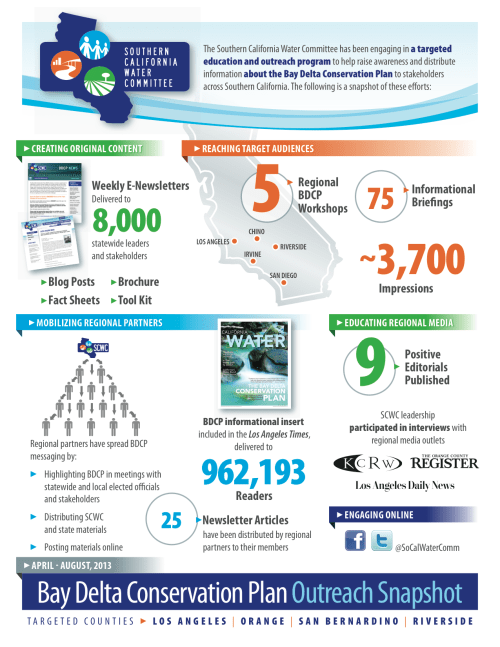
While the citizens in Northern California who will be most affected by the Bay Delta “Conservation” Plan (BDCP) Peripheral Tunnels get “checkbox” public outreach meetings, here’s what the citizens in Southern California are getting to “sell” them on the idea:
BDCP_OutreachSnapshot_0905

We’ve been asking for regional BDCP Workshops or local meetings for months. Five regional workshops and 75 information meetings are now planned in Southern California. Almost 1 million “educational inserts” (myth marketing) included in LA newspapers.

We need the Press

When this much money is being spent on marketing the myths and hype from the tunnel proponents, Northern California must rely on the Press to expose the truth about the tunnels. Northern California groups cannot match the money being spent by the water contractors to sell their Peripheral Tunnel idea.

Grassroots community organizations like Save the California Delta Alliance, environmental organizations and others have been working around-the-clock trying to get the word out, get the press involved, and inform the citizens of Northern California about the Bay Delta “Conservation” Plan (BDCP) Peripheral Tunnels and the impacts they will cause to our area of the state.

Yet still, many attendees at last Saturday’s Tomato Festival in Brentwood had no idea what the Tunnels were or how they would be affected!

What is being done by the State or the BDCP to educate the people who will be effected by the Tunnels? Nothing!

The BDCP public outreach group announced “In Delta” meetings in places like Brentwood and others to allow Delta citizens to come in “as a resource for Delta citizens and community members who are in need of additional information or would like to provide input to the BDCP effort” (according to their website). The actual events were not informative as reported last week People Showed Up for the In-Delta Meeting. We got no answers and DWR reps tried to keep Central Valley Times reporter/photographer Gene Beley from taping the public meeting – see Brown Administration Bars Reporter From Filming Public Meeting On Tunnels.

In the North, attempts are being made to keep people from even knowing about the tunnels with removal of signs and not allowing the Press at public meetings while the water contractor’s marketing machine is busily trying to sell the masses in the South on the fallacy of how good the tunnels will be for them.

Thank you to the Central Valley Business Times, Daily Kos and reporters like Gene Beley, Alex Breitler, and Dan Batcher (and others – sorry if I missed you) who go out on a limb and run controversial pieces criticizing the BDCP and exposing the myths.

We now need even more hard-hitting investigative reporting in major newspapers and on the TV to expose the facts behind the myths to all Californians.

Changes in Tunnel Plans

Updated 8/16/13

Breaking News:

The BDCP is proposing altering the tunnel path which they say is to reduce the impact on the farming towns and farmers in the north. Some changes were announced as improvements on the impacts on the towns of Hood, Courtland, Clarksburg and possibly Walnut Grove. For example, the pumping station will be 30 feet high instead of 60 feet, slightly lessoning the impact on those town’s scenic views but still over 3 stories high.

The BDCP’s new plan is to leave less tunnel muck in the Delta and now Daniel Wilson, the farmer who was threatened to lose his home and fruit packing plants, is out of danger. But Wilson was quoted in the Sacramento Bee as still opposing the project because of other fundamental changes it poses, including altered Sacramento River flows and water quality, and disruption of roads, traffic and scenery.

Read more here: http://www.sacbee.com/2013/08/15/5652161/water-plan-may-shift-delta-tunnels.html#storylink=cpy

Some believe it was motivated more by the need to reduce costs to keep the contractors involved. The new plan cuts the total path from 35 miles to 30 miles and reduces some of the acreage mitigation costs from muck storage by finding uses for it (a new release claims muck will now be “reusable tunnel material”).

THE BAD NEWS:

There is no change in the route through the South Delta. The plan will still cut the South Delta in half impacting marinas, restaurants, boating and recreation. The new route goes through Staten Island, the 9,100-acre island between two forks of the Mokelumne River that California taxpayers spent $32 million to preserve the island as wildlife habitat and may be a disaster for sandhill cranes. While the new plan removes some of the muck areas, there is now an even bigger muck pond shown south of Discovery Bay.

In addition, the long-term water quality issues, salmon issues, and other negative impacts from the tunnels remain.

Updated map: http://baydeltaconservationplan.com/Libraries/Dynamic_Document_Library/Map_of_Proposed_BDCP_Changes_8-15-13.sflb.ashx

State Economic Plan’s Factual Flaw

This Letter to the Editor from Jerry Cadagan (copied below) should be published in every newspaper in the state: http://www.thereporter.com/letters/ci_23839272/letter-study-gets-pay-fact-wrong:

Paul Burgarino’s article about Gov. Brown’s economic study of his Peripheral Tunnels project (“Study: Delta tunnels would net $5 billion benefit,” Aug. 6) includes many reasons to question the professionalism of the economic work, including unfounded assumptions about the amount of water to be delivered, and uncertainty regarding needed voter-approved bond funding for portions of the project.
Those problems alone should doom the proposed project.

But there is a major factual flaw that is bound to sink prospects for the tunnels project. Twice in the study, it is explicitly stated that “the state and federal water contractors have committed to funding 100 percent of the construction and operation of ” the tunnels.

In coming up with all the rosy economic predictions, the study authors must have assumed those contactors would pay the $16.3 billion involved. The problem is simply that the quoted language is flat wrong; the water contractors have not committed to pay those costs. The study results are meaningless, given that major fault.

And if the state and federal water contractors (many of them being south-of-Delta mega agri-business firms) don’t pay the $16.3 billion in construction and operating costs, who do you suppose will end up paying them? Look no further; just go to the nearest mirror.

Jerry Cadagan
Sonora

Westlands versus the Orcas

That sounds like an odd title – right? What is the connection between California’s Central Valley Agribusiness and Puget Sound Orcas?

We know Westlands Water District is working hard on the Peripheral Tunnel plan which will wipe out Delta farmers and communities from north to south, I didn’t know they were after Orcas, too.

OrcasInCanada
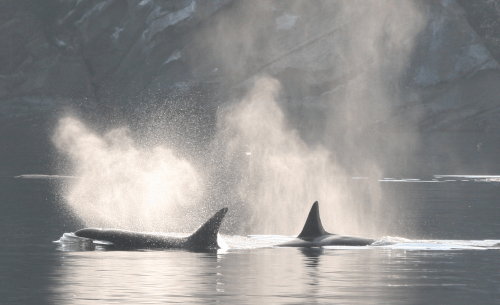
Orca J Pod sighted by Mike, Jan and friends while in Canada

Researching, I found that the Westlands Water District (our “favorite” player in the Peripheral Tunnel scam) had been suing the U.S. National Marine Fisheries Services (NMFS) to take Puget Sound’s critically endangered orcas off the endangered species list. Fortunately, on August 3, the NMFS denied their requests. It seemed very odd to me that Westlands Water District would be going after the Northwest Orcas.

However, they have been trying to rid the Delta of striped bass, saying the bass were the reason for the salmon’s demise (even though both species have lived together harmoniously for over 100 years). Could it have just been a coincidence that the Westlands drive to eliminate bass started right after very loud and numerous bass fishing organizations began speaking out against the BDCP plan? The bass were safe, we thought, when in February 2012 the California Fish and Game Commission rejected the request to make fishing law changes that would result in the end of the striped bass in the Delta and instead named them as a native species. Last week, however, we heard Westlands at the Fresno Delta Water Meeting continue to voice the need to get rid of bass. They never give up.

Obviously they believe they can affect the web of life not only in the Sacramento Delta but in the entire Pacific and eliminate anything that eats salmon rather than accept the fact that exporting too much fresh water from the Delta has been what is ruining the salmon runs (at least according to the NMFS report, the US Army Corp of Engineers report and independent salmon experts).

What’s next? Will Westlands call for the extinction of seals and bears?

For more details on the orcas, I found this article from August 2009 Groups Defend Salmon and Whales from Agribusiness Attack.

Here’s a summary about what happened and why (with my editorial comments included):

  • The National Marine Fisheries Service on June 4, 2009 released an 800-page biological opinion, a plan to prevent Sacramento River salmon runs from plunging over the abyss of extinction. This plan replaced one issued in 2004 by the Bush administration, in a classic case of political manipulation over the objections of federal fisheries scientists, that sent salmon runs into steep decline. Conservation groups, fishing groups and the Winnemem Wintu Tribe filed the lawsuit that resulted in the court order that mandated the federal fishery agency to rewrite the biological opinion.

  • Westlands and 29 other water agencies then filed a lawsuit against the biological opinion on June 15 [interjection – that’s really fast to file a lawsuit against an 800-page document – these guys must have tons of lawyers], claiming that the National Marine Fisheries Service should have prepared an environmental impact statement before adopting a salmon recovery plan that “will divert hundreds of thousands of acre feet of California’s freshwater supplies into the ocean.” The water district tried to portray a scenario of “imminent doom” if the court-ordered plan was allowed to proceed.

    “Denying this much water to California is going to do obvious, serious and enduring damage to habitat, to wetlands, and to other endangered species,” said Tom Birmingham, the general manager of Westlands. [Huh? How is fresh water flowing through the Delta going to damage habitat, wetlands, and fish?]

    “And it will put tens of thousands of people out of work, which affects public health and safety in myriad ways.” [This again illustrates how the exporters who have the rights only to “excess” water have negotiated contracts for much more than there is. Although they will never obtain the full amount of their contracts unless the Delta is run dry, their continual chant is that their water allotment is being “cut” even though the contract’s specific wording is they only have rights to water if there is “excess”. Instead of planning based on how much water is likely, they continue to plan for more water than exists and thus claim it is putting people “out of work”.]

  • Fishing groups, Indian Tribes and environmental organizations intervened in the lawsuit to defend the biological opinion, arguing that to keep exporting massive amounts of water to corporate agribusiness and southern California will destroy the salmon and the people that depend upon them.

I particularly like these quotes in the article:

    “What is it with these people?” asked Gary Mulcahy of the Winnemem Wintu (McCloud River) Tribe, referring to Westlands and other opponents of the federal plan. “Can they not see that what they have done in the past is killing – the Delta, the salmon, cultures, the environment, and with it – people. All for what? Greed.”

    “You cannot continue to destroy the things around you under the guise of economic growth, and expect the people to continue to believe in that lie forever. It is time to stop this madness. It is time to defeat these greedy and untruthful interests,” said Mulcahy.

Ludicrous State Economic Plan

Local Contra Costa County residents were infuriated to read the “Local News” front page headline in Tuesday’s Contra Costa Times that blared “Tunnels may be lucrative”.

The headline should have read “Tunnels may be ludicrous“. The slanted State Economic Report just released is easy to pick apart yet the Delta local newspaper aids in spreading the Bay Delta Conservation Plan (BDCP) marketing hype.

BDCP economist, David Sundling, continues to try to make 2 – 2 = 4. Sunding continues to use “new economic activity” numbers based on Westland’s inflated agriculture numbers and other unjustifiable benefits. He does not subtract the negative impacts that the tunnels will cause to Delta communities due to the loss of boating and recreation among other impacts.

Gene Beley writes in detail about the numerous serious impacts that will occur up and down the Delta, a heartbreaking “must read”.

Although it seems obvious to Delta users that construction activity and loss of waterways would cause huge economic loss to marinas and marina-based businesses, home values, and property values, these losses are not adequately considered in Sundling’s analysis.

The BDCP claims these marinas “can still operate … ” Untrue. Those marinas will not be able to maintain operations. Boaters will move their boats to unaffected marinas; visitors won’t come to camp and eat at restaurants during construction where they will view tunnel muck trucks 24×7 and to listen to construction noise. Boaters won’t keep their boats at marinas where boating and recreation activity is blocked or greatly reduced. In Sundling’s economic analysis though, because the marinas “can still operate”, there is apparently no economic loss.

They admit that “Impacts on water‐based recreation (water‐skiing, wakeboarding, tubing) in these areas [the South Delta] would be long‐term and therefore considered significant and unavoidable.” The mitigation plan is to improve Brannan Island State Park and/or The Meadows (both in the north). Because of the BDCP Plan for “mitigation” in the north, they can count it as no net loss and can make up their own numbers about how many people will flood to the North Delta for bird watching and boating.

Since Discovery Bay (DB) young people can’t take their boats to Brannan Island after school or on weekends, due to fewer waterways, traffic will increase and with it more accidents and risk. Then people will move away. Communities will suffer huge economic losses. I haven’t seen any of this in Sunding’s economic analysis.

South Delta Now   Impacts2
Boating & Recreation Now:
Small boating near Discovery Bay and from Mildred Anchorage (red circles) and anchorages (blue circle)
  South Delta Impacts:
Loss of small boat recreation; almost no local anchorage sites. (Mildred will have construction blockages to the West, muck ponds.).


On the other side of the coin, the agriculture numbers are based on having an infinite supply of water even though the contracts already are for more water than exists in the Delta. Time and time again we’ve seen reports of the economic benefits of agriculture in the Central Valley that time and time again the legislature or independent economists have proven to be false.

According to Sunding, there is a “benefit” in the state’s report of making the Delta home to nearly 180,000 temporary new jobs, which will be full time but for one year only. Does the Delta have the roads and infrastructure for these workers? Is there a real benefit to the state in creating 180,000 temporary one-year jobs while taking away nearly 37,000 farm jobs, loss of marinas, and closure of recreation access resulting in abandoned homes?

The article even throws in a statement that the plan would preserve “the long-term economic vitality of the state [including] the defense industry, technology in Silicon Valley,” even though the plan does not provide one drop of additional water or reliability for urban users in Silicon Valley or LA.

Adam Scow, of Food & Water Watch seems correct when he says: “They’re either deliberately cooking the books or refusing to do a real cost analysis. It’s a misappropriation of taxpayer resources.”

Why did the State Release an Economic Plan?

The reason is on page 2 of the Contra Costa Times article: “Brown administration officials pointed out that Monday’s study is not required; rather it is part of the extensive research being undertaking in designing the plan, informing the public and helping guide policy makers.”

Isn’t that just another way of saying the release of this State Economic Plan was timed for and it’s total purpose was marketing? It was produced to sway public opinion into thinking the tunnels will be good for the state instead of only for the handful of powerful agribusiness corporations who will truly benefit? To sway legislators throughout the state that they can have a little pork through “mitigation” projects if they just drop their opposition and let the tunnels go through?

Barbara Barrigan-Parrilla, Restore the Delta, was quoted with her answer: “It’s the purest piece of propaganda they’ve come out with yet.”

While the newspaper where the damage will be done’s headlines blare how “lucrative” the tunnels will be, a more balanced title was today’s Sacramento Bee: Study Touting Economic Boon of Delta water tunnels draws criticism. I also like mine.

Where’s the Press Coverage?

If you want to help get more press coverage, one member suggests Letters to the Editor. See “How to get your Letters to the Editor Published” at the bottom of this post.

Because the citizens of the Delta are protesting and marching – yet where’s the Press?

After the Hood Fire Chief attended a town meeting where Melissa Terry (who is with the North Delta Water Agency and also sits on the board of the Bay Area & Delta Conservation Plan) told Hood residents how their livelihoods would be greatly impacted by the tunnels, the Chief wanted as many “Stop the Tunnel” signs as possible on the roads leading to Courtland for the Courtland Pear Fair last weekend.

Barbara Daly from Clarksburg manned a booth for STCDA at the Courtland Pear Fair Sunday (thanks again, Barbara!) and said that the people coming into the Fair had seen all the road signs and were full of questions like “What Tunnels?” Our booth and the Restore the Delta’s booth were next to each other and the crowds kept both booths busy all day. Barbara said it was amazing how many people living in that area had no idea about the tunnels or the imminent effect they would have on their lives.

Yet Courtland, Clarksburg, Hood farmers and people who have been following the BDCP plans feel like they are living in “ground zero.” Their quiet, scenic farming communities are where the BDCP is planning to build the massive, multi-story pumping stations and forebay. Family farmers are being threatened with eminent domain. The construction will block farm roads, keeping farmers from getting to market. What are now scenic views will instead be of the hugh industrial structures. Tunnel muck ponds will destroy their pear orchards. As Barbara said, “If the tunnels go through, that will be the end of the Pear Fairs.”

Gene Beley has posted a video taken during the Courtland Pear Fair last weekend (snaps below taken from his video).

The town came together to build floats. They gathered up “Save the Tunnel” signs and made their own to decorate floats and wave in the parade. Check out the video. It looks like about half of the parade was devoted to stopping the tunnels including the Restore the Delta coffin pulled by a specter. But the only thing I’ve seen in the press about the community uprising is a small paragraph in Vacaville’s “The Reporter”. I liked the title, Delta Residents Hit the Streets, but only one real paragraph was devoted to the community protest and the rest about CalTrans removing “Stop the Tunnel” signs illegally.

A community parading to stop the tunnels looks like big news to me. This isn’t a standard protest – this is a real-life community event overtaken by the fear of what these tunnels are about to do to their community and their way of life.

When will the press start covering what these tunnels are going to do to the Delta Communities? The tunnel proponents’ marketing campaign leads people to believe it’s a fish versus farmers battle and the BDCP is the only way to insure clean drinking water to LA and Silicon Valley while saving the fish. Even people living in the affected areas are often unaware of the true tunnel impacts.

We were very happy the Discovery Bay on the bus to Sacramento made the 6 O’clock News in Sacramento thanks to Melinda Meza who lives in Discovery Bay and is a KCRA Sacramento Channel 3 reporter. However, I haven’t seen any follow-on in the press. People massing to go to Sacramento to protest, community events overtaken by the concern about what this huge tunnel project is going to do and yet there is very little press coverage.

Where is the hard-hitting investigative reporting asking: “What are you going to do for people whose farms are taken away by eminent domain, for communities who face economic turndown during this tunnel construction project, for people whose home values will be affected?” Or ask the obvious: “Those are great goals but are they doable without fresh water?” Or better still: “Who will really profit primarily from this boondoggle?”

Where are Woodward and Bernstein?

How can we get more press coverage? One of our press-knowledgable members says we should get more Letters to the Editor in major newspapers.

How to get your Letters to the Editor Published

Here are hints from the SF Chronicle’s Editor on how to get letters to the editor accepted. One thing he looks for is the opportunity for personal perspectives that force readers with very different life experiences to consider another viewpoint. Read his hints.

Then send them off. Here are Links to Newsletters – Where to send your Letter to the Editor with information about maximum number of words, etc.

More on the BDCP July 17 Meeting

“Stop the Tunnel” protesters are being seen in many press article pictures covering the BDCP meeting. A very comprehensive article released yesterday in Maven’s Notebook.

Protesters outside the meeting – view Maven’s Notebook to view more photos

Here, Maven provides an extensive transcript of the first half of the meeting. Sections I find enlightening are Jason Peltier’s (Westlands Water District representative) viewpoints. He totally ignores that fact that because water contracts in California are for 2 to 5 times the amount of water in the estuary and that Westlands only has the lowest tier rights, of course they will NEVER get 100%. He ignores the fact is that his area’s farmers allocations will run from 0% (dry years like 2013) up to maybe 60% of their full contracts (very wet years). I’m not sure what the original concept was when these contracts were issued but if you have the lowest level rights for excess water and your contract is for more water than exists, it seems irresponsible to plan for 100% and assume that there will never be a drought or dry water years. Yet his viewpoint is that their contracts are being “cut … reallocated or reserved to the environment.” As long as there is no acceptance that the amount of water in the Delta is finite, they will obviously continue to take more and more (as they have done the past 20 years increasing almond acreage) until there is no water left.

Related is today’s article that water use is skyrocketing by Tehachapi County farmers due to increased agricultural footprint in that area: Tehachapi News “Water Use Skyrockets”. It seems so irresponsible to continue to expand agricultural acreage in the Central Valley when there already is not enough water in the Delta for the acreage expansions from over the past 10-20 years. Which circles back to the clear fact that any plan needs to start with clarity about how much water is needed to maintain a healthy Delta (i.e., the “Delta Flows”) versus can be exported (the “excess”) and plan from there.

I always find comments by Melinda Terry, North Delta Water Agency worthwhile in these BDCP meetings. In Maven’s Notebook, read Melinda Terry’s comments during the BDCP meeting about the “Funding and Benefits Assumptions” and especially further down under “Questions and Answers Part 2 – Equal Time for Delta Impacts”. Take time to read everything Melinda Terry says there because she points out the real negative impacts that will occur from the construction destruction up and down the Delta to communities, farmers and boating which the BDCP is ignoring.

I also always appreciate Bob Wright, Friends of the River’s comments: “ … This is simply not a permittable project under the endangered species act. To say that taking those kinds of quantities of fresh water away from those fish, including the winter and spring run Chinook salmon, would not adversely modify their critical habitat does not pass the laugh out loud test. … “ Plus Dr. Jeff Michaels, UOP, always provides logical economic input and takes the BDCP to task: “… without a cost allocation, how can you evaluate financial feasibility?” And Dr. Michaels questioned why the tunnel alternative was chosen when “… the through-Delta alternative performed better for all the fish species, which is what this is supposed to be about.”

Maven’s report quits before the great comments by the fellow in the yellow shirt from the American River who tells Jason Peltier to stop saying it’s “between fish and farmers” because the truth is that it’s “people versus people” and his other interesting remarks including that it’s real people, communities, farmers in the Delta are being affected, not just fish. Mike McCleery, Discovery Bay, commented on how from his experience in the commercial sector, the BDCP’s low return-on-investment even before inflation and overruns makes it an unreasonable project to pursue from a financial standpoint; how no Delta levee has ever fallen down during an earthquake, even in 1906; and asked why Dr. Pyke’s proposed newer technology of permeable layers could not be used at Clifton Court Forebay to protect fish to allow continuance of the current through-Delta option rather than add any new tunnels. Michael Brodsky, STCDA Legal Council, caught the panel in a previous misstatement: their claim that environmental protection would be available even after a take permit was issued because the permit could be withdrawn later if the agencies did not manage pumping operations effectively and that permits have been withdrawn in the past. Brodsky’s research revealed that according to Fish & Game, no take permit has ever been revoked in California and the example stated at the previous BDCP meeting was erroneous. Brodsky also re-iterated and expanded on his objection to the BDCP “adaptive management” structure and why it cannot protect the co-equal goals as long as water contractors like Peltier have veto power. From Peltier’s statements made earlier in the meeting Peltier clearly does not believe that fish need fresh water. Thus the logical assumption is that Westlands would always use its veto power along every step of the process which would negate any objections made by Fish & Game or others trying to protect the salmon.

Webcast of the entire meeting.

Earlier Press pixs about the protest:
Original Channel 3 write-up and video: http://www.kcra.com/news/discovery-bay-residents-protest-twin-tunnel-project/-/11797728/21024494/-/127pxic/-/index.html

A bad day at the office for Jason Peltier greeted by protesters outside the BDCP Meeting (includes video): http://www.centralvalleybusinesstimes.com/stories/001/?ID=23838

Discovery Bay got “On the Bus”

The Discovery Bay’s “Get On the Bus” event filled the bus plus got great TV coverage – thanks to Melinda Meza and KCRA Sacramento Channel 3 for showing up at both Discovery Bay and Sacramento! Amanda Dove and her kids did a great job on camera. See more from KCRA TV.

The DWR rep Nancy Vogel who was also interviewed by KCRA gave the party line that the BDCP is going to “restore the habitat” even though WE all know the main thing fish need is fresh water and that is what the BDCP plan will be removing.

The construction project, tunnel muck, and lack of fresh water will seriously impact all Delta communities and Delta farmers. Let alone the poor farmers who’s farms are being threatened to be taken away by eminent domain.

It was great to see Discovery Bay getting notice on TV because for us, like the rest of the people living in the Delta area, it’s about our way of life on the Delta.

Getting on the bus (photo by KCRA)


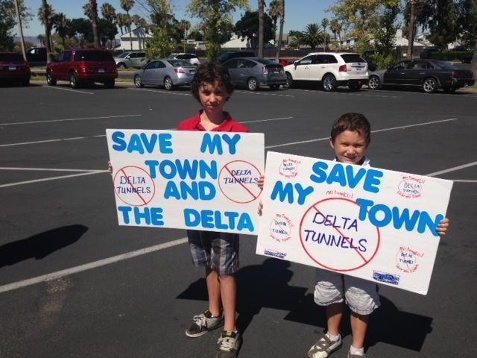
Even the kids came out to protest (photo by KCRA)


Discovery Bay citizens outside the BDCP meeting (photo by R. Wisdom, DB Press)


“Stop the Tunnels” signs line the BDCP meeting walls (photo by R. Wisdom, DB Press)


Blog Stats

  • 125,967 hits

Support the STCDA

Sign up for Emails

Sign Up Now

Request a New Lawn Sign

Click Here to send an email to the lawn sign committee.

Receive news blog via email.

More Blogs

Educational Books about the Delta

Sassy the Salmon
and
The Fable of the Farmer and the Fish
All ages: K and above
Proceeds go to STCDA